This content has been automatically translated and may include minor variations.
Live events are back on the rise — and with them, the logistical challenges that B2B marketers know all too well. In today’s competitive landscape, a strong event marketing strategy hinges on seamless collateral management. From branded banners and tablecloths to promotional giveaways and social media visuals, event collateral plays a pivotal role in brand experience.
But with decentralized teams, tight timelines, and limited resources, the process of producing and managing these materials often spirals into chaos.
To make every event smoother, more impactful, and more scalable, you don’t need more tools — you need smarter systems. Here are five essential hacks to help you take control of your event collateral — so every rollout is fast, flawless, and fully on-brand.
1. Templates are your event marketing MVP
Event collateral demands variety — and the right content creation tools make it easy to scale across markets. You’ll likely need social tiles, flyers, banners, digital signage, merchandise tags, and more — and often each in several versions depending on the audience, location, or format.
Creating each version from scratch wastes valuable time and creates dependency on overbooked designers. Templated designs solve this by letting you build one branded layout that can be quickly adapted across markets, channels, and formats.
Using a content platform with templating capabilities allows teams to customize only what’s needed — like location names, dates, or languages — while design elements stay locked in place. This ensures every asset is brand-compliant, produced faster, and requires zero design experience on the user’s part.
2. Fast-track approvals to keep your event marketing strategy on track
Approvals are one of the biggest blockers in event execution. Even when assets are ready, delays in sign-off can stall production, miss print deadlines, or compromise event timelines. These delays are rarely intentional — they’re often the result of unclear processes or unaligned expectations.
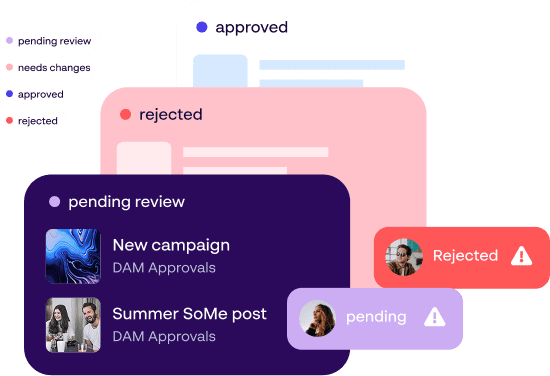
Clarify who needs to approve each asset, brief them early, and build your timelines around that reality. A tech solution with built-in approval workflows can also help manage this complexity. Assign reviewers, set deadlines, and trigger automated notifications so that everyone knows what to expect and when. Having full visibility into the status of each task also prevents bottlenecks from going unnoticed until it’s too late.
3. Creative ideas don’t need to create more work
Memorable activations are what turn a standard booth into a standout experience. But creative ideas can be hard to scale — especially across multiple regions or events. What’s needed is a way to maintain the concept while adapting it for different markets, audiences, or objectives.
Using a flexible content platform that allows importing of custom designs (like from InDesign) into editable templates makes it easy to replicate successful ideas. Teams can localize visuals, update content, and get them printed through integrated partners — all without reinventing the wheel or compromising creative quality.
4. Local production beats global shipping every time
Shipping event collateral across borders adds layers of complexity to your event marketing efforts. Customs, shipping delays, minimum order quantities, and added costs all increase the risk of something arriving late — or not at all.
A solution that connects with a network of verified local print and production suppliers, especially one that can access your approved designs or templates, cuts out most of that risk and can help eliminate the pain of global logistics.
You maintain central oversight of materials and designs, while regional teams receive high-quality, on-brand assets produced and delivered locally — faster, cheaper, and with fewer risks.
5. Consolidate vendors to reclaim your time
From booth design and printed signage to giveaways and apparel, most events involve coordinating multiple suppliers. But managing separate orders, quotes, and communication threads for each one adds pressure — especially when you’re running several events at once.
Where possible, bring these processes into one place. Whether through a single point of contact or a centralized management platform, reducing the number of separate touchpoints can save hours — and minimize the chances of important details falling through the cracks. It also simplifies finance and procurement, making it easier to track spending, approvals, and post-event reporting.
Why event collateral matters across every market
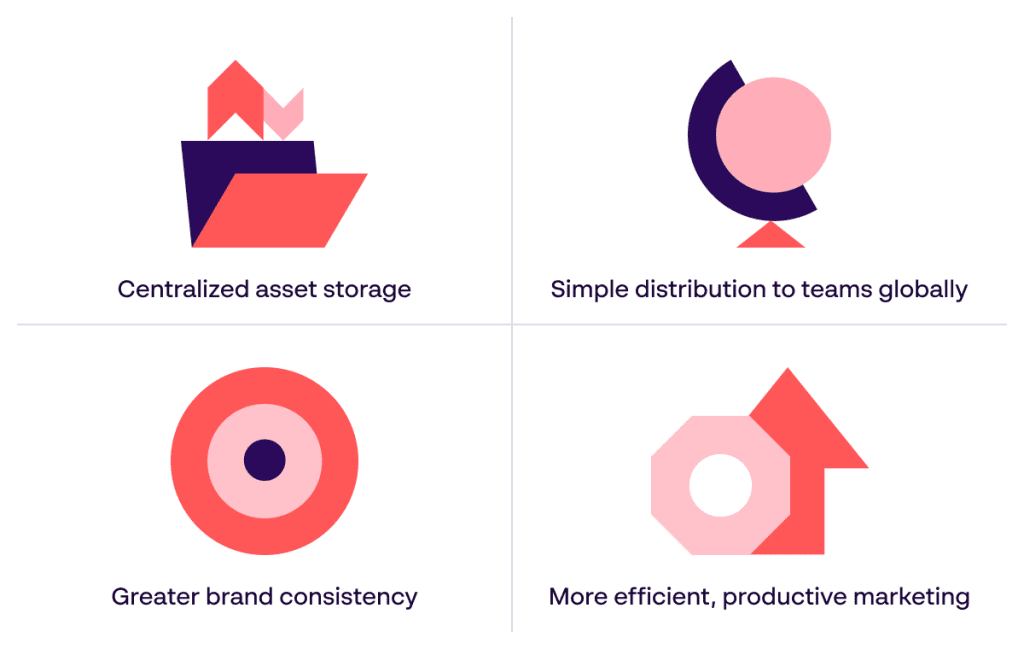
Every uncoordinated process, unclear workflow, or duplicated task doesn’t just cause a momentary setback — it compounds over time and across events. When event collateral production is optimized, everything from timelines to team morale improves. You reduce costs, improve brand consistency, and free your teams to focus on what matters most: creating standout experiences.
Get these five areas right, and your events become not only more impactful — but more repeatable, scalable and sustainable across every region you operate in.
To hear more about this, catch our on-demand webinarwhere we discuss how to optimize event logistics with Christian Saetburg, CRO and co-founder of Ciloo — one of Papirfly’s partners specializing in simplifying global merch production.
Ready to simplify your event planning and scale with consistency?
Empower teams with smarter event collateral management. Find out more!
This content has been automatically translated and may include minor variations.
In a competitive talent market, a strong employer brand isn’t just an advantage—it’s a necessity. As organizations grow and evolve, refreshing an employer brand ensures it remains compelling, consistent, and engaging. But achieving this at scale presents a common challenge: how do you maintain brand consistency while allowing for local nuances?
The answer lies in technology.
Maintaining employer brand consistency across global recruitment teams
Rebranding on a large scale is complex. Variations in brand representation can weaken impact, create confusion, and dilute the core message. Talent management leaders know that empowering employees to bring the brand to life—without compromising its integrity—is critical.
PepsiCo faced this exact challenge when revamping its employer brand. With teams operating in 77 countries and over 318,000 employees, maintaining a cohesive brand identity while allowing for regional adaptation was no small feat. As Sally Elbassir, Associate Manager of Global Talent Attraction & Engagement at PepsiCo, explained:
“It was challenging to maintain brand consistency. All it takes is a little tweak here and a little tweak there, and then suddenly your brand doesn’t look like your brand anymore.”
Without the right technology, ensuring consistency across regions, teams, and channels is nearly impossible.
A centralized brand governance system for a consistent employer brand
To overcome these challenges, companies like PepsiCo are turning to digital asset management (DAM) and rebranding software—comprehensive systems designed to centralize, simplify, and scale employer brand governance.
Key benefits include:
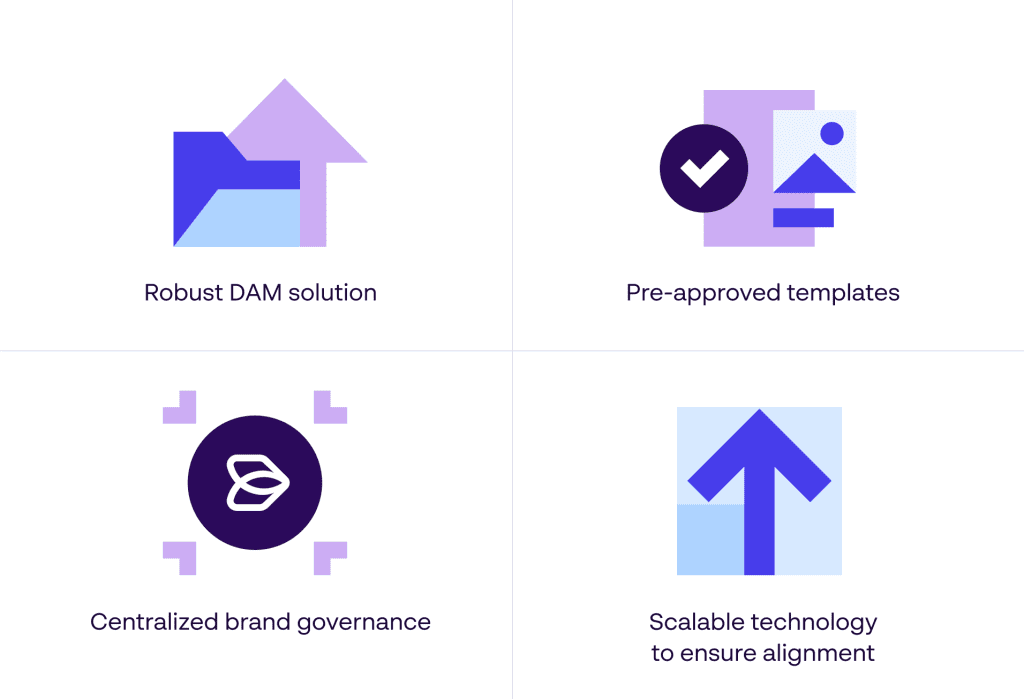
One source of truth – A brand portal for brand guidelines, approved assets, and templates ensures every team has access to the right materials.
Streamlined content creation – Pre-approved templates enable employees to quickly produce on-brand assets without reliance on external agencies.
Effortless localization – Local teams can adapt materials for cultural relevance while maintaining global consistency.
Workflow efficiency – Automated approvals and structured asset management eliminate bottlenecks and reduce delays.
PepsiCo leveraged this approach to empower teams globally. “Papirfly is a tool that everyone feels empowered to use,” Elbassir noted. “We made sure that we set it up so that folks could take the templates and use them to build assets that are still customized but also maintain the global brand.”
Deliver a scalable, sustainable employer brand strategy
By embedding digital asset management and rebranding management software into an employer brand strategy, organizations can achieve:
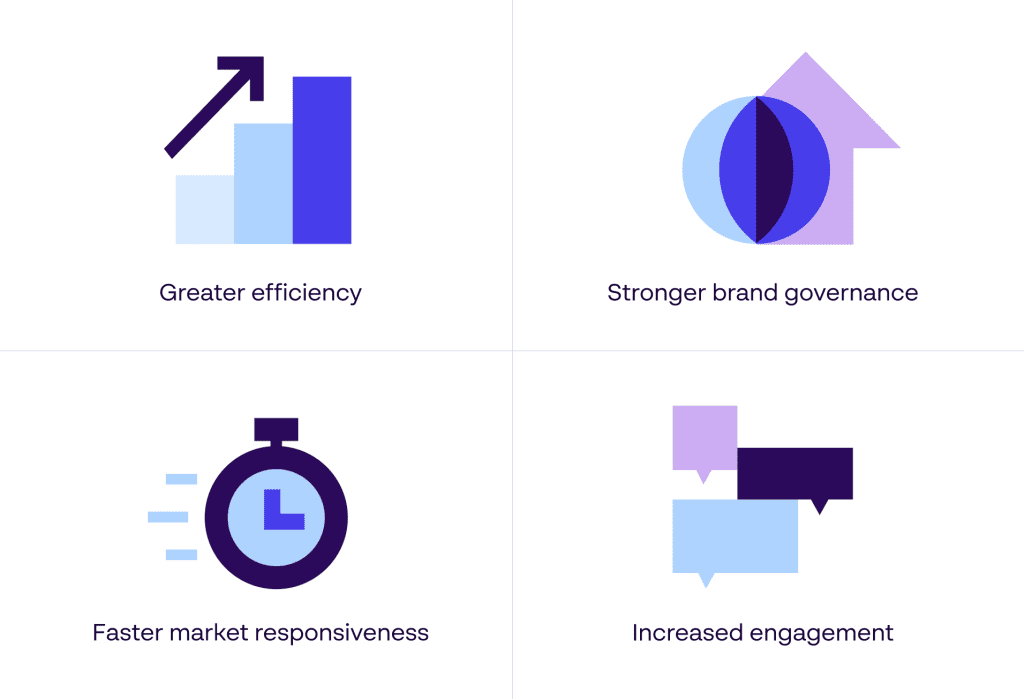
Greater efficiency – Teams can produce high-quality, on-brand content in-house, reducing costs and speeding up execution.
Stronger brand governance – Centralized control ensures assets remain compliant, while flexible tools empower local talent managers.
Faster market responsiveness – Campaigns roll out seamlessly across multiple regions, keeping pace with recruitment demands.
Increased engagement with next-gen employees – Younger talent expects visually compelling, interactive, and dynamic content that resonates with their digital-first mindset.
The urgency: Why now is the time to invest
According to Forrester’s 2025 Predictions Report, companies are under increasing pressure to demonstrate ROI on their technology investments. Many organizations that fail to build a structured approach to brand governance will scale back investments prematurely, putting them at a long-term disadvantage.
Forward-thinking leaders must prioritize solutions that balance immediate wins with long-term sustainability. Investing in a DAM solution and rebranding management software now ensures a scalable, future-proof foundation that drives efficiency and brand integrity.
Additionally, with Millennials and Gen Z comprising a growing share of the workforce, employer brands must embrace innovative, technology-driven approaches to content creation. Digital tools allow for the seamless production of engaging, creative assets that align with how these generations consume and interact with content—whether through short-form video, personalized visuals, or interactive storytelling.
Lessons for employer brand professionals
For HR professionals, recruitment marketers, and employer brand managers considering an employer brand refresh, the next steps are clear:
Invest in the right tools – A robust digital asset management and content creation solution ensures brand consistency and efficiency.
Empower local teams – Giving employees access to pre-approved templates reduces bottlenecks and increases engagement.
Centralize brand governance – A single, structured system prevents inconsistencies and ensures seamless execution.
Scale with confidence – Technology enables a brand to grow, adapt, and maintain alignment across global teams.
Create content that resonates with new generations – Leveraging digital tools enables more engaging and relevant employer branding content that attracts younger talent.
Rebranding isn’t just about new messaging or fresh visuals—it’s about creating a system that sustains and scales an employer brand over time. With the right technology, businesses can maintain brand integrity while giving teams the flexibility to bring it to life.
Ready to evolve your employer brand with confidence and clarity?
Explore our rebranding solutions and discover how the right technology empowers local teams, ensures brand consistency, and accelerates impact across every market.
This content has been automatically translated and may include minor variations.
Most content marketers don’t talk about “workflow problems.”
They talk about delays in creation processes and inconsistent brand messaging across blog and social media posts. A last-minute piece of content that went out off-brand and a local team that couldn’t find the right asset. A campaign launch taking three rounds of back-and-forth to go live!
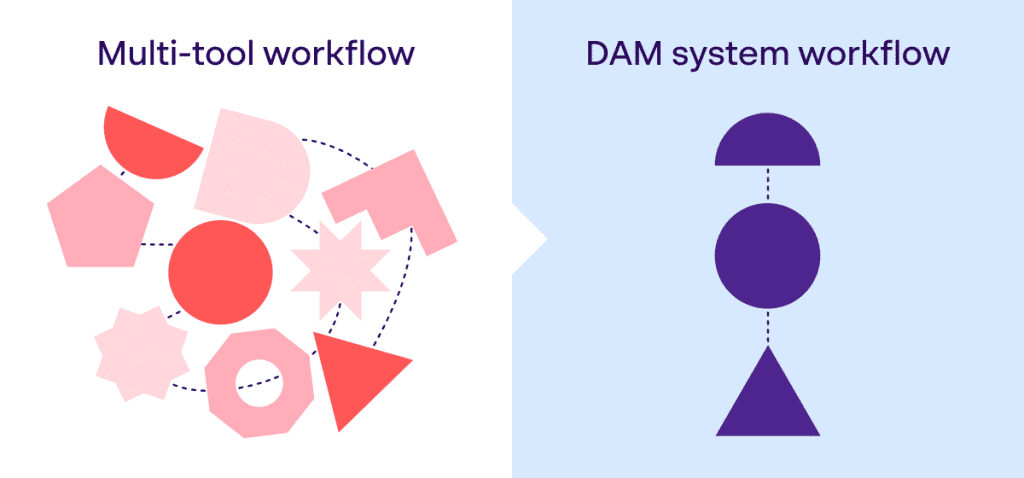
In every one of these situations, the cause is often the same: disconnected systems. When content creators and marketers rely on siloed tools, every handoff adds friction. And every friction point costs time, budget, and brand equity.
More content creation tools, more friction
Today’s content creators juggle a growing arsenal of solutions; Adobe for video content creation, Canva for social media graphics, Figma for UX mockups, Dropbox and SharePoint for file sharing. Then there are dedicated DAM or brand portal systems. At the same time, they’re expected to move faster, generate content in real time, and deliver high-quality assets in every content format – from blog posts and case studies to short-form video.
But if those tools aren’t talking to each other – if your DAM doesn’t sync with your creative suite, or your templates sit separate from your keyword research and content strategy documents – every step of your content creation process takes longer. What feels like a few minutes lost here and there quickly adds up to days of delay, rework, and waste across your teams and target audiences.
7 hours are wasted by Marketers due to poor asset management and disconnect workflows
Source: Net Imperative
7 hours are wasted by Marketers due to poor asset management and disconnect workflows
Source: Net Imperative
The hidden cost of fragmented content creation workflows
Disconnected workflows lead to visible problems:
Assets created outside of brand guidelines
Designers duplicating work because they can’t find existing templates
Marketers waiting on files that should have been self-serve
Local teams improvising content without the right approvals
But the real cost is what you don’t see – slower speed-to-market, budget overruns, and gradual erosion of brand control. When content marketers and content strategists face too much friction, they cut corners on quality content. They pick the fastest tool, the quickest social media platform, or the simplest video template – sacrificing consistency and governance just to hit deadlines.
Integration is not about IT – it’s about outcomes
Discussing integrating design tools with content systems like DAMs can sound technical – like an IT project. But for marketers and brand managers, integration means:
Speed – Content creators stay in their preferred tools and pull approved assets instantly, whether they’re working on blog posts, social media posts, or video scripts.
Consistency – Templates, logos, and visuals are locked to your brand standards in every piece of content and every content format.
Control – Local teams can generate content on demand—without risking off-brand assets or delays.
Clarity – Everyone works from a single source of truth—no more “Where’s the final version?” emails or Google Docs chaos.
Ownership – Original creatives are safely stored in your company’s DAM, not scattered across personal drives or multiple content creator accounts.
Integration isn’t just about smoother workflows – it’s about unlocking real scale for your content strategy without losing governance or creativity.
Leading brands are already there
Case studies show that integration delivers real results for global teams:
Orkla Health manages over 80 sub-brands, each with unique content needs. By connecting its DAM with creative tools, Orkla replaced complexity with clarity – so every internal or external content creator works from the same foundation.
Helly Hansenruns four seasonal campaigns a year across 26 countries. With brand assets embedded directly inside their teams’ daily tools, they can create faster, localize smarter, and stay fully aligned – whether they’re drafting a blog post, designing a banner ad, or producing a TikTok video.
These brands aren’t just producing more content – they’re doing it with less waste, fewer review rounds, and stronger brand equity.
Want to see how this works in practice?
On July 30, I’ll walk through a real-world example of a connected content workflow with our partners at CI Hub.
You’ll see how the full Adobe CC suite can integrate directly with your content system to deliver the efficiency and consistency that global content marketers and brand managers depend on.
This content has been automatically translated and may include minor variations.
Today’s customers expect seamless, consistent brand experiences across every channel. In fact, 95% of them use more than one platform to make a purchase. That means your marketing content must perform everywhere – email, print, social media, mobile apps, websites, and beyond.
But the more channels you serve, the more complex your asset libraries become. From localized print to global campaigns, many organizations find themselves drowning in creative files – most of which are scattered, duplicated, or outdated.
Without structure, managing digital assets becomes an almost impossible challenge, slowing campaigns, creating inconsistencies, and damaging brand trust.
If this sounds familiar, you’re not alone. But you can take control.
The true impact of digital asset chaos
Digital asset chaos is more than just an inconvenience – it’s a drain on your resources and a threat to your brand equity. For example:
Marketing budgets take a hit
Teams waste valuable time searching for the right assets or – worse – recreate them from scratch, eating up your budget and slowing speed to market.
Brand consistency breaks down
Brand equity depends on familiarity. But without a system for managing digital assets centrally, outdated files keep resurfacing, undermining your visual identity and leaving your audience confused.
Workflows stall and teams lose momentum
When design files are disorganized, even a simple task like sharing content on social media can become a long and involved process. The confusion causes team members to second-guess themselves. Cue endless back-and-forth with marketing leaders, wasting time and energy that would be much better spent elsewhere.
4 tips for keeping digital assets organization
Here’s how to create a more effective brand ecosystem and get all your digital assets under control.
1. Audit your existing libraries
Start by taking stock. Map every folder, drive, and repository your teams use. Identify what exists, where it lives, and whether it’s up to date.
Yes, it’s time-consuming – but also essential. Without clarity on what you already have, you can’t create a sustainable structure for the future.
2. Create clear taxonomy guidelines
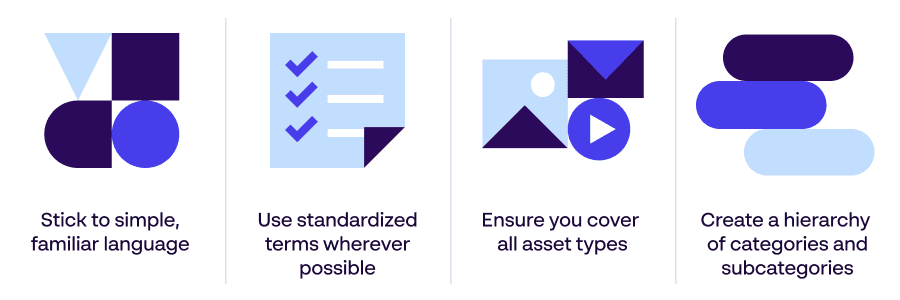
Once you know what you’re working with, standardize how it’s organized. Establish naming conventions, tagging rules, and folder structures that everyone understands – and make sure everyone sticks to them. Without clear rules, the same file might be saved under five different labels, making it harder for people to search for and find the assets they need.
3. Implement a Digital Asset Management (DAM) solution
Once you have audited your content and established a uniform naming structure, your next step is to physically organize your digital files – something Digital Asset Management software can really help you with.
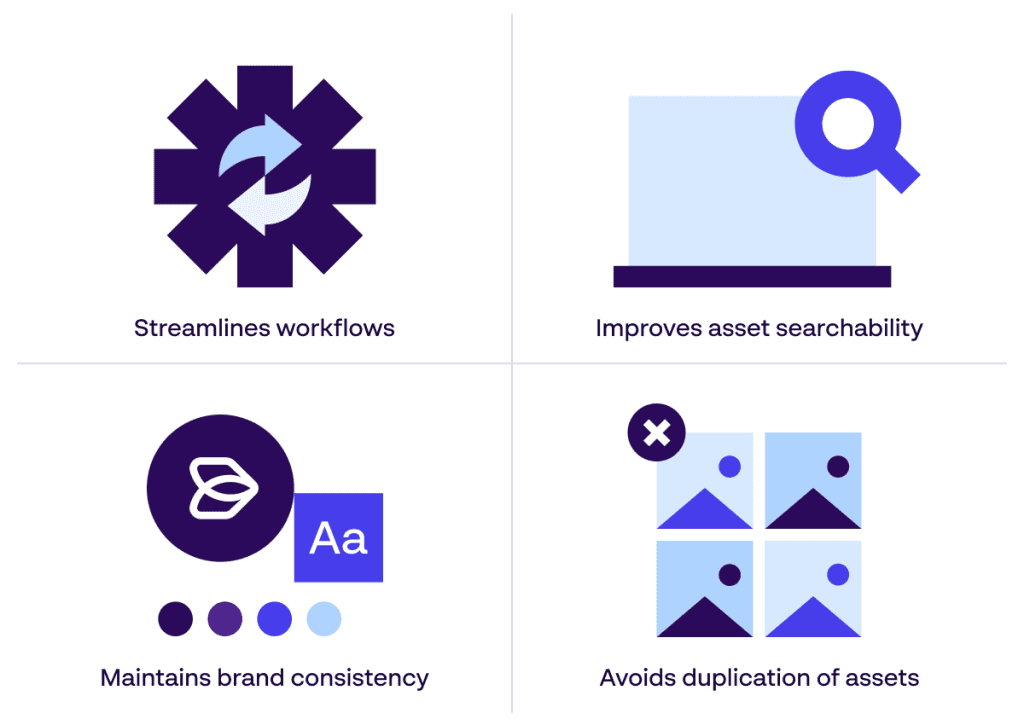
So what is Digital Asset Management (DAM)? Put simply, DAM solutions are digital, centralized locations where all your collateral can be stored and shared with teams worldwide. With powerful search functionality, version control, and role-based permissions, they minimize duplication, streamline workflows, and ensure only the right content is used.
Even the best-managed libraries fall short if users don’t understand how to use what they find.
Brand portals bridge that gap. These user-friendly hubs combine your DAM with brand education, housing brand guidelines, examples, usage rules, and localized content all in one place.
Set up a dedicated brand portal for each region, department, or campaign, so users only see what’s relevant to them – no confusion, no missteps.
A new era for managing digital assets
In today’s multichannel world, content drives everything – from product awareness and employer branding to customer loyalty.
But when assets are scattered, delivery slows, campaigns suffer, and your brand takes a massive hit.
With a clear taxonomy, the right structure, and powerful tools like Papirfly’s Digital Asset Management system and brand portals, you can bring order to digital chaos. Result: faster execution, greater compliance, and consistent brand experiences at scale.
This content has been automatically translated and may include minor variations.
You’ve invested weeks perfecting your latest campaign – refining the message, aligning visuals to brand identity, segmenting audiences. But as launch day approaches, cracks appear. Outdated assets are activated. Mismatched content is sent to the wrong region. Teams scramble, unsure which version is the right one.
Sound familiar?
This isn’t just a workflow hiccup – it’s a brand governance issue. When teams lack clarity or access, brand consistency falters. And with today’s hyper-aware consumers, inconsistencies aren’t just noticed – they’re never forgotten.
At its core, a Digital Asset Management (DAM) system is your centralized asset library. It stores, tags, organizes, and distributes every visual your brand relies on – so teams everywhere have fast, secure, and compliant access to the assets they need.
But a DAM is just the foundation.
A brand portal brings essential context: it houses your guidelines, strategies, and campaign direction – all in one place. When combined, the result is a unified brand hub that enables brand governance, empowers autonomy, and brings clarity to every piece of content.
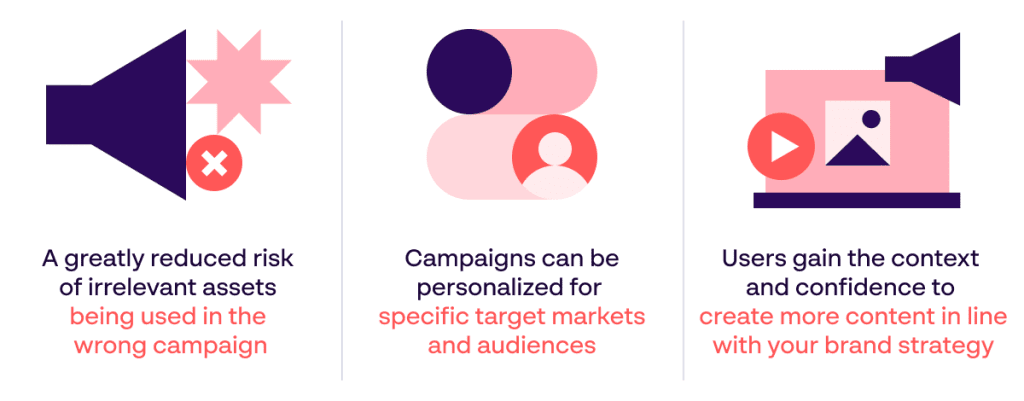
Having a bespoke brand portal for every region, sub-brand and campaign means:
How a DAM and brand portal hybrid powers stronger marketing campaigns
We’ve looked at the theory of DAM and brand portal hybrids. Now let’s see what they do in practice for your marketing campaigns.
Local clarity, global control
Managing global campaigns across markets is challenging. Language, culture, and strategy vary, but brand consistency must be maintained.
By creating a dedicated brand portal for each region, you can ensure teams only see what’s relevant to their audience. No more confusion. No more risk of using the wrong content. Just localized marketing, activated with global confidence.
Campaign-specific pages for streamlined execution
Simultaneous campaigns create overlap. Without structure, the wrong asset in the wrong campaign can dilute your impact or derail your results.
With custom campaign pages in your brand portal, teams access:
Up-to-the-minute information about campaign progress and workflow
Latest approved versions of every asset
Useful details on campaign story, strategy, duration and more
This ensures every team understands the purpose and flow of the campaign they’re supporting – and has the tools to keep it on track.
Smart categorization for smarter content use
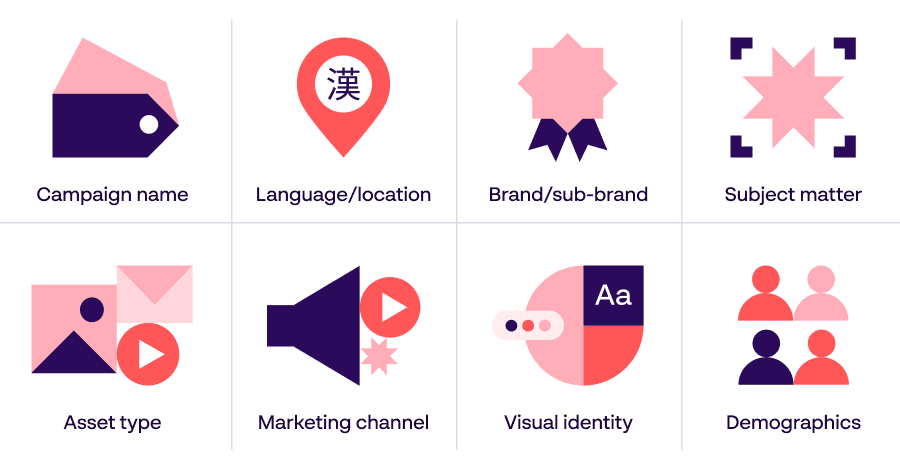
Your DAM should do more than store content – it should guide users to the specific assets they need. Best-in-class solutions allow you to categorize every digital file in your library with helpful tags. For example:
Combine this with access permissions and version control, and you’ve got a system that ensures only the right content is seen and used – no manual policing required.
Clear presentation of a rebrand or campaign refresh
When you launch a rebrand or refresh a campaign, clarity matters. With a DAM and brand portal hybrid, you can:
Update your portals to reflect new branding or visual identity
Make updated brand guidelines and campaign strategies instantly accessible to all
Easily categorize and tag assets that have been fully rebranded and approved
Substitute old assets for their new-look equivalents through version control
In fact, a rebrand is a great opportunity to introduce Digital Asset Management to your marketers and wider employees. It quickly immerses your teams in this new presentation and allows them to handle typical rebrand challenges.
Empower teams to act with speed and confidence
When local teams have the tools and structure they need, they respond faster and with greater precision.
Imagine this: one of your regional teams identifies a local trend and wants to capitalize on it with tailored content. If they have to wait for brand education and approval from central marketing, the opportunity might well be missed.
With a DAM and brad portal hybrid, however, they already have the context they need. Combine it with time-saving content creation tools, and they are empowered to develop their own localized campaign materials – without risk of going-off brand.
DAM & brand portal hybrids in action: BMW NE
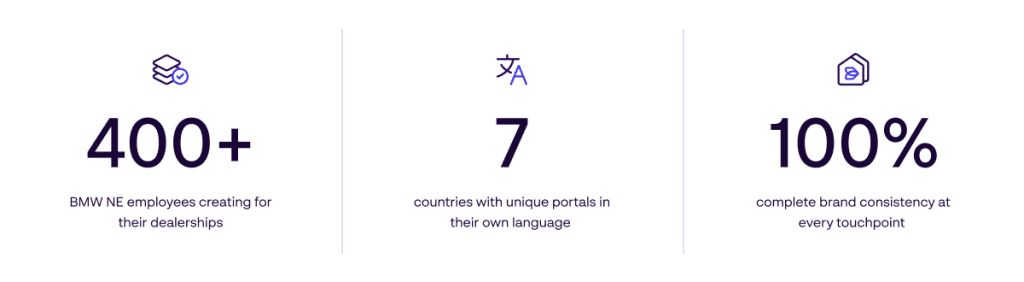
BMW Northern Europe faced a familiar challenge – multiple countries, diverse audiences, and distinct campaigns, coupled with a growing need to stay unified.
The team tried to solve the challenge centrally from HQ. But this approach was slow, inefficient and prone to human error. That’s where a DAM and brand portal hybrid proved to be game-changing.
By establishing a regional brand hub for each division, BMW NE made it easy to people to:
Translate assets into local languages
Understand their area’s specific brand guidelines
Follow the progress of ongoing campaigns
Access all relevant content for their dealership
Papirfly revolutionizes how BMW NE manages its marketing campaigns:
No more missed updates. No more manual distribution. Just one connected system that enables every dealer, employee, and agency partner to fully understand the brand vision and identity – and access the campaign materials they need.
Build campaigns with clarity. Execute with control.
Your campaigns are a reflection of your brand – how clearly and consistently they deliver messages shapes how audiences perceive you.
But great campaigns don’t happen by chance. They require structure, agility, and control. Papirfly’s integrated DAM and brand portal solution gives your teams the foundation they need to build trust, reduce inefficiency, and deliver campaigns that connect and convert.
FAQs
What is the difference between a brand portal and a DAM
A DAM stores, organizes, and distributes digital assets, while a brand portal adds context by presenting assets alongside brand guidelines, campaign information, and usage instructions. Together, they create a single source of truth for managing and creating all content.
Why do marketing teams need both brand portals and DAM?
DAM ensures assets are secure and up to date, while brand portals ensure users understand how and when to use those assets. Combining both reduces confusion, prevents off-brand use, and speeds up campaign execution.
How do brand portals and DAM improve brand consistency?
They ensure teams only access approved assets relevant to their region, brand, or campaign. Version control, permissions, and contextual guidance reduce the risk of outdated or incorrect content being used.
How do brand portals support global and localized campaigns?
Brand portals can be tailored by region, language, or market. This allows local teams to see only what applies to them while maintaining global brand control and consistency.
Can brand portals be created for individual campaigns?
Yes. Campaign-specific brand portals or pages allow teams to access the latest assets, timelines, and strategic context in one place, reducing errors and improving coordination.
How do brand portals and DAM help with rebrands or campaign refreshes?
They allow teams to instantly roll out updated guidelines and assets, replace outdated versions through version control, and clearly separate old materials from newly approved content.
How do permissions and access controls work in a DAM and brand portal setup?
Access can be defined by role, region, team, or campaign. This ensures users only see assets they are authorized to use, reducing compliance risk and accidental misuse.
Do brand portals and DAM improve marketing efficiency?
Yes. By reducing time spent searching for assets, waiting for approvals, or correcting mistakes, teams can launch campaigns faster and focus more on execution and performance.
Who benefits most from a DAM and brand portal hybrid?
Marketing, sales, agencies, dealers, and regional teams benefit from clear access to the right assets and guidance. Central brand teams benefit from stronger governance and visibility.
What should teams look for when evaluating brand portals and DAM?
Key considerations when choosing a DAM include ease of use, customization, metadata and search capabilities, permissions, version control, integrations, and the ability to scale across brands, regions, and campaigns.
This content has been automatically translated and may include minor variations.
You’ve built a strong brand identity with the potential to delight customers and stand out through clear differentiation. But can your teams execute it consistently – across every market, every social media platform, every time?
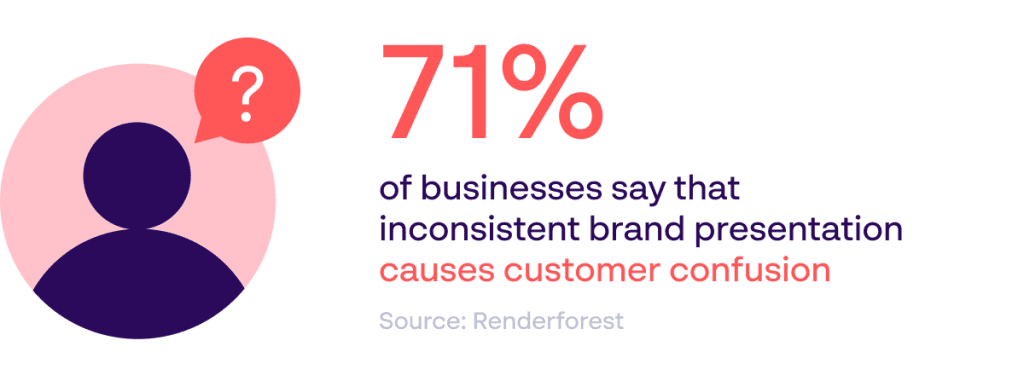
When customer expectations are met – or exceeded – brand equity grows stronger, and your positioning becomes more resilient in the market. But if marketing materials or social media posts go out misaligned or unapproved, the damage is subtle but compounding: lost trust, diluted brand values, and missed opportunities to reinforce your tone of voice and visual assets.
After all, healthy brands demonstrate:
Consistent brand identity across regions
Fast, compliant content creation with strong brand compliance
Clear performance metrics to guide strategy and marketing campaigns
Strong customer loyalty through repeated, relevant experiences
You don’t always see where you’re lacking in these areas until the numbers start slipping – engagement down, financial performance flat, and inconsistent delivery across touchpoints. It can often be difficult to pinpoint why this has happened.
From brand health gaps to stronger customer advocacy
Brand health reflects how well your brand delivers on its promises – not just what products or services are available, but how clearly your tone of voice, values, and brand messaging resonate with your audience. It’s about the emotional connection that encourages customer advocacy and repeat purchase behavior.
Excellent brand health trackers like Talkwalker, Brandwatch, and Qualtrics provide valuable insights into share of voice, customer perception, and brand image. These tools help brand managers monitor performance – but they are only the first step in fixing the issues.
A brand health tracker reveals key signals – positive or negative – like awareness, perception, and customer preference. But the most common wins and gaps point back to execution. Whatever the results, refining your strategy almost always comes down to how you define your branding, create content, and manage your brand communication. Your messaging could be perfect – but if execution is inconsistent, brand equity will suffer.
It’s not a visibility problem – it’s a governance problem
Seeing everything that happens across expanding markets, stakeholders, and touchpoints is an impossible task for any one team. And the issue isn’t visibility alone – it’s the lack of governance, structure, and branding tools that support consistent delivery.
True added value comes when marketing operations give every team the means to manage content in ways that uphold brand governance – ensuring every blog post, campaign asset, and social media presence builds trust with potential customers.
Fixing brand health with a better content creation strategy
If you’re concerned about brand health, chances are your current brand and marketing approach is already showing signs of strain:
Are digital assets scattered across tools or saved locally?
Do local teams create off-brand content due to slow – or no – approvals?
Is your brand book (brand guidelines) clearly understood at every level?
Can you track what’s being created, shared, and reused globally?
If any of these feel familiar, you’re not alone. The path to stronger brand perception and customer relationships starts with control, consistency, and clarity.
1. Consolidate your brand and content ecosystem
Provide branded portals that offer every team – from global HQ to small business units – instant access to the right branding assets:
Visuals and messaging aligned with your brand book
Easy navigation that reflects your branding strategy and user experience
Controlled access by role, region, or team – or create new localized portals
2. Empower teams with Templated Content Creation
Enable templated content creation so visibility is no longer a barrier, and every team can produce brand-consistent content at speed:
Let marketers create personalized content while protecting brand identity
Use locked templates to preserve tone of voice and guard key brand elements
Streamline approvals to go live faster and reduce campaign bottlenecks
3. Measure, adapt, and improve brand performance
Track content effectiveness across regions to see what works – and where you can improve. With the right data insights, your team can strengthen brand equity and improve share of voice:
Use built-in analytics to surface underused digital assets and campaigns
Identify formats and channels that resonate with your target market
Build equity by focusing on what drives customer satisfaction and loyalty
Building brand awareness beyond the health check
Strong brand governance does more than reduce risk – it ensures your brand shows up with impact and consistency across all social media platforms and marketing channels. A healthy brand supports lasting customer relationships, deeper emotional connection, and the brand recognition needed to grow.
Understanding the signals is just the beginning. The next step is giving your teams the tools to act – clearly, consistently, and on-brand.
Explore how Papirfly ‘s modular suite of branding tools empowers your teams to define your branding, scale content creation, and protect every element of your brand—turning insights into real-world results.
FAQs
What is a brand health tracker?
A brand health tracker is a tool that measures how your brand performs across perception, awareness, and customer loyalty. It helps teams understand where the brand is thriving — and where alignment or governance issues may be affecting equity.
Why does brand health matter for brand equity?
Brand health directly influences brand equity. When customers consistently recognize, trust, and advocate for your brand, its equity grows — leading to stronger market positioning and long-term value.
How can a brand health tracker reveal brand consistency issues?
Metrics like share of voice, sentiment, and awareness highlight early signals of inconsistency. If engagement drops or perception varies across markets, it often points to fragmented asset management or off-brand content.
What’s the difference between visibility and governance in brand health?
Visibility shows what is happening; governance ensures it happens on-brand. Healthy brands combine both — giving every team visibility into approved assets and the structure to use them correctly.
How do Digital Asset Management systems improve brand health?
A DAM centralizes all brand assets, ensuring every image, video, or document aligns with your brand identity. This organization builds trust internally and consistency externally — essential for positive brand perception. Read more in our DAM guide.
How does Templated Content Creation support brand governance?
Templated Content Creation empowers teams to produce localized or personalized assets quickly — without compromising tone of voice or design integrity. Locked templates maintain brand control while improving efficiency. The difference in capabilities between consumer and enterprise design templates and their ability to keep teams on-brand directly affects brand governance.
What signals show declining brand health?
Falling engagement, inconsistent visuals, or a drop in customer sentiment often indicate misalignment in brand execution. These are early warning signs that governance and asset control may need reinforcement.
Can brand health tracking improve customer advocacy?
Yes — by connecting insights with consistent execution. When customers experience your brand consistently across every touchpoint, their trust grows, turning them into advocates who actively promote your brand.
How often should companies track brand health?
Quarterly tracking is ideal for most organizations. It allows you to spot emerging trends early and align brand, marketing, and content teams around proactive improvements.
How can Papirfly help improve brand health?
Papirfly enables marketing and brand teams to define, manage, and scale brand experiences. With Digital Asset Management and Templated Content Creation, every team can create on-brand content — strengthening brand equity through consistency, control, and clarity. Learn more in our content at scale guide.
This content has been automatically translated and may include minor variations.
The rise of AI-powered tools is transforming marketing—offering unprecedented efficiency, scale, and automation. But can AI truly replace the strategic and creative force of human marketers?
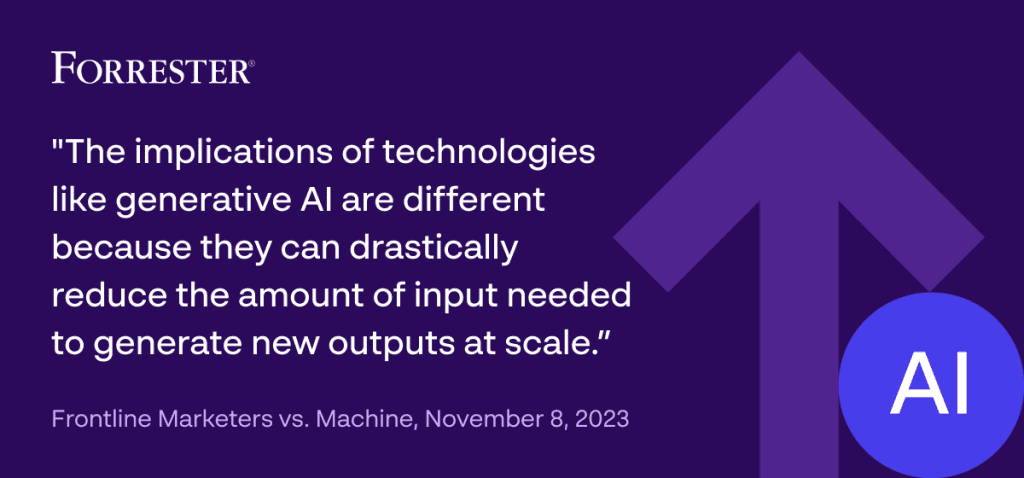
The Forrester report ‘Frontline Marketer vs. Machine’ explores this dynamic. On the plus side, AI marketing tools excel in automation and data‑driven insights. However, they still fall short in key areas: creativity, strategic alignment, and brand governance.
How does AI and human marketing performance differ?
AI marketing automation has reshaped the way teams work—eliminating bottlenecks in asset reformatting, metadata tagging, and workflow execution. These tools analyze enormous volumes of data at unmatched speeds. This enables real-time optimization of digital ad placements and boosts ROI. From campaign personalization to performance tracking, AI in digital marketing delivers measurable productivity gains.
While impressive, AI lacks the emotional intelligence and cultural context to elevate content from functional to truly compelling. The gap between creating content at scale and storytelling remains a human domain.
The challenges of using AI in marketing
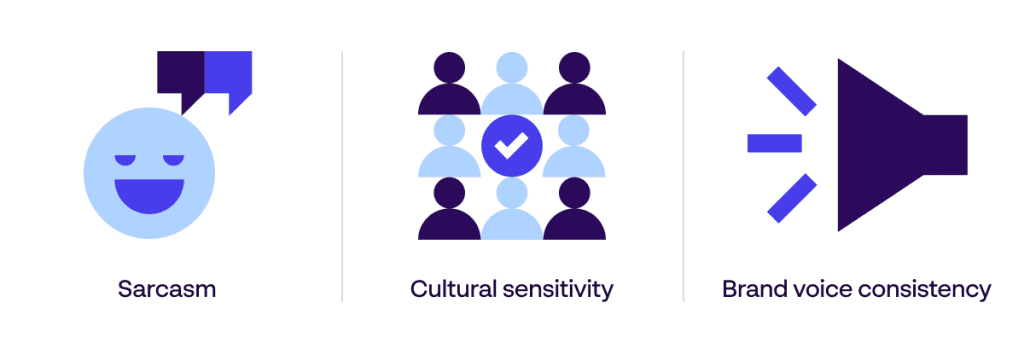
Despite the speed and volume advantages, AI introduces real challenges for marketers. Generative AI for marketing can churn out content rapidly. Ensuring that content reflects brand voice, emotional nuance, and local relevance requires human intervention. AI still struggles with sarcasm, humor, cultural sensitivity, and message alignment—raising risks for brand perception and trust.
“Frontline marketing leaders must anticipate AI’s potential to replace headcounts, roles, accountabilities, or activities […] ” – Forrester report, November 8, 2023
Even the best AI tools for marketing are only as effective as the data they’re trained on. If inputs are biased or outdated, the output can mislead rather than inform—undermining both strategy and ROI.
Can AI replace human creativity?
Creativity is still the greatest limitation for AI content marketing. While these tools can support content generation, they rely on patterns and historical data—not original thinking. That’s why brand-defining storytelling, emotional resonance, and campaign innovation remain areas where human marketers shine.
“Forrester recommends using generative AI to enhance, not replace, human efforts in the short term.” – Forrester report, November 8, 2023
Where marketers continue to outperform AI
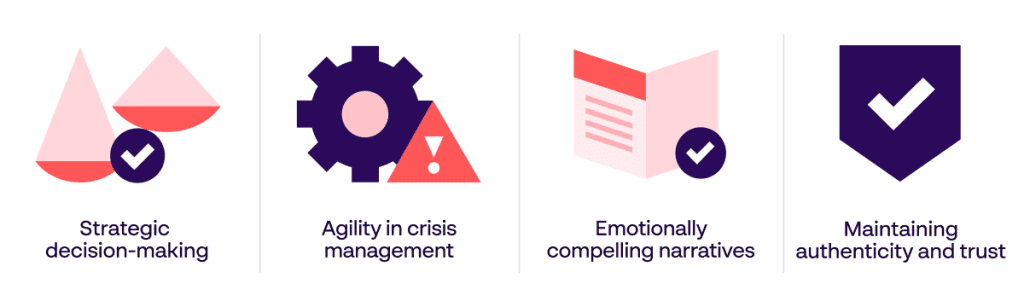
The advancement of AI marketing solutions falls short in replacing marketers. Strategic thinking, contextual awareness, and brand governance sits with your people. Interpreting complex customer needs, responding in real-time to emerging situations, and maintaining brand consistency across regions require human expertise.
“Because AI is destined to become an indispensable, trusted enterprise coworker, frontline marketing leaders must ensure their human workers are equipped with the right technology skills.” – Forrester report, November 8, 2023
How to integrate AI in marketing without losing control
AI should be integrated as a support layer—not a substitute. Use it to automate routine tasks, surface insights, and accelerate production. But always apply human oversight for quality control, message alignment, and brand integrity.
Building AI fluency among your people ensures that AI tools enhance your output. They can’t replace the people who drive strategy. As Forrester puts it: “Enhance, not replace, human efforts.”
Brand consistency and control: The limits of automation
AI can support brand governance by automating compliance checks, applying content templates, and maintaining formatting standards. But consistency is more than appearance—it’s about tone, relevance, and brand authenticity. Over-relying on AI risks producing content that’s accurate but emotionally flat or misaligned across regions.
“Frontline marketing leaders must get ahead of the trend and define the specific ways in which humans and technologies should be driving productivity in their frontline organizations.” – Forrester report, November 8, 2023
Risks and rewards for global marketing teams
AI offers tremendous benefits in marketing automation—improved speed, reduced production costs, and scalable personalization. But global teams must be mindful of the trade-offs: diluted brand voice, ethical risks, and reduced creative agility. Marketers must manage AI with clear guardrails and guide it with human insight to unlock its full value.
The future: AI‑augmented, not AI‑replaced
AI is here to stay—and it’s helping lighten the load on marketing operations. Using AI in marketing teams unlocks powerful efficiency and insight. Yet human marketers remain essential. People bring qualities that cannot be automated—empathy, originality, and judgment.
The future of marketing is a partnership. AI marketing tools accelerate execution, while human marketers ensure creativity, strategy, and brand control stay intact.
FAQs
Can AI fully replace human marketers?
Not yet — and likely not entirely. AI marketing tools excel at automating workflows, analyzing data, and scaling content production. But human marketers bring strategic thinking, creativity, and emotional intelligence — essential for authentic brand storytelling and customer trust.
How can AI support marketing teams without reducing creativity?
Use AI to enhance, not replace. Automate repetitive tasks like tagging, resizing, and data analysis, so your people can focus on strategic and creative work. This balance helps teams produce content faster while keeping human originality and cultural context at the forefront.
What are the biggest risks of using AI in marketing?
AI-generated content can appear off-brand, tone-deaf, or culturally insensitive if left unchecked. Without human review and strong brand governance, automated outputs can damage consistency and brand perception across regions.
How does Digital Asset Management (DAM) help maintain control when using AI?
A DAM must evolve to be AI asset management software to ensure all AI-generated or human-created content is only distributed as approved, on-brand assets. A brand portal provides a single source of truth — protecting your visual identity, messaging, and brand tone as AI tools scale content creation.
What’s the ideal balance between AI and human marketing efforts?
The future is hybrid. AI should handle the volume and efficiency side, while humans lead with creativity, empathy, and strategic oversight. The most successful teams combine automation with governance — ensuring every campaign remains fast, consistent, and unmistakably on-brand.
This content has been automatically translated and may include minor variations.
In today’s competitive automotive industry, standing out is more challenging than ever. The rise of cost-effective foreign manufacturers and global automotive giants puts European brands under pressure. For marketing directors and brand managers, adapting while maintaining brand consistency is crucial.
Staying recognizable in a shifting landscape
1. Rising competition from foreign brands
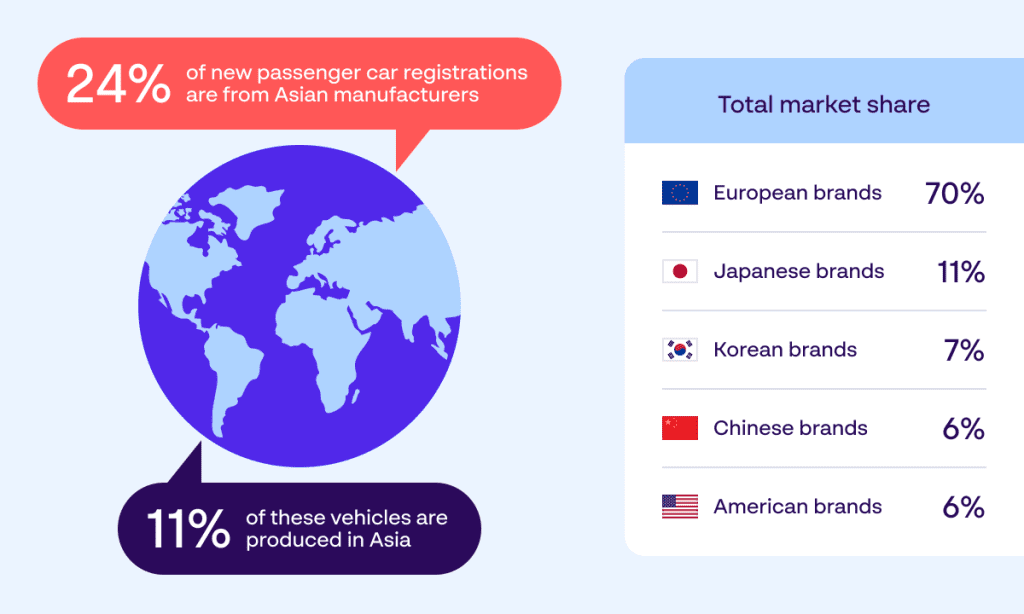
Asian manufacturers now account for 24% of new passenger car registrations in Europe, with 11% of these vehicles made in Asia. Their aggressive marketing saturates media, making it harder for local brands to compete. Without a centralized brand strategy, European brands risk being overshadowed in consumer perception.
Additionally, automotive brands in transformation to e-mobility face a market that isn’t fully keeping up, largely due to economic decline and shifting consumer preferences. The increased influence of U.S. and East Asian brands further challenges German automakers’ ability to maintain dominance in key global markets.
Foreign Brands Gain Ground in Europe
2. Budgetary pressures limiting marketing impact
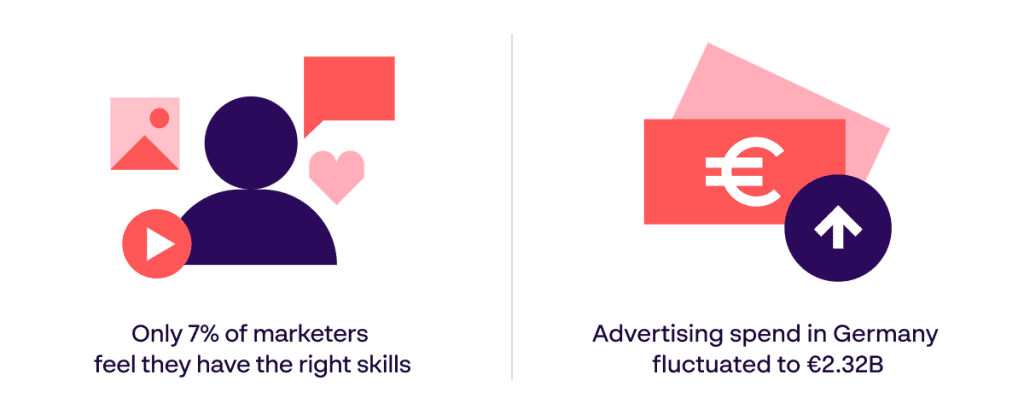
Economic uncertainties have tightened marketing budgets across the DACH region. In Germany, advertising spending has fluctuated, reaching €2.32 billion in recent years. Additionally, only 12% of marketing leaders believe their teams are structured to meet revenue goals, and just 7% feel they have the right skills to execute effective campaigns. With fewer resources, maintaining a strong brand presence requires smarter, more efficient marketing solutions.
Moreover, as budgets tighten, brands struggle to allocate funds to localizing content while maintaining consistency, which can create inconsistencies in branding across dealership networks and sub-brands.
Marketing impact in tight times
3. Dominance of global conglomerates
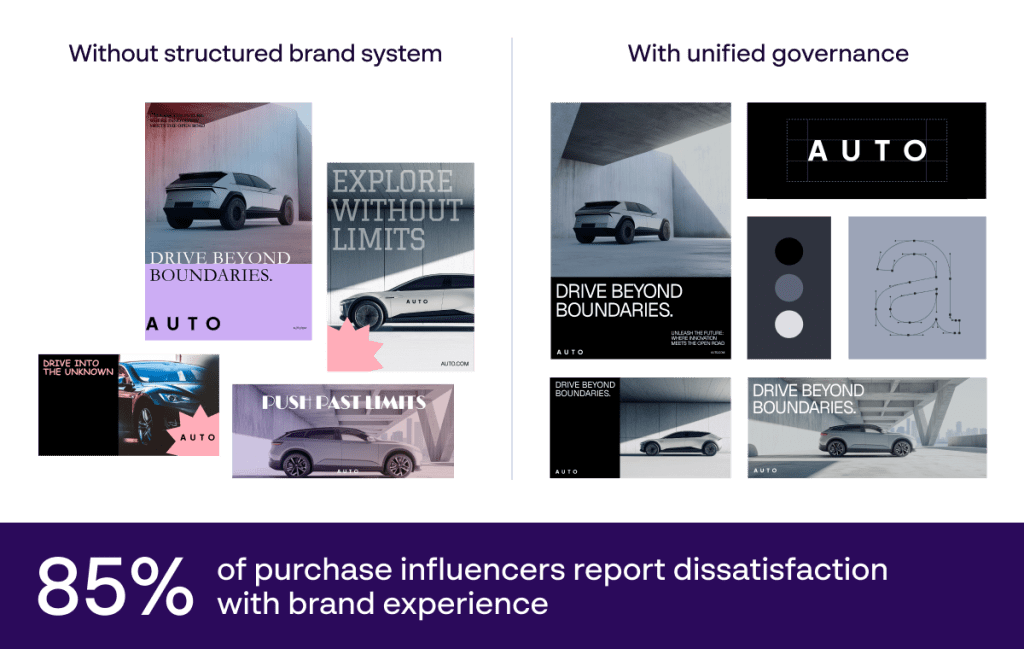
Mergers and alliances allow major players to pool resources, making it difficult for smaller brands to compete. Furthermore, 85% of global purchase influencers have reported dissatisfaction with at least one aspect of a winning vendor’s experience, emphasizing the need for a clear and consistent brand identity that resonates with consumers and business buyers alike.
At the same time, automotive brands in the DACH region face the challenge of managing multiple sub-brands while ensuring unified brand representation. Without a structured system, regional inconsistencies arise, weakening consumer trust and recognition.
Amid these challenges, European brands must focus on speed, efficiency, and consistency to remain visible and strengthen consumer connections.
Consistency Builds Recognition
The role of local dealerships in brand success
One of the most critical elements of brand success in the automotive industry is the dealership network. While corporate teams establish brand identity and global messaging, dealerships are the frontline representatives of the brand. They interact directly with customers, respond to regional market demands, and drive local sales.
However, without a structured brand governance system, dealerships often face challenges such as:
Inconsistent marketing execution – Local teams create off-brand content, leading to a diluted customer experience.
Slow response to market trends – Relying on external agencies slows down content creation, delaying campaigns and promotions.
Lack of visibility over brand compliance – Corporate teams struggle to ensure marketing materials adhere to brand guidelines.
To succeed, automotive brands must strike the right balance between centralized control and dealership-level flexibility.
Leveraging templated content creation
A structured and scalable content creation process offers a streamlined solution for automotive brands, ensuring consistency, efficiency, and adaptability across all marketing efforts.
1. Faster creation = faster recognition
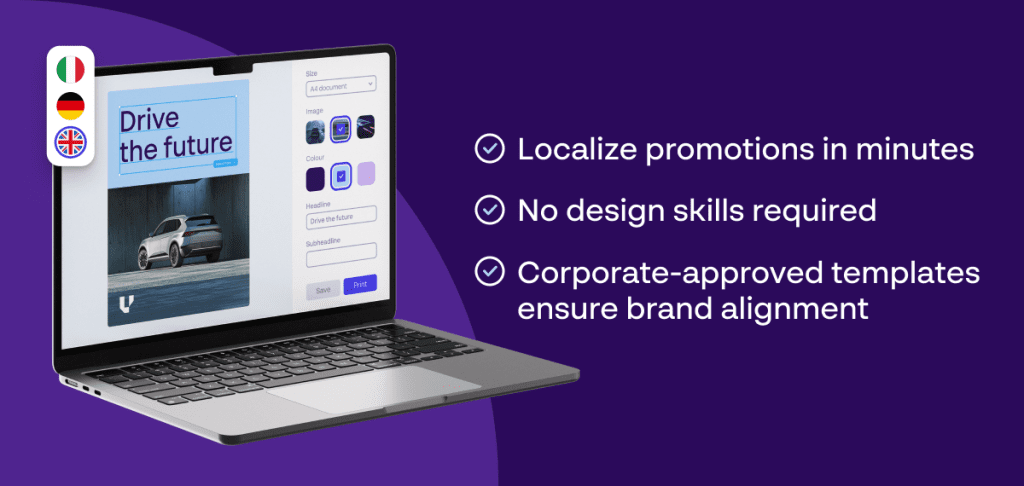
Brand consistency builds trust and strengthens consumer bonds. With on-brand content creation, marketing teams can quickly produce and deploy content using pre‑approved templates, ensuring all marketing materials meet brand guidelines while reducing inefficiencies caused by disconnected regional strategies.
Dealerships can access corporate-approved templates that allow them to customize messaging, promotions, and campaigns while maintaining a strong, unified brand identity.
2. Increased output without extra costs
Scaling content creation without additional resources is crucial in a cost-conscious environment. Since only 7% of marketing leaders feel confident in their teams’ skills, an intuitive templated system enhances efficiency by enabling all stakeholders—from corporate marketing to regional dealerships—to contribute to brand communication without specialist design skills.
With built-in approval workflows, content can move seamlessly from production to publication, ensuring brand compliance at every step and reducing costly design bottlenecks.
Scalable Creativity Without the Extra Cost
3. Localized content with regional consistency
The European market’s cultural diversity demands tailored content. A on-brand content creation solution allows local teams to adapt marketing assets while maintaining a globally aligned brand identity. This ensures:
Faster adaptation of marketing materials to suit local market needs.
Compliance with brand guidelines across all regional activations.
A seamless blend of corporate control and dealer-level flexibility.
By leveraging a Digital Asset Management (DAM) system, automotive brands can:
Centralize all marketing assets, ensuring easy access to up-to-date, approved content.
Implement user permissions that tailor access for dealerships, distributors, and corporate teams.
Maintain a consistent brand identity even as sub-brands and markets evolve.
Building brand trust through digital transformation
A strong and adaptable branding strategy is crucial for automotive brands to remain competitive in an evolving market. To successfully balance global brand consistency with local market demands, companies must implement structured digital asset management and on-brand content creation solutions. Here’s how:
Adapting to shifting consumer demands As consumer preferences evolve and economic conditions fluctuate, brands need to respond quickly. A structured content system allows local teams to launch localized promotions and seasonal campaigns instantly, ensuring they remain relevant and responsive without waiting for lengthy approvals from corporate headquarters.
Enhancing dealer engagement Local dealerships are the face of the brand, and they need tools to execute marketing effectively. Providing an on-brand content creation system empowers dealers to customize materials while maintaining corporate‑defined standards. This creates a sense of ownership and ensures that local marketing efforts align with the broader brand strategy.
Ensuring effortless brand compliance Without proper oversight, brand inconsistencies can arise across different regions and dealership networks. A centralized digital asset management (DAM) system enables corporate teams to control branding elements, ensuring only approved, up-to-date content is used. Automated compliance checks and streamlined approval processes prevent off‑brand messaging and safeguard brand integrity.
A competitive edge for the automotive industry
With Papirfly’s integrated suite, brands can transform their marketing operations to compete more effectively:
On-brand content creation at scale – Ensuring speed and efficiency in marketing asset production across all markets.
Eliminating marketing inefficiencies – Reducing time spent searching for assets and recreating content that already exists.
Strengthening brand consistency – Unifying brand representation across all sub‑brands and dealership networks.
Drive your brand forward with Papirfly
In a dynamic market, speed and consistency are essential. Papirfly’s On-brand Content Creation solution helps brands adapt, strengthen their presence, and engage audiences effectively.
Ready to take the lead?
Discover how Papirfly’s On-brand Content Creation solution can enhance your brand’s marketing and visibility.Visit our automotive solutions page to learn more.
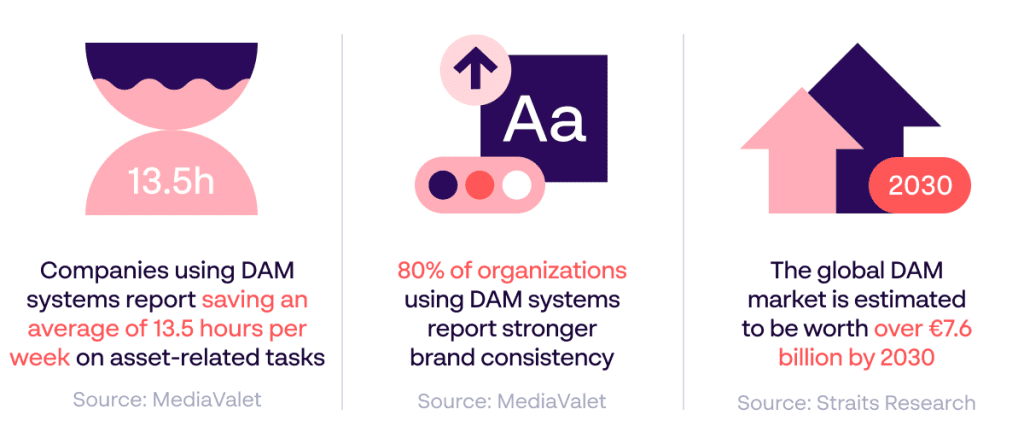
With marketing teams now responsible for more digital assets than ever across an ever-growing number of channels and platforms. To ensure end-to-end brand consistency, campaign efficiency and company-wide collaboration, discovering how to choose a Digital Asset Management system is essential for your organization’s ability to compete in your target markets.
A capable DAM solution enables you to:
Bring all digital assets into a single, comprehensive library, rather than scattered on desktops, servers, emails, Dropbox and beyond
Prevent unnecessary file duplications, versions deviations and GDPR breaches, saving your team’s time, locking down brand consistency and guaranteeing compliance
Establish different access rights across your team, ensuring that people only see the digital assets relevant to them
Improve overall efficiency, with everyone knowing where to store and search for files
Share assets across your marketing ecosystem in a controlled, managed environment
The need for DAM software is clear. But, which is right for your company? As DAM technology has become increasingly important, the choice of solutions has naturally exploded, presenting many possibilities for potential buyers.
While choice can be good, it makes selecting the best DAM software for your organization a real challenge. Not all DAM solutions are created equal, so it’s important you know what to look out for before seeking a system or upgrading your platform.
That’s where this essential guide comes in. Here we’ll outline what features and qualities you should prioritize in your DAM selection process to help guarantee a decision that benefits your creatives, marketers and beyond for a long, long time.
6 essential features defining how to choose a Digital Asset Management system
Understanding the features that separate the best Digital Asset Management tools from the rest is key to meeting the needs of your stakeholders. Below we’ve highlighted some of the most crucial to seek out – some obvious, others less so:
1. Compliance and privacy features
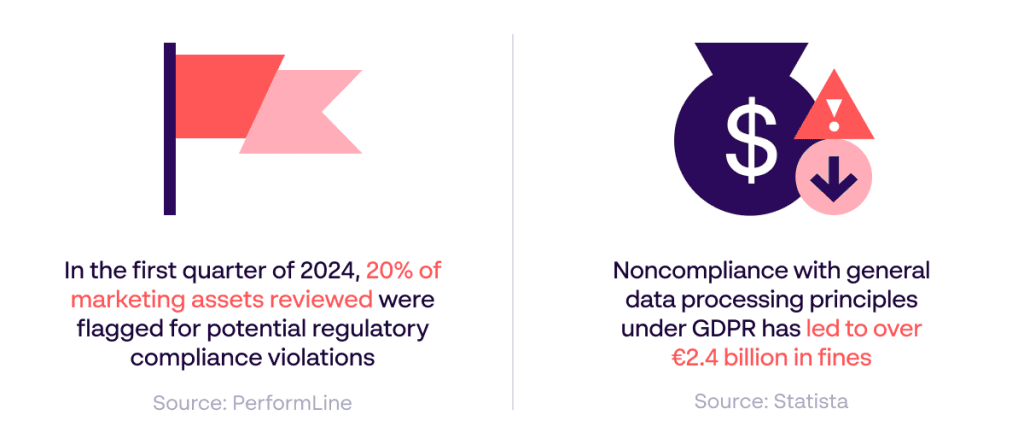
Did you know that in the first quarter of 2024 alone, 20% of marketing assets reviewed [Source: PerformLine, 2024] were flagged for potential regulatory compliance violations?
Managing consent and compliance to use assets in your content and campaigns is a vital, yet often overlooked, aspect of Digital Asset Management. Approached manually, it’s time-consuming, resource-intensive and prone to human error. The right DAM system ensures the GDPR compliance of your assets is never questioned.
Prioritizing a DAM solution with an in-built consent management tool confirms that:
Consent for digital assets is captured from QR codes, physical forms or emails, including facial recognition to simplify GDPR and consent management.
Assets awaiting consent are flagged as “pending approval”, preventing them from being used until they get the green light
Assets that lose consent or compliance are automatically revoked from the asset library, removing any risk of these featuring in future content
Users can exercise their “right to be forgotten” after receiving self-service links to any assets they feature within
By selecting DAM software with dedicated compliance and privacy features, you gain peace of mind that no requests for asset removal will slip through the net, eliminating the risk of costly fines or damage to your brand’s reputation.
2. A great user interface and usability features
Put simply, a DAM system is only useful if people use it. If the software is too complicated or confusing, users will abandon it, leaving you with nothing but a vacuum of wasted time, resources and potential.
To ensure the effort and investment you put into ensuring your assets are organized, shareable and compliant, it’s critical you purchase a truly intuitive DAM – one that seamlessly fits into the workflows of your marketing managers, content creators and frontline employees.
Drag-and-drop uploads for easy file storage
AI-assisted tagging for quick, efficient searches
Version control to ensure access to the latest assets
Access control to prevent misuse of assets
Automated workflows to streamline approvals and distribution
Not overly complex for non-technical users. Not too basic for enterprises seeking total brand governance. That is the perfect balance for a DAM system.
Another key consideration for usability is choosing a DAM with a built-in brand portal. This “front-end” DAM can give your users immediate access to brand guidelines, campaign information and beyond, confirming that everyone understands how and why to use the assets they have access to.
In other words, a brand portal offers a “single source of truth” that informs your users, making it simple for them to manage assets and maintain consistency at every touchpoint.
3. Metadata and categorization
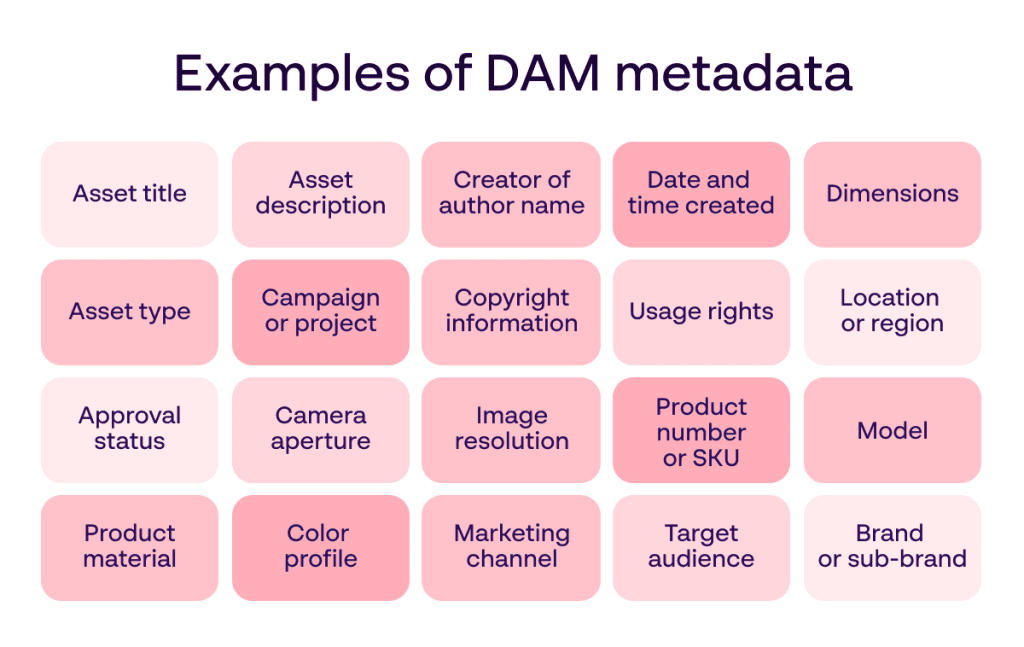
Above all else, a DAM system must make it easy for users to find assets they need when they need them. Therefore, the ability to define metadata tags for each asset – from color scheme and included products to asset type, dimensions and location – is essential for users to search for relevant assets.
The right DAM system must accommodate the unique taxonomy of your organization, establishing a common language that allows people to find the right assets.
Furthermore, selecting DAM software with a multi-level category system means you can create a logical hierarchy for everyone in the company – not just a single department or person.
4. Access and version control
DAM solutions with access control and user permissions ensure that only valid users can access relevant materials. It prevents users from mistakenly using assets intended for certain regions or campaigns, supporting your internal and external (agency) users.
Similarly, version control and file expiration management confirm that users only see the most up-to-date version of an asset, so outdated content never makes it to your channels.
5. AI-driven search and capabilities
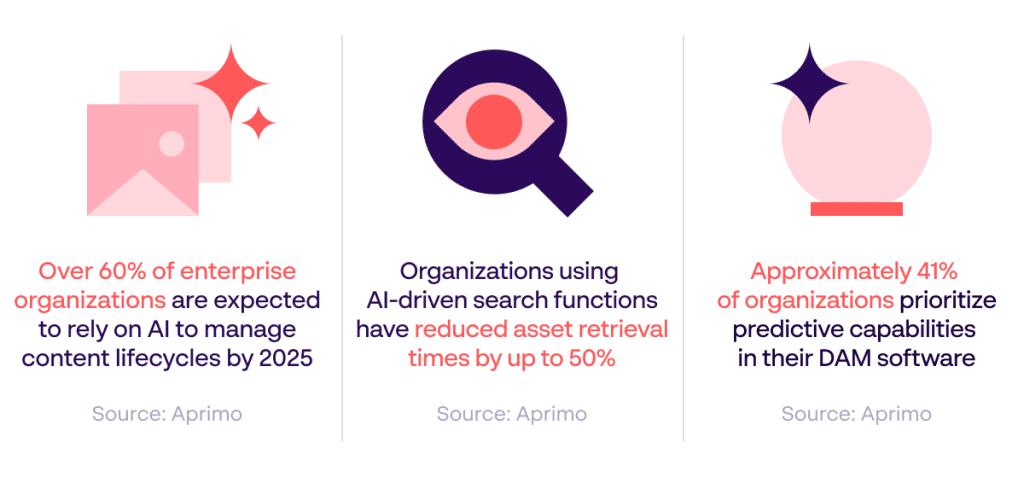
You don’t want to manually fill in all the metadata and tags attached to your digital files, especially as you create more content to satisfy your audiences. That’s why you should pursue DAM solutions that harness AI technology.
For example, faceted search using generative AI can help users find assets faster by understanding context, recognizing objects and interpreting intent. AI-centred DAM solutions can also analyze digital assets to generate suitable metadata and tags based on your taxonomy guidelines.
AI technology will continue to grow more sophisticated and will influence in the DAM space. That said, you want to attach yourself to a vendor at the forefront of innovations which don’t allow the unpredictability of AI to negatively affect your content and risk your brand’s reputation with customers.
6. On-brand content creation and adaptation
Finally, when there is a growing need for local teams and frontline workers to produce content for their specific audiences, choosing a DAM system with on-brand content creation tools enables you to fulfill that obligation.
Rather than simply being a home for your digital assets – putting pressure on your in-house creatives or agency partners to fill that repository – on-brand content creation empowers users to develop branded, quality assets themselves, regardless of their design skills.
Plus, this functionality enables users to download assets from your DAM library and localize/personalize content for their target markets – increasing the accessibility and return on investment (ROI) of your campaigns.
Other notable features to look out for in any prospective DAM system include:
File previews
Automatic file transcoding
Predefined file formats and uploads
Cloud storage
Smart cropping tool
Looking beyond features to find the best DAM systems
Focusing on the key features listed above will be pivotal in your pursuit of top DAM solutions. However, selecting the ideal DAM system for your organization extends beyond the features they do or do not include.
Many providers deliver the same technology and features. What often separates the best from the rest is the DAM software’s characteristics and the vendor’s reputation.
With this in mind, and your aim to acquire a solution that will benefit your whole company and deliver a healthy ROI, make sure you consider the following:
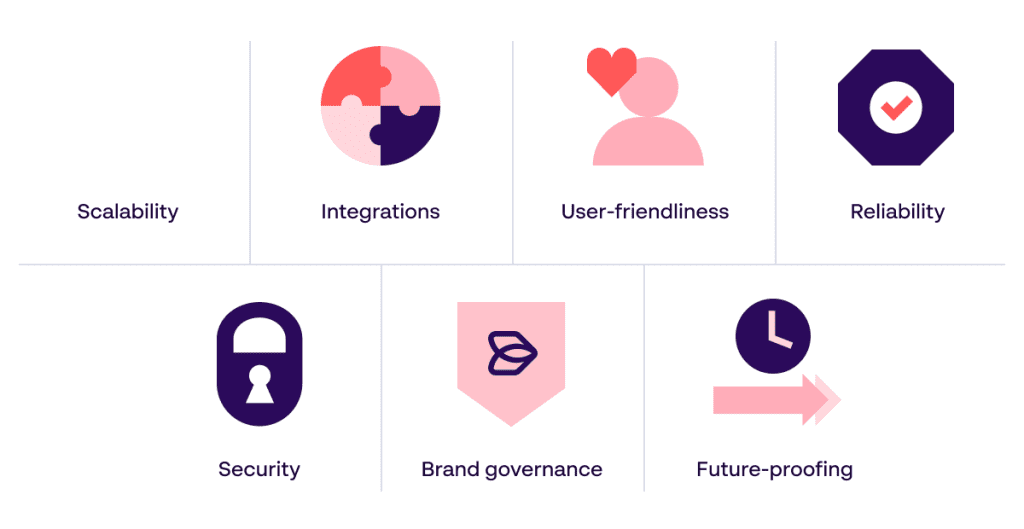
Scalability: Will the DAM system you select comfortably grow and evolve at the same pace as your company? Does it harness cloud storage to make this attainable yet cost-efficient?
Integration: Can the DAM solution agreeably integrate with your existing MarTech, or enable you to reduce your dependency on multiple systems? Will it complement your current ecosystem?
User-friendliness: A DAM system is only valuable if people use it – is the software you’ve identified simple to operate, intuitive and accessible to all users? Is it something you can imagine your teams turning to every day?
Reliability: You can’t risk your files suddenly becoming unavailable – can you ensure that your DAM system will perform 24/7 for your global teams? What is the platform’s average uptime and responsiveness?
Security: Does your chosen DAM software incorporate best-in-class security features and protections? Does it include SSO encryption, disaster recovery plans and dedicated managed services?
Brand governance: Does the DAM solution ensure that every piece of content is 100% compliant? Does it help you fulfill regulations, stay up-to-date with consent rights, and enable seamless sign-off across your assets?
Future-proofing: Is the DAM vendor behind your selected system consistently looking to improve and innovate its solution? Do they have a development roadmap that signals the evolution of their product?
mentioned in the WP, an assurance that every piece of content is 100% compliant – for specific regulatiory needs (not well phrased), has up-to-date consent for anyone featured in a digital assets, and signed off as good to use as on-brand content.
These qualities and intangibles, combined with a strong track record and reputation for a prospective DAM vendor, must be appreciated alongside a DAM system’s core features to ensure you receive the most rounded, comprehensive solution.
Want to choose the best DAM software? Read our complete buyer’s guide
We hope this article has given you plenty of insight into selecting the most suitable DAM system for your requirements. With the abundance of choice in this market and the central role this technology can play in your ongoing marketing operations, you should know what features and qualities to prioritize in your search.
However, this article merely scratches the surface. If you want to know more about how to choose the right DAM software for your needs, and the process of locating and deploying this technology, get hold of our free, comprehensive DAM Buyer’s Guide:
Discover all the essential features you should look for in an optimal DAM system
Know the crucial qualities of a sustainable, future-proof DAM solution
Understand the key attributes to seek out in a reputable, quality DAM vendor, from managed services to innovation roadmaps
Explore the critical steps to identify, purchase and install your ideal DAM software, from creating an RFP document to the all-important deployment phase
Whether you’re investing in a DAM system for the first time or seeking to upgrade your existing solution, our complete DAM Buyer’s Guide will help put you on the direct path to the right system for your exact requirements.
How do I know if my organization needs a Digital Asset Management system?
If teams waste time searching for files or using outdated visuals, it’s time for a DAM. A centralized system keeps assets compliant, current, and easy to find—empowering teams to stay on-brand and efficient.
What features should I look for when choosing a Digital Asset Management system?
Look for powerful search and filtering, metadata tagging, user permissions, version control, and seamless integrations. The best DAM systems also offer branded portals and AI-driven asset organization.
How do I compare Digital Asset Management vendors?
Define your priorities first—such as asset control, collaboration, or brand governance. Then assess each vendor’s usability, integrations, scalability, and customer support. Focus on adoption potential, not just features.
What are the common mistakes to avoid when selecting a Digital Asset Management system?
Avoid choosing purely on price or storage capacity. Many organizations overlook user adoption, taxonomy setup, and brand governance—leading to low engagement and poor ROI.
How much does a Digital Asset Management system cost?
Costs vary by company size and requirements. Mid-market DAM solutions typically start around €25,000 annually, with pricing based on users, storage, and integrations.
What makes Papirfly’s Digital Asset Management different?
Papirfly combines asset organization with brand visualization. Teams don’t just store assets—they experience the brand. Its modular DAM and brand portal architecture ensure assets are accessible, compliant, and always on-brand.
How long does it take to implement a Digital Asset Management system?
Implementation timelines depend on complexity. With a structured onboarding plan, migration, and user training, most organizations achieve full adoption within a few months.
Can a Digital Asset Management system integrate with my existing tools?
Yes. Leading DAMs connect with tools such as Adobe Creative Cloud, Microsoft 365, Google Workspace, and Product Information Management (PIM) systems for smooth workflows.
What ROI can I expect from a Digital Asset Management system?
Brands using enterprise DAMs often see up to 35% faster creative production and a 20–30% reduction in duplicated asset spend (Source: Forrester, 2024).
This content has been automatically translated and may include minor variations.
Over 200 marketing professionals gathered in Oslo for ANFO’s MarTech Dagen 2025. The event centered on the practical application of technology in marketing, showcasing how businesses leverage tools like real-time Customer Data Platforms, marketing automation, and personalized customer dialogues to create valuable customer experiences.
As a sponsor, Papirfly was keen to explore one of today’s biggest branding challenges—maintaining consistency across an ever-growing number of channels—and how the right marketing technologies can help solve it.
The challenge of new channels
The proliferation of marketing channels offers brands unprecedented opportunities to reach diverse audiences, using a multitude of formats. However, this expansion often leads to challenges in preserving a unified brand voice. At MarTech Dagen, speakers highlighted the risks of brand dilution when messaging becomes inconsistent across platforms. The consensus was clear: without a centralized approach to brand management, the essence of a brand can easily become fragmented.
Håvard Kvinnesland at BAS Kommunikasjon, explored the rising potential of RCS (Rich Communication Services)—the next evolution of SMS. With features like branded messaging, rich media, and interactivity, RCS offers a new way to connect with customers directly on their phones.
But as with any emerging channel, it introduces a new layer of complexity: How do you ensure consistent branding and tone of voice in a format that feels more like a conversation than a campaign?
Without clear guardrails and centralised assets, there’s a risk that RCS messages stray off-brand—especially when created quickly or by different teams. It’s another example of why structured content governance and easy access to approved brand materials are critical in today’s Martech ecosystem.
Scaling content without losing control
Key Insight: Increasing content production doesn’t have to lead to chaos. Martech tools, such as DAMs, are pivotal in streamlining content workflows.
As the demand for content grows, so does the potential for inefficiencies. Common pain points include workflow bottlenecks, approval delays, and the dissemination of off-brand assets. At the event, industry leaders emphasized the importance of structured content governance. Implementing Martech solutions like DAMs can bridge organizational silos, ensuring that all teams have access to the latest, approved brand assets, thus maintaining efficiency and control.
Brand Integrity: A recurring theme at MarTech Dagen
One concept that surfaced repeatedly throughout the day was brand integrity—and how difficult it is becoming to preserve in the face of increasingly complex marketing ecosystems.
With the rapid rise of new tools, platforms, and AI-powered solutions, marketers are under pressure to move faster and produce more content than ever before. But in this flurry of automation and innovation, maintaining a clear, cohesive brand identity is more challenging—and more critical—than ever.
Speakers at MarTech Dagen pointed to how quickly brand identity can erode when different teams, regions, or agency partners rely on disconnected systems or outdated assets. As AI tools begin generating content at scale, the risk of going off-brand grows exponentially unless the right governance structures are in place.
This is exactly where Papirfly steps in.
Papirfly supports brand integrity at scale by giving all stakeholders—from local marketers to external partners—access to one platform, one source of truth. With pre-approved assets, templates, and guardrails built in, every piece of content, no matter who creates it or which channel it appears on, stays true to the brand.
Conclusion: Time to take control of your brand presence
MarTech Dagen 2025 underscored that brand consistency is achievable, even at scale, with the right Martech foundation. Centralized systems are essential in streamlining brand management across teams and channels. As brands continue to navigate the complexities of a multi-channel world, embracing these technologies will be crucial in maintaining control, coherence, and—above all—brand integrity.
From ideas to impact—without losing control
Explore how a more structured approach to assets and content creation helps brands stay consistent, no matter the platform.
As Adgistics is now part of Papirfly, the Adgistics website has been retired. You have been redirected to Papirfly website where you can learn more about our AI-powered DAM and enterprise design templating solutions!