
Empowering employer branding – insights from SAP and Papirfly
Papirfly
3minutes read
This content has been automatically translated and may include minor variations.
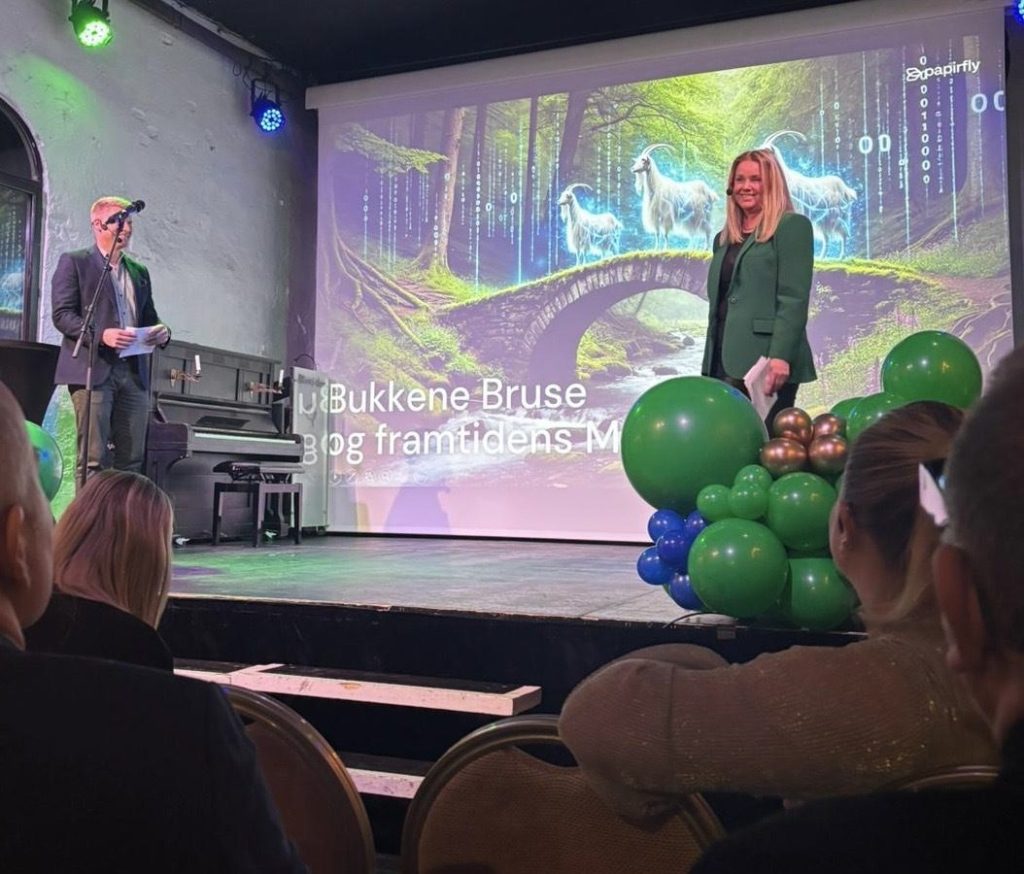
Papirfly and SAP recently joined forces to showcase an engaging discussion on SAP’s employer branding and employer ambassador program.
The session, led by Papirfly’s VP Marketing Siril Jacobsen and Nneka Mmeh, Global Employer Branding at SAP emphasised strategic collaboration and innovative approaches to employer branding. Papirfly’s brand management platform enabled SAP to harness the power of their workforce in storytelling, turning employees into brand champions.
This partnership not only enabled SAP to enhance their employer branding but also showcased the transformative impact of leveraging employee experiences in attracting and retaining top talent. The discussions provided actionable insights into
creating a compelling employer value proposition (EVP)
emphasizing the importance of inclusivity and employee empowerment in building a strong, engaging employer brand
The power of employee ambassadors
SAP’s journey into enhancing its employer branding strategy with Papirfly’s support shows a commitment to not only attract but also to nurture talent by fostering a culture of inclusivity and empowerment. The creation of an employee ambassador program exemplifies SAP’s innovative approach, leveraging the voices of its workforce to amplify the company’s values and culture. This initiative, driven by Papirfly’s brand management platform, enabled SAP employees worldwide to share their authentic experiences. As a result, it humanized the SAP brand and significantly improved its market positioning as an employer of choice.
Revolutionising talent attraction through brand consistency
The webinar highlighted the importance of brand consistency across all channels and the role of Papirfly’s platform in achieving this for SAP. By implementing a centralised employer brand management system, SAP was able to streamline its messaging. This ensured that the employer brand resonated well with its global audience. This strategic move not only enhanced the company’s visibility but also guaranteed that potential candidates received a coherent and compelling narrative about what it means to work at SAP.
Strategic insights for employer branding professionals
For employer branding professionals, the discussion provided invaluable insights into the strategic planning and execution of a successful employee ambassador program. From revamping the employer value proposition to leveraging social media and digital platforms for storytelling, the webinar offered a blueprint for organisations looking to elevate their employer brand.
The role of Papirfly in SAP’s employer branding success
Papirfly’s role in this journey was highlighted as more than just a platform provider. It was a strategic partner enabling SAP to leverage technology for brand management and employee engagement. The use of Papirfly’s solutions facilitated a seamless integration of brand assets, storytelling, and employee advocacy, setting a new standard for employer branding excellence.
Measurable success – the impact of SAP’s employer branding strategy
Increased engagement: SAP saw a remarkable increase in employee engagement on social media platforms, where ambassador content received higher interaction rates compared to standard corporate postings.
Improved talent acquisition: By leveraging employee testimonials, SAP saw a substantial improvement in its talent acquisition efforts. The data showed a notable decrease in time-to-fill for open positions. This highlights the effectiveness of a strong employer brand in attracting qualified candidates swiftly.
Enhanced employer brand perception: Surveys conducted before and after the implementation of the ambassador program indicated a significant improvement in SAP’s employer brand perception among targeted talent pools. The positive shift in perception reflects the impact of humanising the brand through employee narratives.
Greater employee retention: The initiative also played a crucial role in enhancing employee retention rates. By empowering employees to share their experiences and become brand advocates, SAP fostered a deeper sense of belonging and loyalty among its workforce. This contributed to a decrease in turnover rates.
Enhancing efficiency and savings: The financial efficiency gained through SAP’s partnership with Papirfly particularly highlighted a staggering $100,000 saved in potential agency costs in 2023. This reduction in potential expenses was achieved by utilising Papirfly’s platform for in-house brand management and content creation, bypassing the need for costly external agencies. The strategic approach not only streamlined SAP’s marketing expenditures but also illustrated the effectiveness of leveraging internal capabilities to foster a compelling and authentic employer brand. This also shows the tangible benefits of SAP’s innovative employer branding strategy
A blueprint for future success
The collaboration between SAP and Papirfly showcases the transformative power of employer branding when executed with strategic intent and the right technological support. For companies looking to attract and retain the best talent, the insights shared in this webinar serve as a blueprint for leveraging employee voices to create a compelling and authentic employer brand. To discover more about how SAP utilised Papirfly’s brand management platform to get set up for success watch the webinar in full.
Your Digital Asset Management guide to complete content control
Papirfly
15minutes read
This content has been automatically translated and may include minor variations.
If digital asset chaos is making your teams less productive and your brand less consistent, it’s time to look at Digital Asset Management (DAM). Our Digital Asset Management Guide is here with the full lowdown.
Digital Asset Management (DAM) is a structured and secure way of managing all your organization’s digital content. It eliminates the chaos of misplaced files, outdated visuals, and inconsistent messaging, delivering brand assets to your teams on a silver platter.
What are digital assets?
Digital assets are more than just files. They’re all the visual, audio, and design resources your business invests in creating – and which in turn create value for your business. From images to videos, campaign artwork to sales documents, every asset shapes how your organization looks and sounds. Managing them effectively protects your investment and your brand.
Files like images, video, audio, and artwork are digital assets. Anything you can use and combine to deliver strategic goals for your business. For example, by creating marketing collateral, employer branding materials, or ecommerce listings.
Why is Digital Asset Management important?
Your digital assets represent your intellectual property, creative investment, and brand identity. Without the right system, they’re vulnerable to loss, misuse, and inefficiency. And that puts your investment – and your reputation – in jeopardy.
With DAM, assets are securely stored and easily accessible, so everyone uses them correctly every time. Result: faster workflows, stronger governance, and greater brand equity.
What does DAM software do?
A DAM platform provides a single, centralized location to store, organize, and share your brand’s digital files. It replaces fragmented systems – like shared drives or departmental folders – with one intelligent hub built for marketing operations.
Key features include:
• Centralization for easy access across teams and regions
• Metadata and taxonomy for powerful search and discovery
• Permission controls to protect sensitive assets
• Workflow automation to accelerate review and approval processes
Four types of software for Digital Asset Management
Digital Asset Management software comes in several forms, each suited to different business needs and technical setups. Here’s how to tell them apart.
1. On-premise DAM
An on-premise DAM is software that you manage in-house and that’s installed in your organization’s IT infrastructure. You maintain full control over the system, handling updates, security, and performance internally. It puts a lot of responsibility on your shoulders, but can be beneficial for organizations with strict compliance requirements.
2. Cloud-based DAM
A cloud-based DAM (or cloud DAM) is hosted and managed by the software provider. You access it securely through the internet, while your vendor is responsible for all upgrades and maintenance – ideal for teams looking for flexibility and easy scalability. (We compare on-premise and cloud-based DAMs in more detail below.)
3. Enterprise DAM
An enterprise DAM is built for large, complex organizations that need advanced scalability and global brand governance. These systems typically include enhanced digital asset storage, global permissions, and localized support for multiple regions or teams. While the core functionality mirrors standard DAM systems, enterprise versions are optimized for performance and control at scale.
4. Headless DAM
A headless DAM is designed to operate quietly behind the scenes. It does not have a front end for accessing and managing digital assets but instead connects directly with other business systems, like Product Information Management (PIM), ecommerce platforms, or content delivery networks.
Why Digital Asset Management matters more than ever
Here are four key trends that are prompting modern businesses to switch to Digital Asset Management systems.
1. Demand for digital content has skyrocketed
From websites and social channels to intranets, third-party platforms, and traditional print – brands are producing more content in more formats than ever before. Without an intelligent way to organize and categorize assets, it’s easy for teams to lose track, duplicate work, or dilute the brand.
2. Remote work and collaboration have become standard
It is now common for global teams, freelancers, and partners to collaborate across time zones – and they can only do so effectively if they have easy access to the same assets.
A cloud-based DAM enables exactly that. Teams can find, share, and update approved materials anytime, without compromising compliance or version control.
3. Competition for people’s attention is getting fiercer
Digital content is exploding while attention spans shrink. In this world, you only have a few seconds to make an impact on consumers – and consistency and recognizability are two of your greatest brand assets.
DAM acts as your brand consistency software, giving every employee access to approved visuals, templates, and guidelines.
4. Cyber threats are growing more frequent and sophisticated
DAM platforms are built with encryption, permissions, and audit trails to keep digital assets protected. Teams have full control over who can access, edit, or share files.
Six essential features of Digital Asset Management – and how they benefit your business
1. Centralization and organization – one home for every asset
A DAM system serves as a single, centralized digital asset library. Instead of files being scattered across drives, inboxes, and third-party platforms, everything lives in one secure, searchable location. Automatic version control ensures everyone is working with the latest file. Built-in audit trails capture every edit and approval.
Key benefits: Control brand assets, eliminate duplication, and reduce usage errors.
2. Search and discoverability – find what you need, fast
What use is a digital asset library software if nobody can find their way around it? DAM uses metadata, taxonomy, and visual search to make every asset instantly discoverable.
Metadata adds context so assets can be found through multiple search routes – for example through product names, campaign tags, regions, or usage rights. Taxonomy gives your library logical structure. Visual thumbnails make searching easier by allowing users to preview files at a glance.
Key benefits: Boost productivity by saving many wasted hours spent searching for the right file.
3. Security and sharing – protect and control your brand’s IP
Brand assets are valuable intellectual property – and DAM protects them accordingly.
Granular permission controls ensure only authorized users can view, download, or edit specific assets. Encryption safeguards data in transit and at rest, while secure link sharing replaces risky transfers and expired downloads.
Key benefits: Ensure assets can be accessed by the right people – and only the right people.
4. Brand compliance, GDPR and regulatory obligations
Beyond security and sharing, a DAM plays a vital role in maintaining brand and regulatory compliance. With privacy laws and advertising standards tightening worldwide, brands need centralised control over how assets are stored, accessed and used.
By embedding consent information, expiry dates and usage rights directly into asset metadata, a DAM ensures teams only use approved, compliant content. Automated restrictions prevent expired or unlicensed materials from being published, while detailed audit trails capture every action for complete transparency.
Benefit: Reduce regulatory risk, ensure DAM GDPR compliance, and maintain customer trust through controlled, compliant asset management.
5. Collaboration and automation – work smarter, not harder
Today’s DAM systems are built for collaboration. Cloud-based access connects internal teams, agencies, and freelancers, enabling real-time feedback and faster approvals across time zones.
Automation features take efficiency even further. From AI-assisted tagging and automatic file conversions to fully automated workflows for publishing content, DAM removes repetitive manual work so your teams can focus on creativity and strategy.
Benefit: Enable seamless collaboration, reduce bottlenecks, and speed up time to market for every campaign.
6. Analytics – insight that drives smarter decisions
DAM analytics reveal which files perform best, who’s using them, and where gaps exist. This allows you to make data-driven decisions about future content investment and creation.
Benefit: Get clear visibility into asset performance, so you can continuously optimize your brand strategy and content spend.
Integrations – connecting your DAM to the tools that power your brand
Virtually any system that needs access to digital assets can integrate with your DAM – and your DAM can feed images, video, documents, and data directly to that system. Here are four of the most common types of DAM integration:
DAM + CMS
Integrating DAM with your CMS gives web editors advanced search and filtering tools – so they can quickly find the perfect assets to bring your website to life.
DAM + design software
Enable designers to browse, drag, and drop approved visuals directly from your DAM – without having to leave the window they’re working in.
DAM + PIM
Using a Product Information Management (PIM) system? Linking DAM and PIM lets you automatically pull product images into catalogs and ecommerce platforms, accelerating time to market.
DAM + CRM
Integrating with your Customer Relationship Management system allows teams to create brand-compliant assets faster, with content being automatically formatted for each channel.
Who uses DAM systems?
Marketing
Marketers use DAM to centralize, organize and categorize assets, ensuring everyone involved in campaigns can collaborate efficiently. Marketing asset management software gives creatives access to up-to-date assets and artwork, allows for rapid distribution to end users, makes it easier to manage event collateral, and enables you to automate workflows.
Creative agencies
Agencies use DAM to streamline and accelerate production processes and to protect and manage assets for different customers. Some even offer DAM services to customers as an additional revenue stream. Learn more about digital asset management for agencies
Content creators
For publishers and content creators, speed and accuracy are everything. A DAM provides a central hub to store, tag, and retrieve written, visual, and multimedia assets instantly.
Ecommerce and retail
Consumers buy with their eyes. By organizing product images, videos, and marketing visuals in a DAM, ecommerce and retail teams can ensure accurate, consistent, and high-quality presentation across websites, marketplaces, and campaigns.
Employer brands
DAM provides an employer branding platform for teams to manage recruitment campaigns and materials in one centralized asset library. It ensures every message, visual, and video reflects your company’s culture and helps create a unified candidate experience while also acting as an internal communications management tool.
Corporate brands
Consistency builds trust — and trust drives growth. That’s why corporate brands use DAM. By providing a single source of truth for brand guidelines, logos, templates, and visual assets, the system empowers people to represent the brand accurately, wherever they operate.
Make sure the right people access the right assets
Create bespoke hubs for your teams.
Make sure the right people access the right assets
When is the right time to invest in Digital Asset Management?
Every organization reaches a point when managing digital assets manually is no longer sustainable – and when a DAM goes from being a “nice to have” to business-critical. Here are eight signs you may have reached that point.
1. Your systems are slowing your teams down
Disorganized files, outdated systems, and endless searching are draining productivity. A DAM centralizes all your digital assets in one secure, searchable place, so everyone can get what they need – fast.
2. You need to cut costs, without cutting corners
A DAM accelerates and automates workflows, helping you increase operational efficiency and save precious time.
3. Your assets need stronger protection
A DAM’s granular access permissions will help you ensure only authorized users can view, edit, or download assets.
4. Your brand consistency is slipping
By providing a central source for approved brand assets, logos, and guidelines, a DAM helps every department stay on-brand.
5. You have remote working issues
A cloud-based DAM allows freelancers, agencies, and teams to collaborate seamlessly from any location.
6. Your current digital asset storage systems can’t keep up
Switching to a DAM enables you to handle thousands (or even millions) of assets without slowing down. The DAM scales with you, no matter how complex your operations get.
7. You need to raise your content game
A DAM system will enable you to create, distribute, and publish higher-quality content – at speed and at scale.
8. You’re digitizing your processes
Putting DAM at the center of your digitization strategy creates a foundation for smarter, faster, more connected operations.
The business case for Digital Asset Management
From reducing costs to accelerating go-to-market speed, DAM delivers benefits you can quantify and scale. Here’s how it pays off:
1. Greater operational efficiency
DAM streamlines processes across the board – from automating repetitive tasks like image resizing and file conversions to enabling seamless collaboration between global teams. No more duplicated effort, lost files, or “where’s the latest version?” messages. Everything lives in one organized, searchable system, ensuring assets move quickly from creation to delivery.
The impact: Accelerated digital asset management workflow, fewer manual interventions, and campaigns that launch on time and on brand.
2. Smarter resource optimization
DAM eliminates inefficiencies by giving teams instant access to approved assets. That means creatives spend more time creating, marketers spend more time strategizing, and every contributor focuses on work that drives business growth.
The impact: Greater productivity, higher engagement, and stronger returns from every role in your marketing, internal communications, and brand ecosystem.
3. Tangible cost savings
DAM doesn’t just help you achieve time and efficiency gains – it also directly reduces operational spend. For example:
Team members can find and repurpose existing assets, so they don’t have to create them from scratch
Enhanced visibility into your asset stock reduces the risk of duplicated work or purchases
DAM minimizes your risk of costly legal exposure
The impact: Real savings, reduced waste, and smarter reinvestment in content that performs.
The ROI of Digital Asset Management
Based on typical deployment and usage patterns, an average Papirfly customer achieves:
212% Return on Investment (ROI)
$1.17 million Net Present Value (NPV)
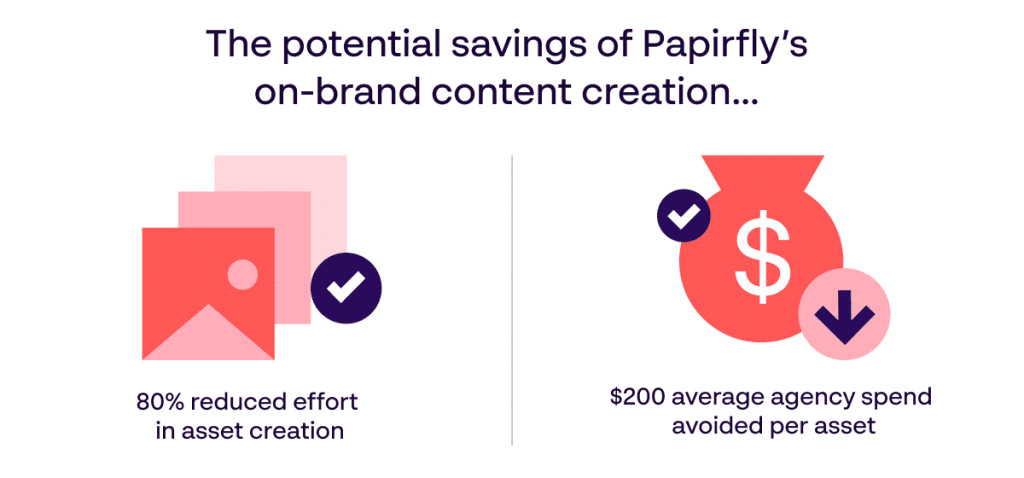
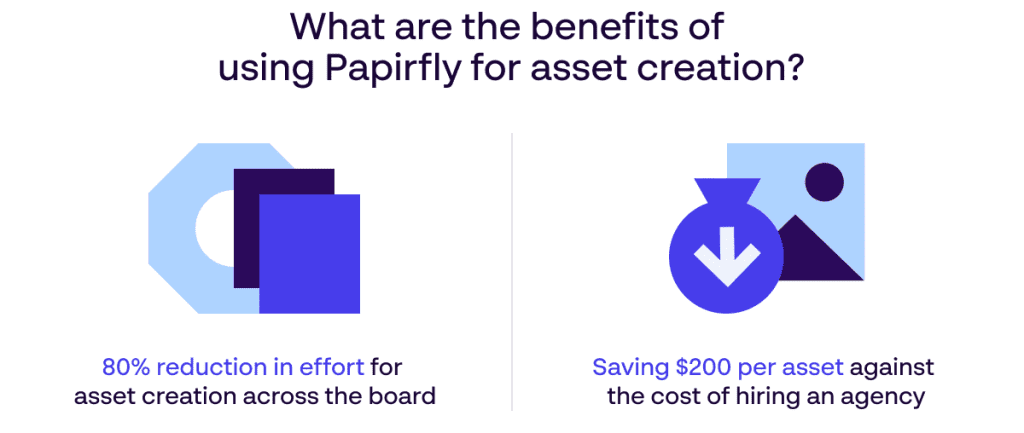
80% reduction in effort required for asset creation
$200 average agency spend avoided per asset
Payback period: under six months
Understanding the costs
We’ve included some typical DAM costs below. When planning your investment, it’s important to weigh these up against the cost of not having a DAM. How much time and money will your organization continue to lose by having disorganized assets?
Upfront costs –Mostly just for on-premise licenses and infrastructure setup
Subscription fees –Cloud-based models usually charge per user per month
Storage – Additional fees may apply for higher volumes
Number of assets – Some pricing models consider how many assets you need to store
Features and customization –Some advanced capabilities, customizations or integrations may incur extra cost
Maintenance and support –You may need to pay a monthly fee for technical support and training
Migration – You may choose to pay the vendor or a third-party to migrate your assets to the new DAM
In-house costs – Don’t forget to factor in-house costs like the time it will take to research and implement the system
How to choose and implement a DAM system
Selecting a DAM system is a major decision that should not be rushed. Here are some pointers to help you make the right choice – and make it count.
1. Define your requirements
DAM works best when it serves the whole organization, not isolated departments. Identify who will use the system, how they’ll use it, and what challenges it needs to solve.
Ask key questions:
What goals will the DAM support?
What types and volumes of assets will it manage?
Which workflows need automation?
Which existing systems (CMS, CRM, PIM, etc.) must it integrate with?
2. Research your options
With hundreds of DAM platforms available, research is essential. Don’t just rely on paid ads or surface-level comparisons. Instead:
Look for vendors with proven success in your industry.
Read independent analyst reports like The Forrester Wave™.
Check user reviews on trusted sites such as G2 or Capterra.
And remember – the best DAM for your organization isn’t necessarily the most expensive. It’s the one that fits your processes, culture, and future vision.
3. Test and compare
Once you’ve narrowed your list, arrange product demos and hands-on trials. Compare each system against your requirements document. Assess usability, performance, and overall fit for your teams.
You should also invite key stakeholders to join the demo sessions. Their input will ensure the system you choose supports every corner of your organization.
Beyond pricing and features, key elements to consider when assessing potential DAM solutions include:
Functionality
Start with the essentials: centralized storage, advanced search and filtering, permissions, and asset version control. Then look at more sophisticated capabilities such as automation, templating, and AI-assisted tagging. If you need your DAM to double as brand portal software or to connect with ecommerce systems, ensure those features are built in, not bolted on.
Scalability
DAM scalability is critical. Look for a solution that will effortlessly expand as your teams, regions, and content volumes grow. You should be able to add users, storage, and integrations without disrupting operations or budgets.
User experience
Even the most powerful DAM won’t deliver ROI if people don’t use it. The interface must be intuitive, visually clear, and easy to navigate. A good user experience encourages adoption and helps teams make the system part of their daily routine.
Integrations
A DAM should fit seamlessly into your existing tech ecosystem. Look for integrations with your CMS, design tools, CRM, or PIM systems to connect workflows and prevent duplication. This ensures assets flow smoothly between teams and channels.
Vendor support
Strong vendor support makes all the difference during setup and beyond. Ask about onboarding, self-service resources, and response times for technical issues. You want a partner – not just a provider.
Which is better? It all depends on how much control you need – and how much responsibility you’re willing to take on. Here’s a snapshot of how the two models compare:
On-premise DAM
Cloud-based DAM
Access
Restricted access
Anywhere access
Scalability
Limited by your in‑house storage capacity
In theory, unlimited storage, but with costs attached
Maintenance and updates
You are responsible for upgrades and maintaining the system
The provider is responsible for upgrades and maintaining the system
Security and control
Direct, maximum control
Reliant on provider
Customization
Customization options via your in‑house team – maximum flexibility but limited by IT capacity
Some customization usually availability via support request – may incur additional cost
Integrations
Via your in‑house team
Some available out‑of‑the‑box and others via your own team using APIs
Upfront costs
Bigger upfront costs – you buy the platform outright
Lower upfront costs – you buy subscriptions (seats)
Deployment
Slower due to need for infrastructure set up
Faster as minimal infrastructure needed – simply deployed online
Data sovereignty
Greater control over geographic location and data sovereignty
Less control over geographic location and data sovereignty
Access
On-premise DAM: Restricted access
Cloud-based DAM: Anywhere access
Scalability
On-premise DAM: Limited by your in-house storage capacity
Cloud-based DAM: In theory, unlimited storage, but with costs attached
Maintenance and updates
On-premise DAM: You are responsible for upgrades and maintaining the system
Cloud-based DAM: The provider is responsible for upgrades and maintaining the system
Security and control
On-premise DAM: Direct, maximum control
Cloud-based DAM: Reliant on provider
Integrations
On-premise DAM: Via your in-house team
Cloud-based DAM: Some available out-of-the-box and others via your own team using APIs
Deployment
On-premise DAM: Slower due to need for infrastructure set up
Implementing a Digital Asset Management (DAM) system is a big deal for your organization – a cultural shift in how everyone creates, manages, and protects content. Following these proven best practices will help you get the most out of your investment.
1. Be strategic from the start
Your DAM initiative should directly support your wider business goals. Whether you’re focused on improving efficiency, enhancing collaboration, maintaining brand consistency, or driving digital transformation, use your objectives to guide every stage of implementation.
2. Audit your assets and workflows
Your DAM provider will have a LOT of questions. Come prepared with knowledge of how many assets you have, where they live, how they’re used, and who needs access to them, as well as information on file types and workflows.
3. Don’t just replicate – innovate
This isn’t about digitizing the status quo. It’s about creating the kind of system you’d love to have. Speak with the teams who create, approve, and distribute content. What challenges do they have? Where do bottlenecks occur? What could be improved? You should also ask your DAM vendor how other customers use the software to see if there are any innovations you could adopt.
4. Plan for onboarding and training
However intuitive your new DAM system, users will still need training and support to use it effectively. Requirements will vary between user groups. For example, admins are likely to need hands-on workshops while casual users should be able to learn through video tutorials or quick-start guides. Create a communication and training plan to help you roll out your new software and get people excited about using it.
5. Commit to long‑term governance
Without regular maintenance, even the best-designed system can become cluttered and inefficient. Establish clear governance practices – and if your asset library is extensive, consider appointing a DAM manager or librarian. Their responsibilities should include:
Archiving outdated or redundant assets
Reviewing metadata and taxonomy for accuracy
Managing user access and permissions
Overseeing security and software updates
Monitoring usage and optimizing performance
The future of AI‑powered Digital Asset Management
DAM systems speed up manual, time-consuming processes – and, with intelligent automation, they’re doing it faster than ever. Here are three ways that AI is shaping the next generation of Digital Asset Management.
1. Smarter metadata through AI auto‑tagging
Modern DAM systems handle one of the most important yet repetitive asset management tasks automatically via AI metadata tagging. AI asset management software can instantly recognize an image, video, or document and apply meaningful tags that describe its content, even during bulk uploads of thousands of files.
The impact: Faster uploads, consistent metadata, and a stronger foundation for content discovery.
2. AI-powered search and recommendations
Search within DAM is evolving from reactive to predictive. AI algorithms now analyze user behavior – from search patterns to content engagement – to deliver smarter, personalized recommendations. Instead of typing in the perfect keyword, users are guided to the assets most relevant to their role, project, or past activity. This means less searching, more discovering, and far greater productivity.
The impact: Assets find you – not the other way around.
3. Generative AI within DAM
Generative AI is the next frontier. While some DAM systems already use it to make light edits, the technology is rapidly expanding in scope. Soon, users will be able to create new assets directly within their DAM environment. Imagine using a brand video maker or image generator to generate campaign variations and localized content in seconds.
The impact: A future where DAM doesn’t just manage content – it helps create it.
Beyond this Digital Asset Management guide – take control!
If digital asset chaos and constant approval bottlenecks are slowing your organization down, a next-generation DAM like Papirfly could be the solution. Organize and showcase your brand, create content on-demand, and scale global governance.
Take the next step on your DAM journey
Discover how Papirfly helps brands manage and scale content.
Take the next step on your DAM journey
Discover how Papirfly helps brands manage and scale content.
Why responsible AI adoption matters for your brand’s reputation
Papirfly
5minutes read
This content has been automatically translated and may include minor variations.
Every week, new AI tools and use cases hit the market. AI for branding and marketing teams can be an exciting prospect, as new ways to work and collaborate are discovered, leading to dramatic time and cost savings and turbocharged creative capacities.
At the same time, however, the rush to invest in or use free online AI solutions can backfire if care isn’t taken, with potentially huge consequences for teams and their businesses.
Amongst the new AI tools on the market, Generative AI (GenAI) is particularly important for brand marketing. As with the popular ChatGPT and Midjourney tools, GenAI allows users to describe tasks and let powerful computers get on with generating outcomes.
These could be AI generated images and brand assets, customer support messages, or new campaign ideas.
For brand teams interested in crafting iconic and trusted brands in the mid 2020s and beyond, the time for getting to grips with these technologies is now.
AI, brand reputation and trust
A survey of communications professionals found that, while almost 86% were optimistic about the potential of AI, 85% were also concerned about the legal and ethical issues.
AI adoption creates opportunities but also seeds new challenges, problems, pitfalls and risks. Customers are curious, but also anxious about what the implications of these new technologies will be for their lives.
Over the coming years, how companies use their AI tools will have a direct impact on their reputation, how much customers trust them, and how markets treat them.
Modern brands should be aiming to use these new technologies to create real value for customers, businesses and society. It starts with knowledge, understanding, and careful planning.
Establishing trust in uncertain times
Customer trust has long been understood to be at the core of successful branding. As consumers we simply like to spend our money with brands that we believe in.
Research also shows that customers who trust a brand are three times as likely to forgive product or service mistakes. [Source: Edelmen]
When it comes to adopting AI tools, it’s therefore important to ask yourself the question – is our company using AI in a way that builds customer trust? Or could our choices be doing the opposite?
Sparebank found this out the hard way, when it came to light that the Norwegian bank had used an AI generated image without being labelled as such.
This broke legislation on misleading marketing, which requires that subjects used in ads be real users of the product or service. It also potentially contravened Norwegian regulations on image manipulation, which require that images that have been airbrushed or edited are clearly marked in order to reduce pressure that could lead to shame or body dysmorphia.
The result was a media storm, in which Sparebank were forced to publicly admit their mistake and promise to take more responsibility in future.
The lesson? New capacities created by AI tools might seem great on paper, saving time and money and helping to bring new creative ideas to life. However, if they contravene legislation or prevailing social norms, the best intentions can quickly backfire.
Respecting privacy with AI technologies
How many people are currently using ChatGPT at work, unaware that information entered into its prompt box is technically in the public domain?
With most companies building their AI tools on the back of third-party machine learning algorithms, complex issues are raised around data protection and privacy. Without proper assessment and training, well-meaning employees may end up breaching GDPR and other data-protection regulations without realising.
Until regulators and legislators catch up with AI technologies and provide clear and unambiguous guidelines, this is a potential minefield for brand reputation.
Companies need to take care not to intrude into their customer and employee’s private lives in ways that overstep reasonable boundaries.
Consider that, as tools get more powerful, brands will be able to advertise and persuade us with increasingly subtle and powerful strategies. Where is the line drawn between personalised, data-driven marketing and outright manipulation?
Or consider that there is at least one AI wellbeing tool in development that purports to allow companies to track productivity alongside employee wellbeing. All good – but what if the algorithm shows that employee productivity drops beyond a certain degree of wellbeing?
These might be speculations, but they could very soon become realities. As the famous theorist Paul Virilio once remarked, “the invention of the ship was also the invention of the shipwreck.”
Companies need to tread carefully to ensure that good intentions don’t accidentally lead to intrusive or manipulative practices, which, once publicly exposed, will meet with an understandable and expected backlash.
Implementing ethical AI solutions
With all this said, what can companies do to minimise the risk and maximise the value that AI can contribute to customers, employees, and society?
We can begin with a simple principle of humility. Despite our best attempts to guess, no-one knows for certain what the impact of AI will be. As we saw with Sparebank, what likely began as a reasonable business intention – “let’s use these new tools to save time and money” – quickly turned into a public scandal.
Sparebank quickly admitted it got it wrong, which may in the long run work to its favour. In times of uncertainty and change, transparency and honesty go a long way towards (re)building trust.
Brand teams should keep this in mind. Over the coming years, more companies are likely to have their reputations tested as they experiment with AI technologies. The most successful will find ways to innovate, while maintaining respect for their customers and sensitivity to when ethical lines are crossed.
Creating an ethical charter is one way that companies can ensure their intentions are aligned with positive societal outcomes. An ethical charter defines clear values for how AI should be used, providing a framework for decision making when boundaries get murky and regulations aren’t much use.
Be a good corporate citizen when it comes to the rightful privacy of our users
Ensure we act in an unbiased manner – always – as we’d expect to be treated too
Build in the highest level of explainability possible, because output is important
Overall, our task is simple – we must build technology that is designed to do good
Within each of these principles are further specific guidelines for how AI should be built and used within our business.
Naturally, ethical charters will vary from company to company to reflect their specific needs and markets. The aim should be to create a strong company culture, laying the foundations for ethical decision making and a reputation that customers can always trust.
Towards an AI powered future
Artificial intelligence depends on responsible humans making clear decisions within strong ethical frameworks.
To learn about how Papirfly is ethically innovating the challenges of branding and AI, check out these links.
At Papirfly, we are committed to using AI to enhance every user’s experience, all while continuing to empower the world’s biggest brands with our all-in-one brand management platform.
Learn about how Papirfly is ethically innovating the challenges of branding and AI.
Papirfly unveils seamless integration with Ungapped
Papirfly
2minutes read
This content has been automatically translated and may include minor variations.
In an exciting development for marketing and brand professionals, Papirfly, the renowned brand management platform, has announced an integration with Ungapped, the user-friendly communication platform equipped with a variety of marketing tools.
This collaboration promises to streamline brand consistency and enhance user experiences for both Papirfly and Ungapped users.
A hub for marketing excellence
Ungapped is a Swedish digital communication platform that caters to various marketing needs, including email marketing, SMS campaigns, event management, surveys, and marketing automation. The platform is also hosted on GDPR-compliant servers. The new integration allows users to easily pull assets from Papirfly’s Digital Asset Management solution, Place, and integrate them seamlessly into their marketing campaigns in Ungapped.
The integration between Papirfly and Ungapped introduces the ability to find, select, and retrieve assets from Place directly within Ungapped. This integration web plugin bridges the gap between brand management and marketing automation, making it easier than ever to maintain brand consistency throughout marketing materials.
How the integration benefits marketing users
Seamless asset retrieval: Users of Ungapped can now seamlessly access assets stored in Place through Papirfly’s integration. This streamlines the workflow, ensuring that marketing materials are consistently on-brand.
Time efficiency: With the integration to Papirfly’s Place, marketers can save valuable time by eliminating the need to switch between platforms. This streamlined process allows them to focus on creating engaging on-brand content and campaigns.
Brand consistency: Maintaining brand consistency is paramount for businesses. The integration ensures that all assets used within Ungapped adhere to brand guidelines, promoting a cohesive brand identity.
Enhanced user experience: Users of both platforms will benefit from the convenience of this integration, resulting in a more user-friendly experience and greater productivity.
In a world where branding and marketing are more critical than ever, the Papirfly-Ungapped integration represents a significant step forward. It empowers businesses to manage their brand with precision while efficiently executing marketing campaigns. With this partnership, users can look forward to a future where brand consistency and marketing automation seamlessly coexist, ultimately driving success and growth for their organisations.
AI beyond the hype – Staircases to (AI) Heaven and Hell
Papirfly
4minutes read
This content has been automatically translated and may include minor variations.
We’ve looked at a number of areas where Artificial Intelligence will drive real and meaningful change in this AI-Illuminate series. We’ve looked at how Hollywood has convinced us of eternal doom, we’ve considered how machines will rid us of meaningless tasks, and we’ve discussed ways that Machine Learning might not build Society 2.0 as equitably as we’d like.
But as with all situations, there are two sides to the coin.
The Staircase to (AI) Hell
Let’s start with the depressing take on the journey ahead. Introducing the Staircase to (AI) Hell.
Beginning with ‘simple automations’ doesn’t feel that scary. Human beings are inherently lazy, we don’t generally like repetitive things, and if there’s a faster way to do something we’ll usually opt for it. Enter the robots! It’s easy to envisage a world where anything even remotely repetitive is simply done by a machine.
Even as we move to the next ‘step’ of the staircase, and we start to see some ‘low priority’ jobs being replaced, most people have little-to-no concern yet. Perhaps because most people discussing the AI debate right now consider their own jobs to be higher priority.
As we approach the step where Deep Learning can do a lot of things better than humans, we end the ‘light blue’ section of this staircase and start entering darker territories.
The first real grey area is the point in time where Deep Learning transfers billions of tasks from humans, replacing hundreds of millions of jobs. We’re no longer ‘just’ talking about the jobs most people think are not theirs – we enter a period of wholesale change with white-collar and blue-collar jobs equally threatened. What do the newly-unemployed do? How do they survive?
As we enter the ‘dark blue’ steps of the staircase we see General Artificial Intelligence (AGI) surpassing most abilities of most humans, which then leads to the point of ‘Singularity’ where machines become too powerful for their human creators to control.
At this point it really is humans vs. robots and, by all accounts, we don’t look set to win.
It is somewhat depressing.
Who can save us?
The Staircase to (AI) Heaven
I believe we can, as is common with many of the debates around AI, look to the past for our saviour. Isaac Newton to be precise. In Newton’s Third Law, he stated that for every action in nature there is an equal and opposite reaction. So perhaps we can turn the Staircase to (AI) Hell into a Staircase of (AI) Heaven? What could that look like?
Well, in Newton-friendly terms, it’s equal and opposite. When we flip the pyramid upside down, we start with the same simple automations that help us humans not have to do the boring things we don’t want to do. This, in itself, can only be a good thing. More efficiency can definitely help us focus on other things. It could likely also be part of the solution to some of our big global problems like waste and the distribution of equitability.
As we progress through the next two steps, there’s a positive to each too.
Complex AI replacing ‘low priority’ jobs is fine if what we mean by ‘low priority’ jobs are jobs humans are not very good at, where it’s dangerous to their health, or where we expend resources doing things unnecessarily. As long as we start to migrate those same displaced people into new, better, roles and / or find ways to replace their income.
Likewise, where AI can do things better than humans, let’s use AI. Of course it makes sense. If a machine is 10x more accurate at doing something, let the machine do it. Where a human+machine combination excels, like in the visual detection of some cancers, then let’s make it happen. Again, we just must not forget to plan for the displaced. Is it time to look at Universal Basic Income (UBI) models again, for example?
Where that displacement of jobs becomes wider and deeper, we do need to be ready. If AI is set to change a billion jobs within the decade, as some academics predict, our policymakers, lawmakers, and politicians need to be working on Plan B now. If we are to leverage the opportunity of the technologies we have created, we need to be ready.
We’ve been here before. The agricultural revolutions of the 19th Century – forever changing what farm labour looked like through the introduction of machinery – are the very reason we’re all able to sit here and read this article when we’d otherwise be out bringing in the harvest so our families could eat. I love the countryside but I’m very grateful for the historic jobs displacement that means I don’t need to grow my own wheat every year.
Daring to dream of AI’s future
The next few steps on the Staircase to AI Heaven are not filled in yet. We don’t know what the future will hold – but we can dare to dream…
Eradicating waste. Making human error a thing of the past, being able to predict things perfectly. Transforming health outcomes. Increasing quality of life for everyone. Curing cancer. Moving beyond fiat money. Driving equitability. Understanding where we come from. Closing the income gap. Working globally as one. People living longer. The end of discrimination. Solving the climate crisis.
It might not all be possible – and certainly not within our lifetimes – but it’s a wonderful AI Heaven to believe in.
This content has been automatically translated and may include minor variations.
In part 3 of this series we explored the Three Pitfalls of AI – privacy, replication, and bias. Each pose significant threats to how we live and work today, barriers to mass adoption of machine intelligence, and complex questions about safety and regulation.
That said, the opportunities AI promises are equally significant. We are likely at the start of a fourth industrial revolution and – even if we don’t know exactly how yet – artificial intelligence is going to change a lot (if not everything).
Operating in a new world without new regulation, the onus on companies like Papirfly – building the technology of tomorrow – to self-regulate becomes critical. Good corporate citizenship, acting responsibly, and pursuing opportunities ethically all require guidance and leadership.
To help our people make promises to our customers and our users about how we’ll build our software, we have created our Ethical Charter.
Comprising eight action statements within four ethical themes, it governs how we – as a company – will build technology, and it sets out a pledge for how we will put users at the heart of doing so.
Today we publish it openly.
Papirfly’s Ethical Charter
Be a good corporate citizen when it comes to the rightful privacy of our users
1. We must always obey local, regional (including GDPR), and international privacy laws. Beyond the question of legality, we must always treat users ethically too. This includes creating AI applications that do not invade their privacy, do not seek to exploit their data, do not collect any data without express (and understood) consent, and do not track users outside of our own walled garden. We do not need data from the rest of their activities, so we should not seek to obtain and use it.
2. We do not, as a hard rule, use data to create profiles of our users to facilitate negatively scoring, predicting, or classifying their behaviours. We must never use their personal attributes or sensitive data for any purpose. Neither of these tactics are required for us to make better software for them (which is what we are here to do) and so it is inappropriate. We must always understand where our ethical red line is and ensure everything we do is on the correct side of that.
Ensure we act in an unbiased manner – always – as we’d expect to be treated too
3. We acknowledge that there can be unacceptable bias in all decision making – whether human or machine based. When we create AI applications we must always try to eliminate personal opinion, judgement, or beliefs; whether conscious or otherwise. Algorithmic bias is partially mitigatable by using accurate and recent data so we must always do so. Remember, a biased AI will produce similar quality results as a biased human – “garbage in, garbage out” applies here, always.
4. We must use AI to augment good and proper human decision making. We do not want, or need, to build technology to make automated decisions. As in other areas of our business, like recruitment, we have not yet proven the strength of affirmative action (sometimes called positive discrimination) and, so, mathematical de-biasing is not considered an option for us. As such, all decision-making inside any application must include humans. Their skillsets, experience, and emotional intelligence can – and should – then be added to by AI.
5. We work to the principle of “you get out what you put in” and understand that in order to build technology for the future we can neither only look to the past (using out of date data, for example) nor build AI on top of existing human biases. Gender, ethnicity, age, political and sexual orientation bias (this list is not exhaustive) are all discriminatory and we must proactively exclude this human trait of today and yesterday in our search for technology solutions of tomorrow.
Build in the highest level of explainability possible, because output is important
6. We are not interested in only building black box solutions. If we can’t create defendable IP without doing so then we’re not doing our jobs properly. We want to, wherever possible – and always when possible – be able to explain, replicate, and reproduce the output of a machine we have built. We owe this to our users and it’s also how we’ll get better at what we do. The better we understand what we are building the quicker we can evolve it.
7. We actively subscribe to the “right to explanation” principle championed by Apple, Microsoft, and others. We must build applications that give users control over their personal data, determine how decisions have been made, and be able to easily understand the role their data has in our product development. We can do this without affecting our ability to defend our IP and, therefore, should do so as a default. Whilst full replication is not always possible (within deep neural networks, for example) our mission – and policy – is to do as much as we feasibly can.
Overall, our task is simple – we must build technology that is designed to do good
8. Technology is a wonderful and powerful thing. As a software company, we must believe that. But behind any, and every, application for good there are usually opportunities for evil too. As we depend more and more on AI it will take on a bigger role inside our organisation. As we craft and hone it, it is our responsibility to put ethics at the forefront and build responsibly. For now, we are our own regulators. Let’s be the best regulators we can be.
Moving forward with ethics at the heart of AI innovation
At Papirfly we have defined an Ethical Charter that governs what technology we build, how we build it, and the ethical parameters within which we build it. In Part 5 of this series we’ll provide a comprehensive analysis of various scenarios related to AI, highlighting both the benefits (“heavens”) and potential drawbacks (“hells”). This balanced perspective will present a clear view of AI’s capabilities and limitations.
This content has been automatically translated and may include minor variations.
You don’t have to look far to feel the air of AI-scaremongering. Robots coming for our jobs, AGI (General Artificial Intelligence) surpassing human ability, reaching the point of ‘Singularity’ – the hypothesis that AI will become smarter than people and then be uncontrollable, and the end of humankind as we know it. Movies like The Terminator, Minority Report, and Ex Machina have Hollywoodified Earth’s surrender to technology for years now.
When you ask corporate leaders about the risks AI present to their organisations, you tend to get similar answers based on similar themes:
What about copyright and intellectual property?
What about job displacement and human capital?
Are we at the start of a machine-led world?
Are we at risk of machine intelligence replacing human intelligence?
How do we compete against infallible machine intelligence?
How do we move fast enough to mitigate the risk of being out-run?
Who wins in the end – us, our competitors, new entrants, or AI generally?
Who can be trusted to regulate this new world?
Each of these questions can be unravelled to create opportunity alongside risk, but many leaders currently find it hard to differentiate. There is so much noise. There is still a talent gap – it’s estimated we need 10x the computer science graduates we have today in order to meet the hiring plans already announced by major software companies. The rapidity of change is increasing faster than existing operational models, such as fiscal years or quarterly reporting, were designed for.
This means, in all likelihood, that we must look elsewhere for a rational and unencumbered view. Let’s look at what academics have reached agreement on.
Academics don’t routinely agree with each other but for the past decade thought leaders from the biggest and best technology education institutions (including Massachusetts Institute of Technology [MIT], University of Oxford, Stanford University, Indian Institute of Technology, National University of Singapore, etc) have settled on the Three Pitfalls of AI as being Privacy, Replication, and Bias.
Privacy
Defined as the ability of an individual or group to seclude either themselves (or information about themselves), and thereby be selective in what they express, privacy is a phrase we’re all familiar with. The domain of privacy partially overlaps with security, which can include the concepts of appropriate use and protection of information.
But the abuse of privacy can be more abstract. Consider the (existing) patents that connect social media profiles with dynamic pricing in retail stores. The positioned use case is usually a discount presented to a shopper because the retailer’s technology knows – from learned social media data – that they are likely to buy if presented with a coupon or offer. This feels win-win for both parties and therefore the data shared feels like a transactional exchange rather than a privacy intrusion.
However, where that same technology can be used to inflate the price of a prescription for antidepressants – because the data tells the retailer’s system that the shopper is likely struggling with their mental health – it quickly becomes apparent that the human cost of privacy abuse could be very high indeed.
Privacy is considered one of the three pitfalls of AI because data (and so often personal data) is so intrinsically linked to machine intelligence’s success. The conversation around who owns that data, how that data should / should not be used, how to educate people about the importance of data, and how to give users more control over the data has been happening in pockets (but far from all) of society for a long time. As AI advances, it’s widely acknowledged that this area has to evolve in tandem.
Replication
The inability to replicate a decision made by Al – often referred to as a ‘black box’ – occurs when programmers and creators or owners of technologies do not understand why their machine makes one decision and not another.
Replication is essential to proving the efficacy of an experiment. We must know that the results a machine produces can be used consistently in the real world, and that they didn’t happen randomly. Using the same data, the same logic, and the same structure, machine learning can produce varying results and / or struggle to repeat a previous result. Both of these are problematic – and can be particularly troublesome when it comes to algorithms trained to learn from experience (reinforcement learning) where errors become multiplied.
The ‘black box’ approach is often excused by claiming IP protection or ‘beta’ status of products. But the prolonged inability to interrogate, inspect, understand, and challenge results from machines leads to an inability for humans to trust machines. Whether that’s confusion about how a lender has credit-scored your mortgage application, or something even more serious like not being able to prove that a prospective employer has used machine learning to discriminate against a candidate.
Replication is considered one of the three pitfalls of AI because we need to know we can trust AI. For us to trust it we need to be able to understand it. To be able to understand it we need to be able to replicate it.
Bias
“A tendency, inclination, or prejudice toward – or against – something or someone” is how bias is usually defined. Today, Google has more than 328m results when you search for “AI bias”. Unfortunately AI and bias seem to go hand-in-hand with a new story about machine intelligence getting it (very) wrong appearing daily.
As the use of artificial intelligence becomes more prevalent, its impact on personal data sensitive areas – including recruitment, the justice system, healthcare settings, and financial services inclusion – the focus on fairness, equality, and discrimination has rightly become more pronounced.
The challenge at the heart of machine bias is, unsurprisingly, human bias. As humans build the algorithms, define training data, and teach machines what good looks like, the inherent biases (conscious or otherwise) of the machines’ creators become baked-in.
Investigative news outlet ProPublica has shown how a system used to predict reoffending rates in Florida incorrectly labelled African American defendants as ‘high-risk’ at nearly twice the rate it mislabeled white defendants. The system didn’t invent this bias – it extrapolated and built upon assumptions programmed by its creators.
Technologists and product leaders like to use the acronym GIGO – ‘Garbage In, Garbage Out’ – and it absolutely applies here. When we train machines to think, all of the assumptions we include at the beginning become exponentially problematic as that technology scales.
Replication is considered one of the three pitfalls of AI because technology is often spoken of as being a great ‘leveller’, creating opportunities, and democratising access. But so long as AI bias is as bad as, or worse than, human bias, we will in fact be going backwards – with large sections of society disadvantaged.
Responding to AI’s challenges
Each of these Three Pitfalls of AI are serious and they have attracted a lot of attention – including from the leaders of the very companies at the forefront of AI’s development and evolution. When more than 1,100 CEOs wrote the now-infamous open letter calling for a halt to AI development they were essentially asking for time for humans to catch up and think about the possible consequences of our actions.
There are further questions about regulation – with lawmakers struggling to keep up with the rate of change. Trust of politicians remains stubbornly low globally and the public is also hesitant to trust a small group of technology company billionaires with what realistically could be existential threats to parts of how we live today. But self-regulation is where we are at currently and that means it comes down to individual technology creators to build responsibly and ethically.
At Papirfly we have defined an Ethical Charter that governs what technology we build, how we build it, and the ethical parameters within which we build it. In Part 4 of this series we’ll share our Ethical Charter and demonstrate how it works in our company.
AI beyond the hype – “AI was invented in December 2022…right?”
Papirfly
6minutes read
This content has been automatically translated and may include minor variations.
Cast your mind back to the end of last year and think about your Instagram, Facebook, and Twitter (as it still was) feeds. If they were anything like mine they were likely full of friends’ AI-generated photos. Or, at least, the ones that made them look smarter, prettier, taller, thinner, etc. Generative AI had exploded into the mainstream.
You could be forgiven for thinking it was invented around then too – and are possibly surprised to know that Artificial Intelligence is as old as the aunties and grandmothers who asked you about it around the dining table at Christmas 2022.
Putting AI to the test
AI is around 70 years old. Its roots can be traced back to Alan Turing (of ‘The Imitation Game’ fame), the British WWII codebreaker. Turing was a leading mathematician, developmental biologist, and a pioneer in the field of computer science. His earliest work created the foundations for AI as we know it. His eponymous test, The Turing Test (created in 1950), tests a machine’s ability to exhibit intelligent behaviour equivalent to, or indistinguishable from, that of a human.
Turing proposed that a human evaluator would judge natural language conversations between a human and a machine designed to generate human-like responses. The evaluator would be aware that one of the two partners in conversation was a machine, and all participants would be separated from one another.
The conversation would be limited to a text-only channel, such as a computer keyboard and screen, so the result would not depend on the machine’s ability to render words as speech. If the evaluator could not reliably tell the machine from the human, the machine would be said to have passed the test. The test results would not depend on the machine’s ability to give correct answers to questions, only on how closely its answers resembled those a human would give.
A thought experiment
The Golden Age of AI followed, spanning roughly 1956-1976. During this period, scientists and researchers were optimistic about the potential of AI to create intelligent machines that could solve complex problems by matching human intelligence – or even surpassing it.
Whilst the era fizzled out it delivered many a ‘first’ that still holds value today. ChatGPT’s ‘great-great-grandmother’ could be considered to be ELIZA – one of the first chatbots (then called ‘chatter bots’) and an early passer of The Turing Test, which was created from 1964 to 1966 at MIT by Joseph Weizenbaum.
Moving into the next decade, John Searle (a prominent American philosopher) set the tone with his Chinese Room Experiment theory. Searle proposed the Chinese Room Experiment as an argument against the possibility of Al, aiming to illustrate that machines cannot have understanding.
Searle uses the following scenario to demonstrate his argument:
“Imagine a room in which a man, who understands no Chinese, receives, through a slot in the door, questions written in Chinese. When he receives a question, the man carefully follows detailed instructions written in English to generate a response to the question, which he passes back out through the slot. Now suppose the questions and responses are part of a Chinese Turing Test, and the test is passed”.
Chess and penguins
The years that followed this ’downer’ of a start to the 1980s were low in ambition and confined to what we now look back as ‘Behavioural AI’. Knowledge based systems, sometimes called ‘expert systems’, were trained to reproduce the knowledge and / or performance of an expert in a specific field. They mostly used the “if this then that” logic flow and they didn’t always get it right – with the identification of penguins (birds but flightless birds) being an oft-cited example of basic errors of the time.
This era produced a few big wins – especially in the efficiency space, like Digital Equipment Corporation’s ‘RI’ application which saved it $40m per year by optimising the efficiency of computer system configurations. But it was prior to the advances of computerised automation which really made corporate adoption commonplace. It’s also acknowledged to be the period of time that birthed the first bias in AI.
A lot happened in the world of AI in the 1990s – seeing major advances in defence, space, financial services, and robotics. So it’s perhaps surprising that most AI historians and computer scientists point to the same turning point for machine intelligence. In 1996 ‘Deep Blue’, a chess-playing computer from IBM, beat then-champion Garry Kasparov. Prior to this, chess had been singled out as a ‘frontier’ for machine vs. human intelligence, with many people believing the human brain to be the only one capable of mastering a game with between 10¹¹¹ and 10¹²³ moves. (A ‘googol’, being the inspiration behind Google’s name, is 10 to the 100th power, which is 1 followed by 100 zeros). Machine intelligence had arrived.
A new era emerges
As the use of computers in domestic settings proliferated, there was an exponential surge in Internet usage in the mid-1990s, with the last few years of the decade renowned today for the dotcom bubble (1995–2000) and its ultimate implosion. Throughout this time AI took a backseat in social contexts, despite already starting to power many consumer applications and early-version software, websites, and applications. Commercially the focus was on automation and efficiency. Neither of which were particularly “sexy” or fun.
Enter…the self-driving car. A longheld obsession and science fiction staple, the period between March 2004 and October 2005 was to become the start of a whole new age. The DARPA Grand Challenge was a competition for autonomous vehicles funded by the Defense Advanced Research Projects Agency, the research lead within the United States Department of Defense. The race saw 21 teams, each with their own self-driven vehicle, prepare to compete in a race spread out over 150 miles / 240km.
A grand total of zero entrants finished the race in 2004. But in the 2005 race, five vehicles successfully completed the course. Of the 23 entrants, all but one surpassed the 7.32 miles / 11.78 km distance completed by the best vehicle in the 2004 race. The winner on the day was Stanley (named by its entrants, the Stanford Racing Team) but the overall winner was AI itself, with optimism levels rallying and the machine intelligence conversation building in reach and volume.
Humanoid robots and sci-fi dreams
In the late 2000s, AI entered its ‘modern era’. A number of humanoid robots brought AI closer to science fiction, driverless car projects became abundant, AI was being built into consumer and commercial applications, and the Internet of Things (IoT) emerged – with the ratio of things-to-people growing from 0.08 in 2003 to 1.84 in 2010 alone.
The 2010s were really where we saw mass proliferation of AI in society. When we think about the mainstream tech we take for granted today much of it was born (or matured) in this decade. Virtual assistants like Siri. Machine learning tools. Chatbots capable of human-quality conversation. Mobile phone use cases. Photography aids. In-car innovations like satnav and cruise control. Smart watches. Smart appliances. Real-time share trading platforms that everyone can use, not just financial giants. Even the humble product recommendation engine. They all use AI.
We arrived in to the 2020s with 70 years’ build-up in artificial intelligence, machine learning, and deep learning. The past few years have seen significant advances and the next few will undoubtedly too.
Embracing AI’s evolution
When you next ask ChatGPT to write that report for you, when you use Papirfly’s Generative AI to create hundreds of illustrations in an instant, or you think about the potential pitfalls of AI (we’ll address these in an upcoming article) do remember that we’re not dealing with a brand new toy here.
Instead, we are working with technology that started its journey in the 1950s. A journey that has seen an amount of change its early creators could never have predicted in their wildest dreams, and one that is likely to transform almost every aspect of human life in the next decade.
This content has been automatically translated and may include minor variations.
When it comes to managing digital assets, compliance with data privacy regulations like GDPR is no longer optional – it’s a business necessity.
Marketing teams today work with thousands of brand visuals, campaign photos, and video clips. Many of these contain identifiable individuals, meaning they fall under the scope of personal data. Without a clear way to track consent, companies face serious risk: reputational damage, regulatory fines, and a breakdown in brand trust.
What is GDPR and how does it impact managing digital assets?
The General Data Protection Regulation (GDPR) is a European Union law that sets out guidelines for the handling of personal data. It mandates that any organization processing personal data must do so transparently, lawfully, and securely – and it applies whether the company is located in the EU or not.
In practical terms for marketers and brand managers, that means:
You must have consent for using images where individuals are identifiable.
Consent must be clear, documented, and retractable at any time.
All data subjects have rights – including the right to withdraw consent.
Managing these obligations manually is time-consuming and error-prone, especially if you’re working across global teams and multiple campaigns. A GDPR manager tool reduces the effort and eliminates the risk by streamlining consent collection, tracking, and removal.
How Papirfly simplifies GDPR compliance in DAM
Papirfly is the leading Digital Asset Management solution for having a built-in GDPR manager tool, designed for organizations that use imagery featuring real people. The GDPR manager tool enables users to create “photo sessions”, meaning they can track and store information about every individual captured in an image.
Key features include:
Consent status at a glance: Instantly view who has given, denied, or withdrawn consent.
Automated withdrawal: If a data subject withdraws consent, the system ensures related assets are flagged and removed from use.
Centralized compliance: All consent records are stored securely, with audit trails for regulatory checks.
User training: The tool can provide employees with guidance on how to manage consent and respond to requests from subjects about their personal data.
Why GDPR automation matters in content creation
When creating marketing materials at scale, it’s easy for outdated or non-compliant images to slip through. Papirfly’s Templated Content Creation tool eliminates this risk by connecting directly to the GDPR manager in your Digital Asset Management system. The result is that every image available in a template has already been cleared for use. No guesswork. No legal risk.
This means:
Local teams can create content confidently, without worrying about consent status
Central teams maintain full visibility and control over image usage
Your brand stays protected – everywhere it appears
Reducing risk by building consent management into your DAM
Data privacy isn’t just a legal obligation – it’s a matter of brand equity. Customers, employees, and stakeholders expect their data to be handled with care. Missteps in this area can lead to loss of brand reputation and trust that’s hard to regain.
By embedding consent management into your DAM:
Marketing teams avoid using non-compliant images
Compliance officers gain peace of mind with transparent audit logs
Employees are trained on what compliant asset usage looks like
DAM software: a proactive solution to consent governance
With Papirfly’s DAM software, GDPR management becomes part of your everyday asset workflow, not an afterthought. Whether you’re scaling campaign content across regions or launching an employer brand refresh, the GDPR manager tool supports responsible storytelling where consent is always clear and compliant.
FAQs
What is GDPR and how does it affect digital asset management?
GDPR is a European Union data privacy regulation that requires organizations to handle personal data lawfully, transparently, and securely. In digital asset management, this means you must track, document, and honor consent for every relevant asset, including all images featuring identifiable individuals.
Why is managing consent manually risky for marketing teams?
Manual consent tracking is time-consuming and prone to error, especially when performed across global teams and large content libraries. Without clear documentation, organizations risk non-compliance, regulatory fines, and reputational damage. Automation via Papirfly’s GDPR manager tool significantly reduces this risk.
How does Papirfly’s DAM software help with GDPR compliance?
Papirfly’s Digital Asset Management solution includes a built-in GDPR manager tool. It enables users to track consent for individuals in images, automate consent withdrawal processes, store secure audit trails, and ensure only compliant assets are available for use.
Why is embedding GDPR compliance into DAM important for brand trust?
Integrating consent governance into Digital Asset Management workflows protects your brand from legal and reputational harm. It ensures that every asset is used ethically and legally, building trust with audiences, safeguarding brand equity, and empowering teams to work responsibly at scale.
A template is not just a template – ensuring your brand can evolve over time
Papirfly
6minutes read
This content has been automatically translated and may include minor variations.
A template is not just a template
A “template” can cover a lot of area and be as simple or as complex as you need it to be. It can be a simple “change the name and address” ad all the way to using advanced layout engines to make multi-page documents of various sizes and pull information and images from integrated databases.
We’ve been at the forefront of evolving design templates for content creation for some of the world’s biggest brands to empower teams and scale content. Find out below the key ways in which templates keep brands agile and on-brand.
Pay now or pay later
Everything is a compromise and has trade-offs. Simple templates can be made in minutes, but more complex, bespoke templates can require over one hundred hours for a developer to create in order to implement all the logic. So when does spending 100x more time on a bespoke template make sense?
A simple template can produce simple outputs — there can be variation in content, but little more. A complex, bespoke template can handle many variations in centrally controlled messaging, languages, colours themes, brands, layout logic and sizes. Using the formula of (conservatively) five of each possible variation, a complex, bespoke template can output 5^5 variants (i.e. 3125 variants)! Even just a handful of colour variations combined with sizes can output 20-30 variations, making the numbers of hours to implement quite valuable.
By investing in and utilising complex, bespoke templates, you have the ability to update the templates as your brand evolves over time, ensuring that all of your present and future templates are consistently up to date. This feature provides an added level of simplicity and a return on investment, making it easier to maintain brand consistency and coherence across all of your materials, while giving you time back on creating simple templates for every possible variation.
Production time is also time spent
It’s the total cost that counts, and while you may be saving on template creation, that helps little if those savings result in more time required by end users (who are potentially not designers) to actually create collateral. Many simple templates can do the same job as a more flexible bespoke one, but what are the trade-off?
Imagine you create a few social media (SoMe) posts for Facebook and LinkedIn. Using simple templates for either, you can quite easily copy and paste the text, choose the same image, and crop the image to fit the size requirements defined by Facebook and LinkedIn. The post will be done in less than ten minutes, but will require the knowledge of how Facebook and LinkedIn limit posts (in terms of size, length of text, etc.). If you compare that process to a flexible, bespoke template where you can select new size (already set-up with the size requirements of the SoMe platform), verify that the text still fits, and “save as new”. This process was done in less than a minute.
While each individual task does not save that much time, everything counts in large amounts. With an organisation that produces hundreds of SoMe posts per week across all locations, the savings become significant. Not only are you getting a significant return on investment, you’ll have happier, more efficient employees who will have spent less time on cumbersome processes and more time on more important work.
Papirfly goes above and beyond by offering an additional time-saving feature: continuously and proactively monitoring sizes of various social media channels. With this approach, you can rest assured that all of your social media templates are consistently up to date, ensuring that your brand is always represented accurately and consistently across all channels.
Create templates without InDesign
Everyone starts their exploration of templating systems somewhere, and it’s natural to assume that creating templates from InDesign or similar design tools is the best way to go. In some cases that would be correct – e.g. if your need is to produce a vast quantity of very different templates that need only a few edit options, and you have designers that know your brand well.
Another appropriate use case for a design tool like InDesign may be that you need to provide end users with many SoMe and/or print templates, where the content — text and imagery — varies. In this case, using one bespoke template to create all needed variants could be the quickest way to reach the goal. Creating content variants with Papirfly’s Create & Activate product (and the amazing products we can wrap around it) is literally as easy as editing a document, where an administrator (non-designer) can easily create a content variant in minutes. The best part is that the end user gets the same quality, bespoke user experience (UX) in each and every one of these templates.
If you require more control over how these templates are used (e.g. locking the background image or heading), we provide solutions for this as well. Template creators can have additional granular controls that let them lock elements down, to the extent that even which parts of the element are editable. An image element can, for instance, be set to fill its frame and the end user can only select images from a specific set of predefined backgrounds. When the template creator has approved the final version of the template, the template is immediately available for the end user.
So what about InDesign?
An InDesign document is a static design, but allowing for different amounts of text and various images requires careful thought and design, as design for dynamic content is important, but easily overlooked.
InDesign to template offers a very quick way to distribute templates throughout an organisation, but the use cases are narrow. The lack of flexibility in designing for content makes it mostly appropriate for stamping logos or addresses on locked designs.
Bespoke templates can be so much more than InDesign-based templates. It may seem like a template is a template, but the value of flexibility and easy-to-use bespoke templates offers should not be underestimated.
Enormous amounts of combinations of sizes, layouts, colours and brands.
Keep content intact when changing the above allows for quickly and efficiently pushing out variants for wider use
Keep content aligned when your brand is updated, as bespoke templates be changed in terms of logo, font, colours, etc. (e.g. when opening a document saved with an older version, the document is updated to the latest version of brand)
Additionally, bespoke templates can have bespoke integrations with external data sources and use them intelligently. Whereas Chili templates can only simply replace text and images, bespoke product elements can react to the content, which allows for a larger range of settings and change in size and proportions while staying effortlessly on brand.
An InDesign file can become a template in minutes, but it is restricted and not a truly usable template. To implement a template that requires a text size change that moves elements and shifts the content around of the template around, the customer either needs trained staff (~2% of our customers) or consultant to do the implementation — exactly the same as with a bespoke template. With bespoke development, all templates are packed into a single application that shares fonts, text styles, colours, etc. This means that the second template will be drastically faster to implement than then first.
Templates that empower
Design templates are more than just InDesign files; they are powerful assets that drive creative excellence, operational efficiency, and brand consistency. They provide a roadmap for crafting visually stunning marketing materials, from landing pages to social media graphics, and empower companies to deliver compelling visuals that captivate audiences. Design templates save time and effort, enabling rapid content creation and iteration, and facilitating seamless collaboration among teams. They also serve as a critical component of brand management, ensuring consistency in visual identity and messaging across various marketing channels. As companies strive to stay ahead in a competitive landscape, design templates are indispensable tools that foster creativity, streamline workflows, and elevate marketing efforts to achieve remarkable results.
Want to learn more about how Papirfly’s templating technology can save you time, ensure consistency in your marketing, and make your team more efficient? Discover how Templated Content Creation will benefit your teams today.
Gå ikke glipp av en faglig ettermiddag i Oslo med eksperter fra Statkraft, Kantar og Papirfly! Start høsten med inspirasjon og konkrete tips til å bygge en sterkere merkevare. Etter faglig påfyll blir det mingling og noe godt i glasset.