
This content has been automatically translated and may include minor variations.
Cooperative advertising is when a brand and its local partners share the cost of advertising: the manufacturer pays part of the bill, and the dealer, retailer or franchisee runs the ad in their own market. It is one of the biggest pools of marketing money most people never hear about.
Done well, Co-Op advertising puts a national brand into hundreds of local markets at a fraction of the cost. Done badly, it pays partners to run ads the brand would never have approved.
This guide covers what Co-Op advertising is, how the funding works, the three main types, real examples, and how to keep every Co-Op ad on-brand when hundreds of partners are creating their own.
What is cooperative advertising?
Cooperative advertising is a cost-sharing arrangement in which a manufacturer or brand pays back part of the advertising costs of its retailers, dealers or franchisees, as long as the ads feature its products and follow its rules. The brand gains local reach. The partner gains a bigger budget than it could afford alone.
You will also see it called Co-Op advertising or Co-Op marketing. To searchers and to most marketing teams, the terms mean the same thing: shared funding for local marketing that promotes the brand.
How does Co-Op advertising work?
Most programs follow the same five steps, from budget to reimbursement.
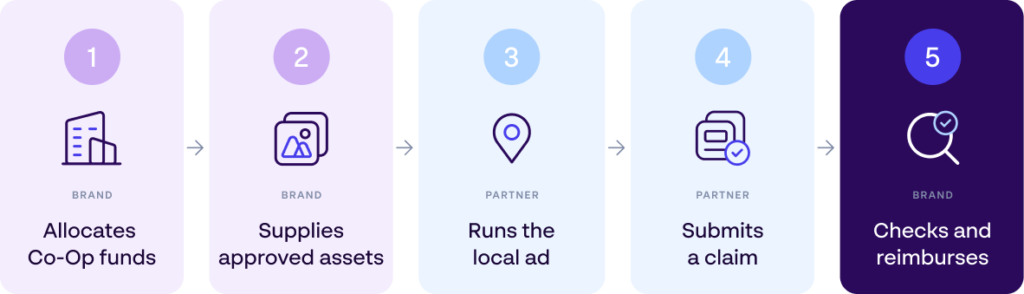
- Co-Op funds are the budget a brand sets aside for each partner. They often accrue as a percentage of the partner’s purchases, so selling more product earns more Co-Op, and unclaimed balances usually expire at the end of the program period.
- Market development funds (MDF) are a close cousin. Instead of accruing from sales, MDF is usually allocated up front for a specific goal, such as entering a new market or launching a product line.
- The cost split is set by the brand. Reimbursing 50% of eligible costs is common, and brands can raise the rate to steer partners toward priority products or channels.
- Proof of performance is how partners get paid: a copy of the ad, invoices and details of where it ran. The brand checks the claim against its guidelines first, so an ad with an outdated logo or an unapproved channel can be rejected.
Here is how that plays out. A dealer runs a $2,000 local newspaper ad for a new model. The program reimburses 50% of eligible costs, the ad uses the approved template and runs in an eligible channel, so the dealer claims $1,000 back. Had the ad used last year’s logo, the claim could have been rejected and the dealer would have covered the full cost.
Most programs set these rules out in a written Co-Op agreement covering eligible media, required logos and disclaimers, any pre-approval step and claim deadlines. Clear terms protect both sides.
3 main types of cooperative advertising
Co-Op advertising comes in three forms, depending on who shares the cost.
| Type | Who shares the cost | How it works | Example |
|---|---|---|---|
| Vertical | A manufacturer and the retailers, dealers or franchisees that sell its products | The brand reimburses part of each partner’s local ad costs | A car maker funding its dealers’ local ads |
| Horizontal | Businesses at the same level of the supply chain | Peers pool budgets for one campaign that benefits all of them | California milk processors funding the “Got Milk?” campaign |
| Ingredient | A component brand and the maker of the finished product | The component maker funds ads that feature its brand inside the product | Intel Inside on PC makers’ ads |
- Vertical Co-Op is the most common form and what most brands mean by the term.
- Horizontal Co-Op brings together peers, such as franchisees in the same region or producers in one industry, who fund a campaign none could afford alone.
- Ingredient Co-Op is run by a component supplier that pays part of a manufacturer’s ad costs in return for featuring the component’s brand.
4 top benefits of Co-Op advertising
- Shared cost: partners get a bigger local budget than they could fund alone, and brands get local advertising in every market without paying for all of it.
- Extended reach: pairing a brand with a local partner reaches both sets of customers – people loyal to the store and people loyal to the product.
- Local relevance: partners know the offers, events and language that land in their market, which a national campaign can’t match. It is the core of franchise and local marketing.
- Stronger partner relationships: funding and ready-made assets give dealers and franchisees a reason to put your brand ahead of others they carry, and a program that is easy to use keeps them coming back.
When Co-Op advertising can erode brand consistency
Co-Op works because partners know their local markets. It also carries one built-in risk: the brand pays for the ad, but the partner makes it. Across hundreds of dealers, franchisees and retailers, small deviations can creep in – an outdated logo here, an off‑brand color there, a headline the legal team never saw.
Each ad looks close enough on its own. Left unchecked, they can start to blur the brand. These gaps are easy to miss without regular review processes, as seen in automotive Co‑Op advertising cases:

Direct digital bookings are projected to generate more than $400 billion in hotel gross bookings by 2030, overtaking online travel agencies
Source: Skift Research, 2024

One OEM (Original Equipment Manufacturer) found 34% of campaign assets failing compliance checks requiring reimbursement, while $4 million in eligible Co-Op funds were going unclaimed each year.
Source: Customer data (pre-Papirfly)
Execution also affects how much the extra reach is worth. A study of retailer ads featuring manufacturer brands in the US, UK and Australia found that Co-Op advertising expands the combined buyer base.
Yet the expected lift in ad memorability was cancelled out. According to Nguyen et al. in the Journal of Retailing and Consumer Services (2020), shoppers who bought from the retailer but not the manufacturer – or the other way around – were less likely to recall the ad. The researchers point to information overload as a likely cause. That suggests clear, focused creative matters as much as where the ad runs.
None of this is a reason to pull back from Co-Op. It’s a reason to plan for consistency from the start. When brand consistency is built into the Co-Op program itself, not left in a PDF brand book partners never open, Co-Op delivers local reach without the drift.
Cooperative advertising examples
- Automotive dealer Co-Op: car makers fund dealers’ local ads that feature approved models, offers and branding. Many programs are under-used: more than half of available Co-Op budgets in automotive Co-Op marketing goes unspent each year.
- Retailers featuring manufacturer brands: weekly circulars, retailer emails and in‑store promotions that feature a manufacturer’s products are often co-funded by that manufacturer.
- Intel Inside (ingredient): from 1991, Intel reimbursed part of PC makers’ ad costs when their products and ads carried the Intel Inside logo. By the end of 1992, more than 500 manufacturers had signed on.
- Got Milk? (horizontal): launched in 1993 by the California Milk Processor Board, which is funded by the state’s milk processors, the campaign pooled competitors’ money to grow demand for the whole category.
- Franchise advertising Co-Ops (horizontal): many franchise marketing systems ask franchisees in the same market to pool contributions into a regional advertising Co-Op, which buys media for the whole area at rates no single location could get.
How to run Co-Op advertising and stay on-brand
The fix is not more policing after the fact. It is making the on-brand version the easiest one to create.
- Give partners locked, on-brand templates
With on-brand templates, the brand locks the logo, colors, fonts and legal copy, and partners edit only what should change locally: the offer, the address, the photo. The ad reaches the claim stage already compliant. - Centralize approved assets
A brand portal backed by Digital Asset Management (DAM) gives every partner one place for current logos, product images and campaign kits. - Localize without going off-brand
Build templates for every format partners actually use, from print ads and flyers to social posts and digital banners, in every language they need. - Build compliance into approval
When ads are created from approved templates, reviewers check exceptions instead of every submission, and claims move faster. - Track adoption
See which partners use the templates, which assets get used and where Co-Op money sits unspent, then follow up with the markets that are falling behind.
Some brands go a step further and tie reimbursement to the template itself: an ad built from an approved template qualifies automatically, while anything built outside it goes through manual review. Partners quickly learn which route gets them paid faster.
Make every Co-Op dollar count
Co-Op advertising works when partners have the money, the assets and the freedom to go local, and the brand still recognizes itself in every ad. Getting there is less about stricter rules and more about better tools, which is where brand management meets day-to-day execution.
Succeed in your Co-Op marketing strategy
Give local partners one place to land compliant Co-Op campaigns, with a brand portal and on-brand multichannel templates.
Succeed in your Co-Op marketing strategy
Give local partners one place to land compliant Co-Op campaigns, with a brand portal and on-brand multichannel templates.
Give local partners one place to land compliant Co-Op campaigns, with a brand portal and on-brand multichannel templates.

FAQs
What are Co-Op advertising funds?
Co-Op advertising funds are budgets that brands make available to retailers, dealers, franchisees or other partners to help pay for local advertising. Funds often accrue based on a partner’s purchases and may expire if they are not claimed within the program period.
What is the difference between Co-Op funds and MDF?
Co-Op funds often accrue as a percentage of a partner’s purchases and reimburse eligible advertising costs. Market development funds (MDF) are typically allocated upfront for a specific objective, such as launching a product or entering a new market.
What are the three types of cooperative advertising?
The three main types are vertical, horizontal and ingredient Co-Op advertising. Vertical Co-Op involves a brand and its sellers, horizontal Co-Op brings together businesses at the same supply-chain level, and ingredient Co-Op involves a component brand funding advertising by the finished-product manufacturer.
What are the benefits of cooperative advertising?
Co-Op advertising can help brands extend their reach while sharing costs with local partners. It can also give partners larger marketing budgets, make campaigns more locally relevant and strengthen relationships between brands, retailers, dealers and franchisees.
How do partners claim Co-Op advertising reimbursement?
Partners typically provide proof of performance, such as a copy of the advertisement, invoices and details of where it ran. The brand then checks the claim against its Co-Op guidelines before approving reimbursement.
Why do Co-Op advertising claims get rejected?
Claims can be rejected when advertising does not meet the brand’s program requirements. Common issues include outdated logos, unapproved channels, missing disclaimers or other deviations from the agreed brand and advertising guidelines.
How can brands keep Co-Op advertising on-brand?
Brands can provide locked templates that protect logos, colors, fonts and legal copy while allowing partners to customize approved local details. Centralizing current assets in a Brand Portal backed by Digital Asset Management can also help partners find and use the right materials.
How can brands improve Co-Op advertising adoption?
Make compliant campaigns easier for partners to create and claim. Providing approved templates, centralized brand assets and streamlined approval processes can reduce friction, while tracking template usage and unspent funds helps identify partners that may need additional support.
Table of contents:
- What is cooperative advertising?
- How does Co-Op advertising work?
- 3 main types of cooperative advertising
- 4 top benefits of Co-Op advertising
- When Co-Op advertising can erode brand consistency
- Cooperative advertising examples
- How to run Co-Op advertising and stay on-brand
- Make every Co-Op dollar count
- FAQs