
Brand Management

Why automotive Co-Op advertising leaves millions on the table

Automotive Co-Op advertising is one of the most significant investments OEMs (Original Equipment Manufacturers) make in their dealer networks. The idea is straightforward: allocate funds for dealers to spend on local marketing whilst ensuring that spend stays on-brand and in approved channels, so local campaign activity scales without central teams managing every execution.

Most programs don’t deliver on that promise. Funds expire unclaimed. Spend goes out in channels it shouldn’t. Creative that fails brand guidelines gets reimbursed anyway. And by the time central marketing has visibility into any of it, the year is already over.

This isn’t a resource problem or a budget problem. It’s a structural one. For OEMs managing hundreds or thousands of dealer relationships, the gap between what Co-Op is supposed to do and what it actually does adds up to real money.

Millions in unclaimed funds every year

Most automotive Co-Op advertising funds are allocated annually and expire at year-end. Unused balances are forfeited without the option to roll over.

For central marketing, that’s budget designed to drive local activity that never got spent. For dealers, it’s marketing support they were entitled to and didn’t access, likely because the claims process was complex enough that it wasn’t worth the effort.

At enterprise scale — OEMs managing hundreds or thousands of dealer relationships across multiple markets — the unclaimed figure can be significant. When one global automotive OEM audited their Co-Op program, they found over $4 million in eligible advertising spend going unclaimed every single year. (Source: Papirfly customer data) Not because dealers didn’t want the funds. Because the process of claiming them was too slow, too manual, and too unclear to navigate consistently.

That’s the hidden cost of undermanaged Co-Op: it doesn’t just create admin burden. It actively prevents the program from doing what it was built to do.

The compliance gap nobody’s tracking

Unclaimed funds will show up eventually in the end-of-year forfeiture figure. What’s harder to see is the spend that does happen, but shouldn’t.

When automotive Co-Op advertising programs run on spreadsheets or basic claims tools, compliance review becomes manual and inconsistent. A dealer submits a claim for an ad using an outdated logo, an unapproved channel, or messaging that violates regional guidelines. Without automated review at scale, central marketing can’t catch every instance.

Before the same OEM overhauled their Co-Op management, 34% of campaign assets running under their brand failed compliance checks. One in three ads going out to market was off-brand, in the wrong channel, or both — and all of it was reimbursed by central marketing.

Research from Demand Local (2024) puts this in context: 65% of automotive dealers describe their Co-Op relationship with their OEM as “complex,” and 43% find it “frustrating.” That frustration goes both ways: dealers struggling to claim, OEMs struggling to control what runs.

Why dealer adoption is the metric that matters

Most Co-Op programs track utilization: what percentage of the allocated budget was spent. It’s a reasonable proxy, but it doesn’t tell you whether dealers are engaged or whether the program is working as designed.

When automotive Co-Op advertising is easy to access, fast to reimburse, and compliant by default, adoption follows. The same OEM referenced above now sees 93% dealer adoption of their Co-Op platform, not because dealers were required to use it, but because the incentive is clear and the process doesn’t get in the way.

High adoption also gives central marketing something utilization figures can’t: visibility. When dealers run campaigns outside a managed platform, OEMs have no view of what’s going to market. When they run inside it, central teams can see what’s live, what’s compliant, and how spend is tracking across the network.

Speed is a cost most programs don’t measure

There’s a consequence to manual Co-Op management that rarely makes it into budget conversations: time to market.

Creative reviews that run on email take days, sometimes weeks. Claims that go into a manual queue get processed in batches. Dealers who’ve waited three weeks for reimbursement on one campaign think twice before submitting the next one.

Local activity dries up. The program built to scale local marketing ends up discouraging it. The OEM referenced above cut time to market by 50% after moving to a properly managed Co-Op system. For a dealership, that’s the difference between a campaign landing during a model launch window and landing three weeks after it.

Where AI fits in automotive Co‑Op advertising

AI-assisted compliance review is already changing how automotive Co-Op advertising programs operate, particularly for OEMs with tightly controlled templates.

When dealer flexibility is limited — swapping a phone number, updating a local address — AI can handle the full compliance check without human review. Faster approvals, lower cost per claim, no bottleneck. For programs that give dealers more creative latitude, AI handles routine checks and flags edge cases for a human reviewer.

The practical split: the more flexibility you give dealers, the more you need human judgment in the loop. The more locked down your templates, the more AI can carry independently. Most programs sit somewhere in the middle — and AI will handle more of it every year.

Discover Co-Op advertising for automotive OEMs

See how dealers marketing stays 100% on-brand.

Discover Co-Op advertising for automotive OEMs

See how dealers marketing stays 100% on-brand.

See how dealers marketing stays 100% on-brand.

What the best Co-Op programs do differently

Automotive Co-Op advertising is one of the most undermanaged investments in OEM marketing. The budget exists. The dealer relationships exist. What’s often missing is the infrastructure to make it run properly — automated compliance, fast reimbursement, and real visibility into what’s actually going to market.

The programs that work don’t rely on spreadsheets or manual claim reviews. They treat Co-Op as an operational function, not an annual admin task. And they measure success by dealer adoption and compliance rates, not just by how much budget got spent before December 31.

FAQs

What is automotive Co-Op advertising?

Automotive Co-Op advertising is a cost-sharing arrangement where an OEM allocates funds to its dealer network to reimburse approved local advertising spend. Dealers claim back a set percentage of their eligible campaign costs — typically 50% — through the OEM’s Co-Op program. The goal is to increase local marketing activity while ensuring it meets brand and channel guidelines.

Why do automotive Co-Op funds go unclaimed?

The most common reasons are administrative complexity, unclear eligibility rules, and slow reimbursement cycles. When claiming is difficult or reimbursement takes weeks, dealers deprioritize Co-Op submissions — particularly for smaller campaigns. Automating the claims process and tightening reimbursement SLAs typically has the biggest impact on utilization rates.

How does Co-Op compliance management work in automotive?

Compliance management means reviewing dealer-submitted creative before approving it for reimbursement — checking it meets brand guidelines, channel eligibility, and program terms. Depending on how much creative flexibility dealers have, this is handled by AI, human review, or a hybrid of both. Without a structured review process, non-compliant spend gets through.

What’s the difference between a Co-Op tool and a Co-Op managed service?

A Co-Op tool gives you the platform to run the program — claims submission, fund tracking, compliance workflows, and reporting. A managed service means an external team handles operations on your behalf: reviewing creatives, processing claims, and supporting dealers directly. Papirfly offers both, with a 24-hour creative review SLA and claims processing within five days as part of the managed service.

How does AI improve automotive Co-Op advertising management?

AI automates compliance checks at the point of claim submission, removing the manual review bottleneck for high-volume programs. For OEMs with locked-down templates, AI can handle the full review independently. For programs with more flexible creative, AI pre-screens submissions and flags exceptions for human review — speeding up approvals without reducing accuracy.

Brand Management

Where to start: The brand management maturity model

I expect most central marketers can name what is wrong with brand consistency in their network. Far fewer can say which part to address first. 

In my own conversations with brand and marketing leads running franchised, dealer, branch and managed networks, I kept hearing the same answers. At first I treated the answers as competing explanations, depending on sector, network size, or how independent the sites were. But it led me to dig a little deeper and what I realised is that what sounded like five separate problems is one problem at five different points.

Following my instincts, I looked to the data to accurately assess my observations. We went back over a full year of discovery conversations with distributed networks and classified each one against these five points. The result was actually more lopsided than I expected.

This is where the brand management maturity model was born, and what can help when you’re trying to decide where to start taking control of your brand consistency challenge.

What is the brand management maturity model?

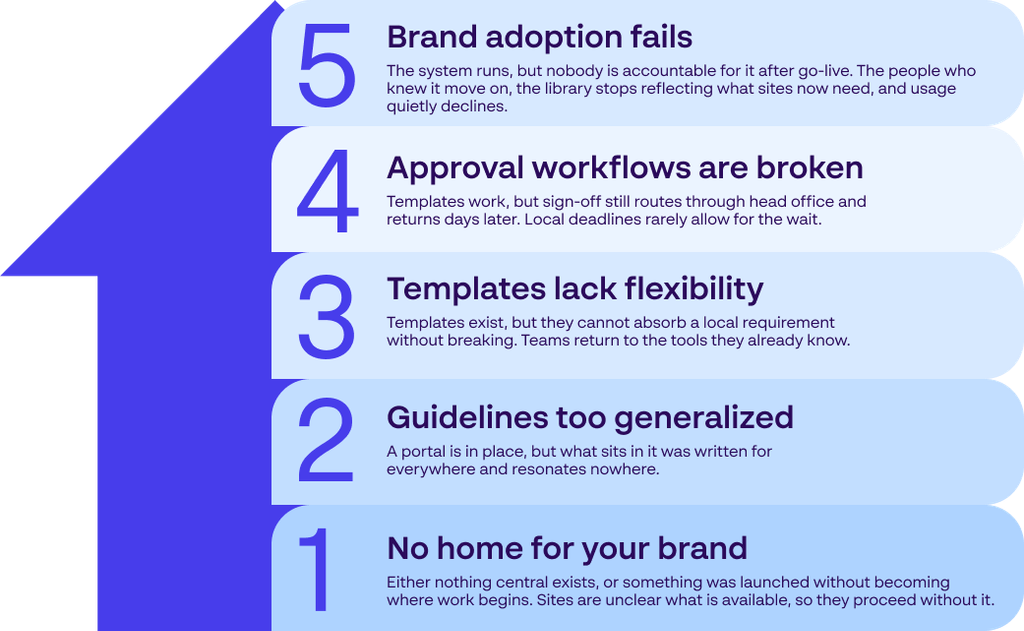
The brand management maturity model describes five stages at which brand consistency breaks down across a distributed network. The stages run in sequence, and each only becomes visible once the one before it has been resolved.

A network cannot have a template flexibility problem until it has templates, or an approval bottleneck until the templates are good enough that sites want to use them. Most networks recognize all five and assume they are dealing with several at once. We’ve visualised this below:

The five stages of the brand management maturity model as an ascending arrow: 1 no home for your brand, 2 guidelines too generalized, 3 templates lack flexibility, 4 approval workflows broken, 5 brand adoption fails.

The practical consequence is that effort spent on a later stage while an earlier one is unresolved returns almost nothing. A network at stage one that invests in sophisticated approval routing has built a fast process for content nobody is producing centrally in the first place.

This happens more often than it should, and it is rarely a failure of judgment. The later stages are simply more visible to the people making decisions — an approval delay generates complaint emails that reach head office, while a site that never adopted the brand hub generates silence.

Stage one is where most networks actually are

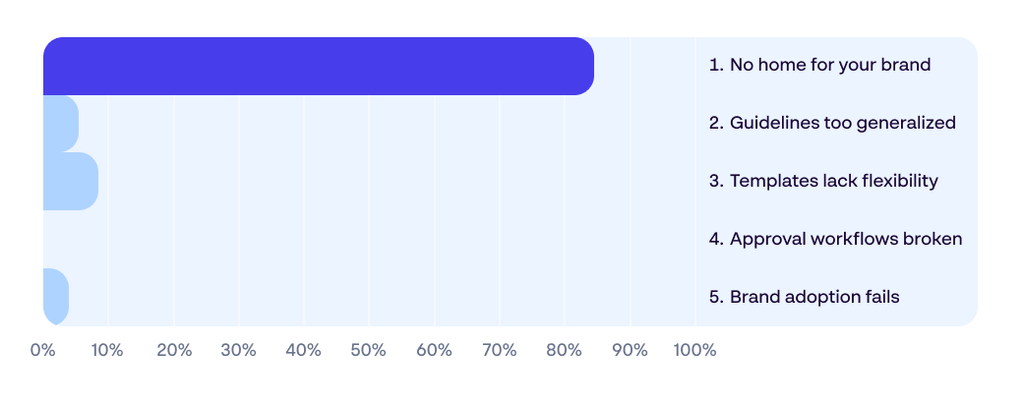
84% of the distributed networks we spoke with over the past year were at stage one when the conversation started (Source: Papirfly new business discovery analysis, 2025–2026). Around one in ten were at stages two or three. A small minority were at stage five.

Horizontal bar chart showing 84% of distributed networks sit at stage one of the brand management maturity model, with far fewer at stages two to five.

Almost none were at stage four. Approval delay is one of the most commonly voiced brand complaints in the category, and it was virtually never the thing actually holding a network back at the point it came to us.

Stage one is also the stage networks are least likely to place themselves in. They describe themselves as working on localization or approval speed, but on examination they do not yet have a place where the brand lives.

Stage one has two forms. Either nothing central exists at all, or something was launched and never became where work begins — which produces the same outcome and is harder to admit. Site Managers and their teamsare unclear what is available to them, so they proceed without it.

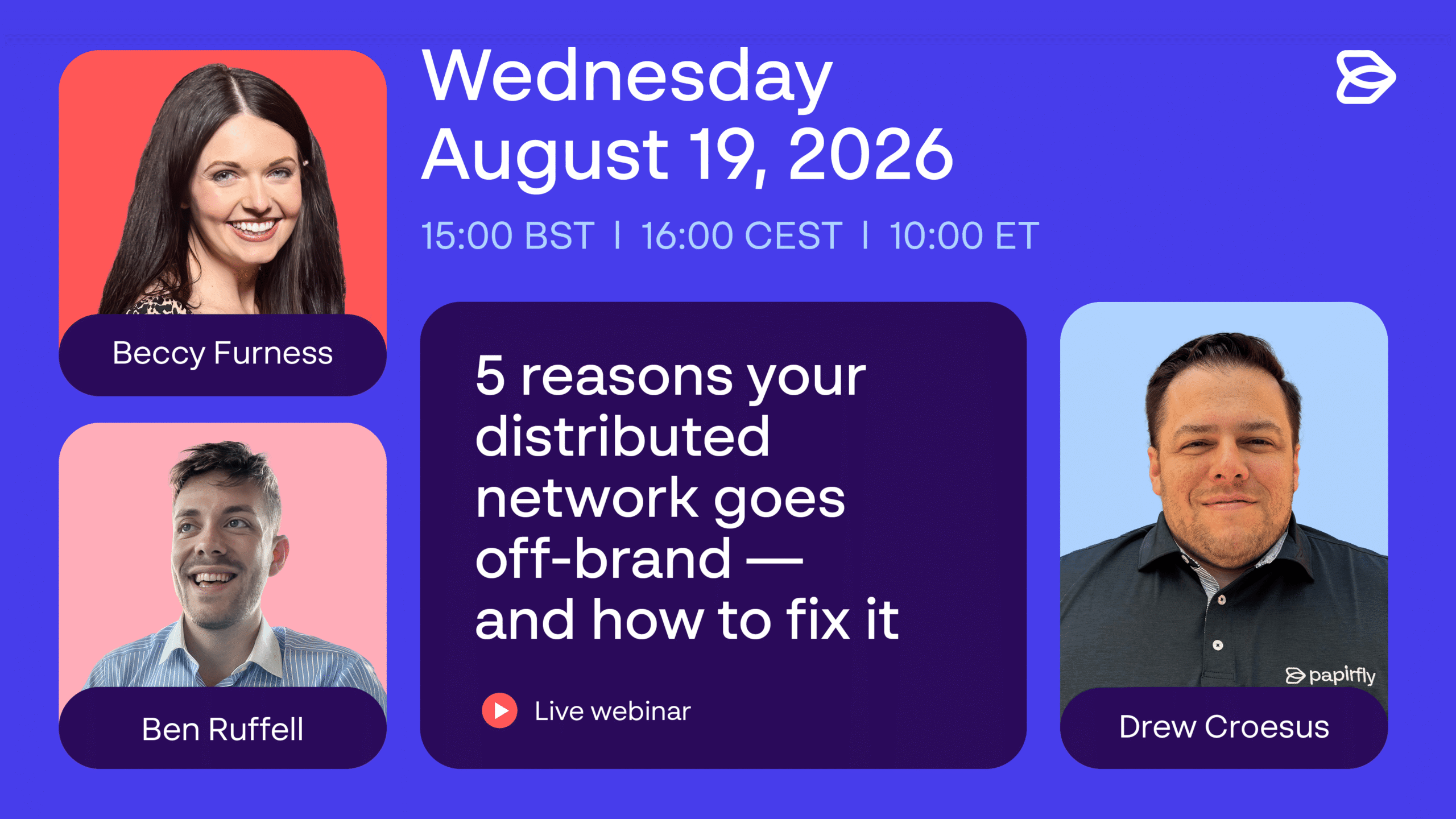
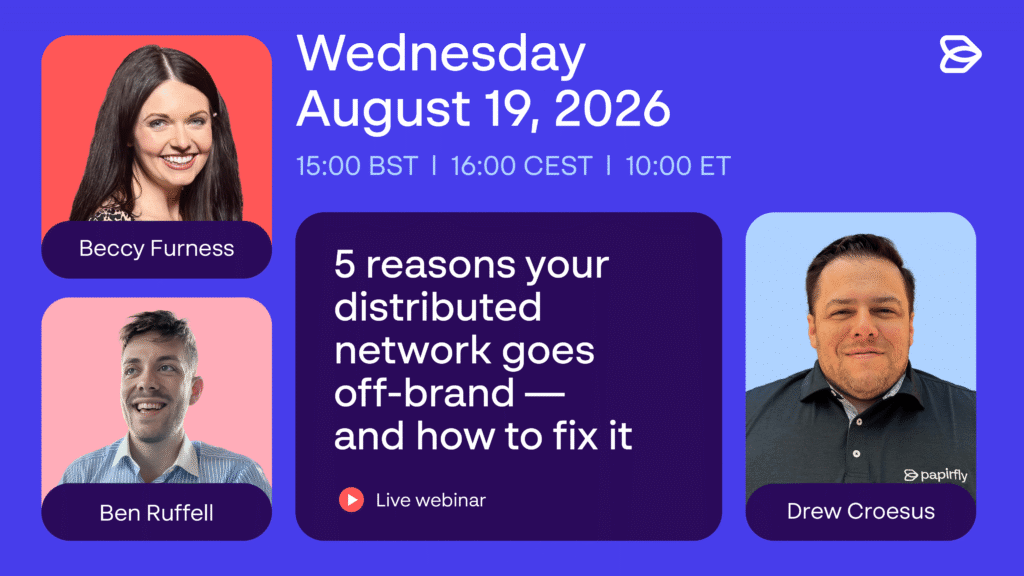
Drew Croeses, Account Manager at Papirfly, speaks to these networks at the point they begin looking for a solution, and continues working with them once the platform is live. In a recent webinar, I asked him what they report happening on the ground before a central home exists.

“It’s usually not framed as a brand problem when they first come to us. It shows up as an operations complaint. Someone on the marketing team tells me they had a request for the same file from three different locations in the space of a week, or a market manager who requested the same logo four times over the last quarter.”

Drew Croeses headshost

Drew Croeses
Account Manager at Papirfly

What is needed at this stage is a single place where the brand is explained, not simply stored. The distinction that matters is between a repository location managers  are told to use and a platform or folder they choose to open. This is decided by context — what an asset is for, when to use it, and the reasoning behind the rules of where to find it.

The clearest test is what a new site manager encounters in their first week. A link to a shared folder teaches them the brand is paperwork. A place that answers their questions teaches them it is something they are part of, and that difference determines whether they return.

This is where organizations with a mature Digital Asset Management (DAM) system are most often caught out. Assets are cataloged, rights are managed, metadata is clean — and the conclusion drawn is that stage one is behind them.

It usually is not. A DAM is built for people who already know what they are looking for, which describes the central team and its agencies rather than a site manager in their first week. Access frequently stops well short of the network edge, and even where it does not, an asset library explains nothing about the brand it holds.

Organized is not the same as understood. A network can have every file in the right place, correctly tagged and version-controlled, and still have no destination where individual locations can learn what the brand stands for, which campaign applies to them, or why a rule exists.

A creative director at a consumer products brand, already running a DAM, put it more plainly than I could:

“We have a brand book, but nobody reads it. It’s in a Google Drive.”

Developing brand guidelines had been a significant piece of work. They turned it into a PDF, and then nobody opened it — which left him wondering what the point had been. His description of his own job was trying to act as a brand gatekeeper in an environment that is fluid and constantly changing.

This shows up repeatedly. Close to one in ten of the networks arriving at stage one already run an established enterprise DAM, with assets governed and brand guidelines sitting inside it as a PDF (Source: Papirfly new business discovery analysis, 2025–2026). The DAM had solved a real problem.

What do stages two to five need?

At stage two a central home exists, but the guidelines governing how campaign content gets made were written for the whole network and land in no particular market. A marketing lead at a multi-site healthcare group described what follows:

“We see clinics go rogue with their own content.”

A colleague on the same call added that anything campaign-related, the sites tend to get very creative with. What they wanted was not tighter control — it was freedom for sites within a framework HQ had set.

What is needed is campaign material assembled by market rather than distributed to everyone — the idea, the assets, the guidance and the templates on one page, already relevant to the site opening it. Region and role determine what appears, but relevance is the outcome rather than the mechanism.

At stage three templates exist and break at the first local requirement. What is needed is templates that absorb local reality without failing: copy that runs long, a language that expands, a requirement nobody anticipated. That is decided element by element when the template is built, which is why some hold and others do not.

Ben Ruffel, Project Manager at Papirfly, builds and launches these systems for large decentralized networks. I asked him how he decides what stays locked and what stays open.

“There are two failure modes. Under-locking is where a central team gives away too much control, and a dealership manager can recolor the primary logo or swap a high-res photo for a grainy camera shot. The result is material no central brand team would ever approve. 

Over-locking is the more common mistake. The team gets nervous about brand integrity, locks everything down, and the local operator abandons the system within five minutes and builds something off-brand in another tool instead.”

Ben Ruffel headshot

Ben Ruffel
Project Manager at Papirfly

At stage four the templates work but sign-off still routes through head office and returns days later. What is needed is review that happens where the content is made, and an explicit decision about what requires review at all. Most networks have never written that down; it lives in habit and in a few individuals, and separating what genuinely needs sign-off from what does not is where the delay disappears.

Around 81% of companies report dealing with content that does not follow their brand guidelines, and only 30% of organizations with guidelines say they are consistently enforced (Source: Lucidpress, now Marq, State of Brand Consistency Report, 2019; Marq, 2026). Those figures have barely moved in the years since.

Stage five arrives after everything appears to be working and the launch of the system is touted as a success by HQ. Here is where the central team can be blind sided by the same issue they tried solving from the get go – consistent usage. Usage does not collapse, it erodes — the people who knew the system move on, the library stops reflecting what sites now need, and activity quietly declines.

Drew’s first observation when a network raises a decline is that the decline is a visibility problem before it is an activity problem:

“Just because people stop using the system doesn’t mean they stop producing content. It hasn’t changed. We just can’t see it anymore.”

Drew Croeses headshost

Drew Croeses
Account Manager at Papirfly

What stage five needs is a named owner and visibility of who is actually using the system. A decline noticed  early indicates a need for action rather than a failure in the system itself, and it usually describes something the network now needs that nobody has built yet. Only once someone has been assigned to own the system, can those continued changes be made and local teams encouraged to stay on brand.

How do you find your starting point?

The fastest diagnostic is not a survey of your sites. It is a question about your own central team: what did the majority of their week actually consist of?

  • Fielding requests for files that already exist somewhere points to stage one.
  • Hearing nothing from the sites at all, while off-brand local material appears anyway, also points to stage one.
  • Rewriting or adapting central material for particular markets points to stage two.
  • Fixing broken layouts and handling exceptions to templates points to stage three.
  • Clearing a review queue points to stage four.
  • None of the above, but usage falling, points to stage five.

This works because a central team’s workload is the most reliable record of where the system is failing. Whatever the network cannot do for itself arrives at head office as a request, and the shape of those requests describes the stage precisely.

Marketers already spend substantial time on asset management, with 37% spending five to ten hours a month on it and 27% spending more than ten (Source: Storyblok, global survey of 500 marketers, 2023). Those hours are the most honest brand consistency data most organizations hold.

A second check is worth running alongside it. Ask what proportion of your sites produced anything at all through the central system last quarter — networks that assume they are at stage three or four routinely discover that a substantial share never reached stage one.

Conclusion

The five stages are not a maturity score to be reported upward. They are a way of converting a problem everyone discusses in general terms into one specific enough to act on.

Most networks are further back than they believe, and that is not a criticism of the teams running them. The stages are genuinely difficult to see from the center, because each is hidden behind the one before it.

If you take one thing from this, take the diagnostic rather than the model. Look at what your central team spent last week doing, and your starting point will identify itself.

Discover the reasons networks go off‑brand in our webinar

Learn more about the brand management maturity model.

Discover the reasons networks go off‑brand in our webinar

Learn more about the brand management maturity model.

Learn more about the brand management maturity model.

FAQs

What is the brand management maturity model?

It is a five-stage model describing where brand consistency breaks down across a distributed network. The stages run from having no central home for the brand through to having a system that runs but nobody owns, and each stage only becomes visible once the previous one has been resolved.

How do I know which stage my network is at?

Look at what your central marketing team spends most of its time doing. Requests for files that already exist point to stage one, adapting central material for local markets points to stage two, fixing broken templates points to stage three, and clearing review queues points to stage four.

We already have a DAM. Does that mean we are past stage one?

Not necessarily. A Digital Asset Management system organizes and governs files for people who already know what they are looking for, which is usually the central team rather than the sites. Stage one is only cleared when the network has a destination that explains the brand, not simply a library that stores it.

Why does the order of the stages matter?

Because effort spent on a later stage while an earlier one is unresolved produces very little return. Building fast approval routing for a network whose sites cannot find anything centrally solves a problem that network does not yet have.

Does this apply to networks that are not franchises?

Yes. The model applies to any structure where a central team holds authority over the brand but not over the people executing it — dealer networks, branch networks, managed sites, country offices and tied agents all encounter the same five stages.

Local marketing icons representing brand governance, campaign performance, location targeting, digital assets, and franchise campaigns.

A guide for multi‑location and franchise brands

See how multi‑location and franchise brands can run local marketing on‑brand at scale.

Read article

Create unlimited on‑brand content

Explore how templated content creation helps global teams move faster while staying on brand.

Download overview

Achieve brand consistency with DAM

Enable teams to use approved, compliant assets at scale.

Read article

Brand Management

Franchise marketing agency vs template software: how to scale your business

A small central marketing team supporting a large franchise network knows the feeling well: requests pile up faster than the team can handle, and franchisees start making their own materials just to keep local marketing moving.

The usual next step is to call a franchise marketing agency. But that is no longer the only option available to a lean team trying to protect the brand.

This guide compares hiring a franchise marketing agency against bringing franchise marketing in-house with software, and looks honestly at where a hybrid of the two makes sense. Along the way, we’ll cover what franchise marketing software should include if you go that route, and how a small central team decides between the three paths.

What is a franchise marketing agency?

A franchise marketing agency is a specialist firm that manages some or all of a franchise network’s marketing on the franchisor’s behalf. Services typically span brand strategy, paid media, local SEO, content production, and franchisee support and training.

Agencies exist because franchise marketing has a structural problem: one brand identity has to work across dozens or hundreds of locations, each with its own local audience and competitive context. That’s a lot of ground for a small in-house team to cover alone.

Why franchise marketing teams look for outside help

The tension at the heart of this decision is simple. A central team wants to protect brand standards, but a handful of people cannot realistically service an entire network on demand.

When requests outpace capacity, franchisees start creating their own flyers, posts, and local ads just to keep business moving. Consistency breaks down at the exact point where the customer meets the brand.

This is precisely the problem 47% of franchisors cite as their biggest challenge: managing brand reputation consistently across multiple markets (Source: Constant Contact, State of Franchise Marketing, 2025). It’s also why 59% of franchisors say consistency, not local performance, is the main reason they set the level of marketing control they do (Source: Constant Contact, State of Franchise Marketing, 2025). Faced with that pressure, hiring an agency is the instinctive first move — but it isn’t the only one.

Option 1: Hiring a franchise marketing agency

Bringing in a franchise marketing agency gives a stretched central team immediate access to specialist skills and hands-off delivery. It’s a well-worn path for a reason, but it comes with real trade-offs for a brand that wants to keep tight control.

Pros of a franchise marketing agency

An agency arrives with strategists, designers, and media buyers already in place, so campaigns can launch in weeks rather than months. There’s no recruitment, onboarding, or tooling to sort out first.

That breadth of expertise also means access to specialisms a small team is unlikely to have in-house, from paid media optimization to franchise-specific local SEO. For a network without the budget or the appetite to build a full team, this is often the fastest route to professional-grade output.

Cons of a franchise marketing agency

The trade-off is control. Decisions, timelines, and day-to-day priorities sit with a partner outside the business, and few agencies understand the brand as intimately as the people living it every day.

Cost is the other factor. A full-service agency retainer can run comprehensive marketing support for $50,000 to $150,000 a year, and that spend continues indefinitely rather than converting into an owned asset (Source: Chariot Creative, 2025). Over time, dependency on an external partner can also limit how quickly the central team can flex or bring work back in-house.

Option 2: Bringing franchise marketing in-house with software

The alternative is for a lean central team to run franchise marketing themselves, using software built for the job rather than handing the work to an agency.

This isn’t about doing more manually — it’s about giving a small team the tools to produce, control, and distribute local marketing at a scale that would otherwise need a much bigger headcount.

Pros of the in-house software model

The right platform lets non-designers in every location create on-brand materials in minutes, without waiting on the central team or an outside partner. Control stays entirely with the brand, and every asset produced is a reusable part of the business rather than a one-off agency deliverable.

It’s also considerably cheaper at scale. Building a comparable in-house agency-style team costs $450,000 to $550,000 a year for just four people once salaries, benefits, and tools are counted, against a fraction of that for a software platform (Source: Chariot Creative, 2025).

Cons of the in-house software model

Software doesn’t replace strategic thinking. A central team still needs to set direction, build the initial template library, and manage rollout, which takes time upfront even if it saves time later.

There’s also a learning curve for franchisees who are used to making their own materials from scratch. Getting them to adopt locked templates rather than choosing quick shadow tools (that often take you off-brand) instead requires some change management, not just a login.

The hybrid approach

Many franchise brands don’t choose one route exclusively. A common pattern is to use an agency for strategy, brand campaigns, and big creative swings, while software handles the day-to-day local execution and keeps every market on-brand between those campaigns.

This division of labour plays to each model’s strengths: the agency’s outside perspective and campaign firepower, and the platform’s speed and control for everything franchisees need day to day. It also explains why hybrid setups are becoming the norm rather than the exception — the share of B2B companies combining in-house and external marketing resources is projected to climb from 36% to 46% between 2025 and 2026 (Source: Sagefrog B2B Marketing Outlook, 2026).

Franchise marketing software: what to look for

If you’re leaning towards the in-house or hybrid route, the software you choose does most of the heavy lifting. A handful of capabilities matter more than the rest when you’re supporting a large, dispersed network.

  • A portal for franchisee access: a single, intuitive brand portal for every location to find what they’re approved to use.
  • Templated content creation for localization: ready-made design templates that let franchisees swap in local details without touching locked brand elements.
  • Centralized asset library: the backend Digital Asset Management platform as a home for logos, imagery, and approved materials – so franchisees are never working from outdated files.
  • Role-based access and permissions: the right level of control for head office, regional teams, and individual franchisees.
  • Approval workflows: a clear, auditable path for anything that needs sign-off before it goes live.
  • Analytics and reporting: visibility into what’s actually being produced and used across the network.

For a fuller comparison of platforms against this checklist, see our guide to the best franchise marketing software on the market today.

How Papirfly helps a small central team scale

Papirfly’s suite maps directly onto the pains a stretched central team faces, without turning day-to-day marketing into a design bottleneck.

One source of truth for every brand asset

Papirfly’s DAM gives the central team a single, governed library for every logo, image, and approved asset. Franchisees always pull from the current version, so outdated or off-brand files stop circulating.

Templated content franchisees can localize

Templated Content Creation lets franchisees build their own local materials from pre-approved templates, without needing design skills or the central team’s time. Output stays on-brand because the templates are built that way from the start.

A brand portal every franchisee can access

The brand portal gives every location one intuitive place to find guidelines, campaigns, and approved templates. It replaces the scattered folders and PDF brand books that push franchisees toward off-brand shortcuts in the first place.

Lock what can’t change so off-brand work isn’t possible

Locking functionality protects the elements that matter — logos, colors, fonts — while leaving room for franchisees to customize local details. It’s how a small team enforces brand consistency across locations without reviewing every single asset by hand.

How to decide: marketing agency, templating software, or both?

Reach for an agency when the network needs strategic firepower or major campaign work that the central team genuinely doesn’t have the bandwidth or expertise to produce itself.

Lean toward software when the bulk of the workload is repeatable local execution — local versions of existing campaigns, everyday social content, in-store materials — that a locked template can handle safely. And consider a hybrid when both are true: strategy needs an outside partner, but volume demands a platform.

Franchisors who pair the right technology with clear guardrails are 2.5 times more likely to run an adaptive, best-in-class marketing operation than those who don’t (83% versus 44%) (Source: Constant Contact, State of Franchise Marketing, 2025). That gap is the clearest signal of which lever actually moves the needle for a lean team.

Scale your franchise marketing with Papirfly

A small central team can protect the brand and keep pace with a growing network, but not by absorbing every request manually or by handing the whole problem to an agency indefinitely. The right mix of strategic support and the right platform is what makes that possible.

For most lean teams, that means software that lets every franchisee produce on-brand content independently, with the central team setting the guardrails rather than doing the work by hand. Papirfly’s DAM, Templated Content Creation, and brand portal are built for exactly that job.

See how Papirfly keeps every franchise on‑brand

Scale with best‑in‑class portals and templates.

See how Papirfly keeps every franchise on‑brand

Scale with best‑in‑class portals and templates.

Scale with best‑in‑class portals and templates.

Frequently asked questions about franchise marketing agencies

Can software replace a franchise marketing agency?

For day-to-day local execution, yes — templated software lets franchisees produce on-brand content without an agency’s involvement. For strategy, major campaigns, or specialist skills like paid media, many brands still value an agency’s outside expertise.

What should franchise marketing software include?

Look for a centralized asset library, templated content creation for localization, a brand portal for franchisee access, role-based permissions, approval workflows, and analytics. Together, these let a small team govern a large network without reviewing every asset manually.

Is franchise marketing software cheaper than an agency?

Usually, yes, especially at scale. A comprehensive agency retainer typically costs $50,000–$150,000 a year on an ongoing basis, while software is a one-time investment in a reusable system rather than continuous spend on external production.

Brand Management

Franchise social media marketing: Your guide to localized brand consistency

Every franchise brand has a presence in hundreds of local markets, and each account is run by a different franchisee or location manager. Social media is where local customers actually engage with the brand, but a small central marketing team can’t post for every location.

So franchisees post their own content, and the brand starts to look different everywhere: different fonts, tone, photos, sometimes different logos altogether.

This guide covers why franchise social media matters, how to structure accounts and guidelines that hold up across a network, and how templated content keeps every location on-brand without creating a bottleneck at head office. If you’re weighing up franchise marketing software, the sections below cover what to look for.

Why social media matters for franchises

Social is where local discovery happens. A customer choosing between nearby options is more likely to check a location’s Instagram or Facebook page than a national homepage, which is exactly where a well-run local account earns trust a national campaign cannot.

Approximately 806,270 franchise establishments operate in the US alone,
employing 8.7 million people and generating more than $800 billion a year.

A network that gets this right can outperform independent competitors. Pairing a recognized national brand with a real, locally-run presence gives customers both the reassurance of a known name and the authenticity of a business that feels part of their community, which is why social sits at the center of most franchise marketing plans today.

The core tension: brand consistency vs local relevance

Central marketing wants the brand protected on every account: consistent colors, tone and messaging, wherever a customer encounters it. Local teams want to post quickly and speak to their own community, without waiting on approval from head office.

Both goals are legitimate, and the tension is structural rather than a sign either side is doing something wrong. The question is not which side wins, but how much freedom locations get and within what boundaries.

When the balance tips too far toward local freedom, off-brand posts creep in: mismatched logos, inconsistent photography, a different voice from one location to the next. Left unchecked, this is what rogue posting looks like at scale, and it affects how much a customer trusts the brand overall. 

How to structure franchise social media accounts

Most franchise networks run a hybrid structure: a national or brand-level account that carries flagship campaigns, alongside individual location pages that handle local offers, events and community engagement.

Facebook and Google Business Profile are generally the easiest platforms to structure this way, since both offer native tools for managing multiple linked location pages under one parent brand. Instagram and TikTok need more judgment about whether a standalone local account is worth the investment.

A useful test: does this location have enough distinct local interest, operator capacity and content to sustain its own page?

If not, it’s often better served by a shared regional account than a page that goes quiet after a few weeks. The pay-off for getting this right is real:

Choosing the right social platforms

Not every platform deserves equal investment. Facebook and Instagram tend to carry the most weight for local discovery and community engagement, while LinkedIn matters more for franchisee recruitment than local customer engagement.

Prioritize based on where your audience spends time and what content locations can realistically produce.

A network of gyms or restaurants may lean harder into Instagram and TikTok, while a professional services franchise may get more from LinkedIn and Google Business Profile updates.

Social media brand guidelines for franchises

Social-specific brand guidelines are the governance layer that keeps every account recognizable, even when hundreds of different people are posting. They need to go further than a general brand book, because social moves faster and involves far more contributors.

At minimum, guidelines should cover visual consistency, such as logo use, color palette and photography style, plus tone of voice for captions and comment replies. They should also state which elements a location can and cannot change, what hashtags to use, and how to handle complaints in public replies.

Framed this way, guidelines aren’t a restriction; they’re the reason a customer can walk into any location and recognize the brand immediately, whether they found it through a national ad or a local post. See how brand consistency across locations affects customer trust.

Social media marketing templates for locations

Templates turn brand guidelines into something a busy franchisee can actually use. Instead of interpreting a brand book, a location manager opens a pre-built template, edits only the fields they’re allowed to change, and publishes something on-brand in minutes.

This is where speed and consistency stop competing. Locked elements, such as the logo, color palette and layout, stay untouched, while editable fields, like the local offer or event date, give each location room to speak to its own audience.

Well-designed templated content creation removes the need for local teams to have design skill, and removes the need for central marketing to manually review every post before it goes live.

Building a franchise social media content strategy

A workable content strategy blends national and local content on a shared calendar, so head office campaigns and local activity never clash. National content typically covers flagship promotions and brand-wide announcements, while local content covers community events and location-specific offers.

Coordinating this doesn’t mean controlling every post. Build the calendar around fixed national moments, then leave defined space around them for local customization, whether that’s a seasonal offer, a partnership or a community shout-out.

Common franchise social media mistakes

Most of the problems franchise networks run into on social media come down to a handful of recurring issues.

  • Inconsistent posting across locations, where some accounts post daily and others haven’t updated in months, damages the network’s credibility as a whole, not just the quiet location’s reputation.
  • Ignoring local relevance by pushing only national content leaves locations feeling like an afterthought, and gives customers no reason to follow a local page over the national one.
  • Off-brand or rogue posts, from mismatched logos to an inconsistent tone, chip away at the recognizability that makes a franchise brand valuable in the first place.
  • No approval process for what gets published means problems are caught after they’ve already reached customers, rather than before.
  • Missing user-generated content (UGC) rights, where a location reposts a customer photo or video without permission, creates real legal exposure for the whole organization, not just the local branch.

If you’re comparing platforms to fix these issues, our roundup of the best franchise marketing software is a good next stop.

How Papirfly helps franchises stay on-brand on social

Every pain above comes down to the same root problem: a small central team cannot manually govern what hundreds of locations post. Papirfly’s Digital Asset Management (DAM), Templated Content Creation and brand portal work together to solve that without slowing local teams down.

One source of truth for social and brand assets (DAM)

A Digital Asset Management system gives every location access to the same approved logos, photography and campaign assets, instead of sourcing their own images or reusing outdated files. When the source of truth is centralized, off-brand assets stop entering the network at all.

Templated social posts locations can localize

Locations use ready-made templates for offers, events and seasonal campaigns, editing only the fields they’re permitted to touch. This is the practical version of the earlier balance: national marketing keeps brand elements locked, while local teams still speak to their own community.

A brand portal every location can access

A brand portal gives every franchisee, regardless of location or team size, one place to find approved templates, guidelines and assets, rather than chasing head office for the right file. That single point of access often determines whether guidelines actually get followed.

Lock brand elements so off-brand posts aren’t possible

Locking functionality means a franchisee simply cannot edit the logo, brand colors or core layout, even if they wanted to. It replaces manual review with a structural safeguard, so off-brand output stops being a risk that has to be caught.

Run franchise social media on‑brand with Papirfly

Getting franchise social media right means resolving the tension between central control and local relevance, not picking a side. That means clear account structure, usable guidelines, and templates that let local teams move fast without going off-brand.

Brands that manage this well protect what makes their name recognizable while letting every location feel genuinely local. The ones that don’t end up with a network that looks like dozens of different businesses loosely wearing the same logo.

Papirfly brings DAM, Templated Content Creation and a brand portal together so franchisors don’t have to choose between speed and consistency. See it in action with a personalized demo.

See franchise social media done on‑brand

Let everyone create in an instant.

See franchise social media done on‑brand

Let everyone create in an instant.

Let everyone create in an instant.

Frequently asked questions about franchise social media

Should each franchise location have its own social media account?

It depends on the platform and the location’s capacity. Facebook and Google Business Profile support linked location pages well, but a standalone account only makes sense with enough local interest and someone to run it consistently. Smaller or newer locations are often better served by a shared regional page.

How do you keep franchise social media on-brand?

Combine clear social media guidelines with templates that lock core brand elements, such as logos and colors, while leaving room for local editable fields. A shared DAM system and brand portal ensure every location works from the same approved assets.

What should social media brand guidelines include?

They should cover visual consistency, tone of voice, which elements locations can and cannot change, hashtag use and how to respond to comments and complaints. Together, these form the governance layer that keeps a network recognizable across hundreds of accounts.

How do social media templates help franchise locations?

Papirfly templates let non-designers produce on-brand posts in minutes, without waiting on head office. Locked brand elements stay protected, while editable fields let each location speak to its own community and local offers.

Digital Asset Management

5 insights from Forrester’s latest DAM trends report

Marketing and content teams are under growing pressure to produce, govern, and distribute content across more channels and regions than ever. Digital Asset Management (DAM) is expected to keep pace, but new research suggests most organizations are still working out what “keeping pace” actually requires.

Forrester’s June 2026 trends report, Digital Asset Management Anchors Modern Content Operations, draws on its Q3 2025 DAM Survey of 313 global decision-makers and interviews tied to The Forrester Wave™: Digital Asset Management Systems, Q1 2026. Here are five Digital Asset Management trends from that research – plus one regulatory deadline our team is flagging alongside it.

1. Integration, not features, is now the top DAM priority

For years, DAM selection centered on storage capacity, search features, and file format support. That calculus has shifted.

According to Forrester’s Q3 2025 DAM Survey, nearly half of DAM decision-makers (47%) name ensuring their solution is well integrated with adjacent systems as a top priority for the next 12 months (Source: Forrester, 2026). That figure outranks every other stated priority, including evolving DAM for go-to-market strategy (41%) and extending DAM into creative operations (39%).

Forrester’s interviews with mature DAM programs describe the same pattern: leaders position DAM as the hub for intake, approvals, rights enforcement, and distribution into CMS, product information management, commerce, and campaign tools. Teams still relying on email and shared drives report the lowest adoption – DAM that sits apart from daily workflows gets bypassed, regardless of how strong its feature set looks on paper.

Separately, Forrester’s Enterprise Applications Software Survey, 2025 found that 29% of enterprise application decision-makers are expanding existing DAM implementations rather than replacing them (Source: Forrester, 2026). About one-third of decision-makers (31%) go further, expecting DAM to orchestrate workflows across multiple other systems – routing approvals, managing localization and reuse, and controlling distribution rather than acting as a passive endpoint.

2. Findability failures are eroding trust in DAM

A DAM system can hold every asset an organization owns and still fail at its core job if people can’t trust what they find in it.

Roughly two-thirds of DAM decision-makers (67%) report difficulty reusing, updating, or retiring existing content, which Forrester links directly to discovery and metadata gaps (Source: Forrester, 2026). The report frames this plainly: search failures become trust failures. When people can’t reliably locate the right asset, they recreate it from scratch or pull from unofficial sources – the exact behavior a DAM system exists to prevent.

Forrester’s interviews point to the fix: better findability depends less on search technology and more on upstream discipline – consistent taxonomy, naming conventions, and required metadata captured at the point of upload.

3. Governance pressure is rising fast

Nearly two-thirds of DAM decision-makers (64%) cite legal or regulatory compliance as a significant challenge, and about a third (36%) plan to prioritize expanding digital rights management in the next year (Source: Forrester, 2026). Interviews add an important nuance: even where automation exists, most organizations still rely on human oversight for brand and rights governance.

Forrester’s conclusion is that successful governance works as an operating model – with clear roles and workflows – rather than a technical checkbox. Adoption follows the same pattern: teams that invest in training, documentation, and simplified portal experiences see governance rules actually followed, not worked around.

4. AI adoption in DAM is being paced, not avoided

AI is reshaping DAM product roadmaps faster than most organizations can absorb it, and Forrester’s data shows this gap is by design rather than reluctance.

Well over half of DAM decision-makers (58%) cite challenges with AI integration strategy, and 41% point to organizational restrictions as a hindrance to AI adoption (Source: Forrester, 2026). Interviewees told Forrester they’re impatient for AI features, but they’re prioritizing a deliberate sequence: fixing metadata quality, taxonomy, and integration patterns before scaling automation on top of them.

That caution isn’t the same as disinterest. Roughly two-thirds of decision-makers (67%) expect AI use in DAM to increase over the next two years, particularly for discovery, content operations, and content generation.

Teams are testing AI tagging, visual search, and transformation in narrow contexts first, then pausing when accuracy, brand risk, or regulatory exposure becomes unclear. This is a readiness problem, not an ambition problem – organizations that treat metadata quality and taxonomy as prerequisites are best positioned to move past pilots once the guardrails are in place.

5. DAM investment is rising, but only operational impact will justify it

Eighty percent of businesses plan to increase DAM investment over the next two years, and some expect increases of more than 20% (Source: Forrester, 2026). That spending is arriving alongside real pressure to prove impact – not just capability on paper.

A clear majority of DAM decision-makers (63%) expect DAM optimization to meaningfully improve customer experience, and interviews link that outcome to end-to-end integration: time savings, higher reuse rates, faster launches, and lower compliance risk (Source: Forrester, 2026). Forrester’s recommendation to DAM leaders is to clarify the system’s role as the system of record, invest in stewardship and change management, and stabilize metadata and workflow foundations before scaling AI ambitions on top of them.

Forrester also flags architectural ambiguity as a recurring blocker: when DAM overlaps with other systems on discovery or asset adaptation, ownership gets murky and teams end up duplicating uploads across CMS, creative, and collaboration tools. Positioning DAM clearly as the system of record – rather than one repository among several – is what removes that friction.

Beyond Forrester’s data: the EU AI Act is an arriving compliance deadline

Forrester’s survey captures where DAM organizations stand today. It doesn’t cover a regulatory shift landing within weeks, so we’re adding it here alongside the five trends above – not as one of Forrester’s findings, but as our own perspective on what else 2026 planning needs to account for.

From August 2, 2026, Article 50 of the EU AI Act introduces transparency obligations for AI-generated or AI-manipulated content: end users must be able to tell when the content they’re viewing was substantially produced by AI (Source: EU Artificial Intelligence Act, Article 50).

The obligation applies regardless of where the agency or vendor producing the content is based, as long as that content reaches an EU audience. Penalties for non-compliance reach €15 million or 3% of global annual turnover, whichever is higher, and they apply to both the providers of AI tools and the organizations deploying AI-generated content in market – brands and their agencies, not only the software vendors.

For DAM and content teams, this turns AI labelling from a brand-safety preference into a governance requirement with a hard date attached. Systems that can already track what was AI-generated, AI-assisted, or fully human – and surface that at the point of publishing – have the shortest path to compliance.

Forrester’s 2026 trends report makes one thing clear: DAM’s biggest opportunities and failure points both sit outside the feature list. Integration depth, findability discipline, governance operating models, and provable operational impact determine whether a DAM investment pays off.

Alongside those five trends, the EU AI Act’s transparency deadline adds a new, non-negotiable line item for any brand producing AI-assisted content: knowing what’s AI-generated, and being able to prove it.

For teams weighing where to focus next, the report’s own guidance is a useful filter: prioritize connection over collection, and readiness over novelty. This is the same principle behind how Papirfly’s Enterprise DAM approach is built – embedding DAM into the systems and workflows content teams already rely on, rather than asking teams to work around another repository.

If you’re assessing where your own DAM setup stands against these trends, our related guide on building a system of action for content operations is a good next step.

See how DAM becomes a system of action

Explore what integration‑first DAM looks like in practice.

See how DAM becomes a system of action

Explore what integration‑first
DAM looks like in practice.

Explore what integration‑first DAM looks like in practice.

FAQs

What did Forrester’s 2026 Digital Asset Management report find?

Forrester’s June 2026 trends report found that DAM value depends on integration, findability, and governance rather than feature breadth alone, and that AI adoption in DAM is being deliberately paced behind foundational readiness.

Why is integration the top priority for DAM decision-makers in 2026?

Nearly half of DAM decision-makers (47%) told Forrester that integrating their DAM with adjacent systems is their top priority, because disconnected DAM systems get bypassed even when their features are strong.

Why do organizations struggle to find and reuse assets in their DAM?

Forrester found that two-thirds of DAM decision-makers struggle to reuse, update, or retire content, tracing the problem to weak upstream taxonomy, naming conventions, and metadata discipline rather than search technology itself.

Is AI adoption in Digital Asset Management actually slowing down?

Not exactly – interest is high, with two-thirds of decision-makers expecting AI use in DAM to grow over the next two years, but organizations are deliberately sequencing AI behind metadata, taxonomy, and integration fixes to manage risk.

What does the EU AI Act mean for AI-generated marketing content?

From August 2, 2026, Article 50 of the EU AI Act requires that AI-generated or AI-manipulated content be clearly disclosed to anyone viewing it in the EU, with penalties of up to €15 million or 3% of global annual turnover for non-compliance – rules that apply to brands and agencies deploying the content, not only the AI vendors. This point is not part of Forrester’s report; it is added here as Papirfly’s own perspective.

Brand Management

What the EU AI Act means for marketing

Somewhere in the last few years, “is this real?” became a fair question to ask about almost anything you come across online — a photo, a voice, a product shot, a conversation. That shift happened fast, and mostly without anyone deciding it should.

Article 50 of the EU AI Act is a response to that shift, and the intention behind it is a good one: if knowing something was AI-made would change how a person reads it, they’re entitled to know. Not that AI shouldn’t be used to generate or shape content — it says nothing about that. It says the audience gets to have accurate footing when they look at the result.

That’s a reasonable thing to ask for, and it’s one most brands would probably want to meet even without a regulator asking. Where the frustration lives is in the doing — tracing which assets involved AI and how much, deciding what counts as disclosure-worthy, and getting that answer to actually travel with the asset all the way to publication. That’s real operational weight, and it’s fair to feel that weight even while agreeing with the reason for it.

The EU AI Act’s transparency obligations became applicable on August 2, 2026. They are the broadest section of the entire regulation, because they reach any organization that uses a generative AI system – not only the companies that build one.

For anyone responsible for brand governance across markets, a narrower question is more useful: which of these duties falls on a brand, which falls on the AI vendors it uses, and what has to change in the workflow producing campaign content. Those are the questions customers have put to me for months.

What the EU AI Act actually requires?

Article 50 is not a single labeling rule. It sets out 4 distinct duties, aimed at different actors and carrying different exceptions, and collapsing them into one is the most common source of both over-compliance and under-compliance.

The duties are:

  • People interacting with an AI system must be told they are, unless it is obvious from the context.
  • Providers of systems generating synthetic audio, image, video, or text must mark those outputs in a machine-readable format, detectable as artificially generated or manipulated, to the extent technically feasible.
  • People exposed to emotion recognition or biometric categorization systems must be notified.
  • Deployers publishing deep fakes must disclose them visibly, as must those publishing AI-generated text to inform the public on matters of public interest.

Enforcement arrived on the same date as the obligations themselves. Breaches of Article 50 sit in the tier carrying administrative fines of up to €15 million or 3% of total worldwide annual turnover, whichever is higher (Source: EU AI Act Article 99, 2024). Enforcement sits with national market surveillance authorities rather than with Brussels.

That ceiling is not the highest tier – prohibited practices carry up to €35 million or 7% – but it is high enough that “we assumed it had been delayed” is an expensive position to hold.

Why the disclosure duty lands differently on brands than on AI vendors

The distinction that matters most here is between a provider and a deployer. A provider builds or places an AI system on the market; a deployer uses one. A marketing organization generating campaign copy or imagery with a commercial AI tool is, in the ordinary case, a deployer.

That matters because the machine-readable marking duty falls on providers. The obligation to embed detectable markers in generated output sits with the vendors of the generative tools, not with the brand that used them.

What reaches a deployer is considerably narrower. Visible disclosure is required for deep fakes – content resembling real people, places, or events – and for AI-generated text published to inform the public on matters of public interest.

There is a further carve-out worth knowing about. The marking duty does not apply where AI performs only an assistive function for standard editing, or where it does not substantially alter the input data or its semantics. The European Commission adopted guidelines on the scope of these duties on July 20, 2026, ahead of the application date (Source: European Commission, 2026).

For most brand campaign work, the deciding questions are whether an asset resembles a real person, place, or event closely enough to count as a deep fake, whether text is being published to inform the public on a matter of public interest, and whether AI substantially altered the content or merely assisted with standard editing.

Answering those is a legal judgment, and it belongs with counsel rather than with a marketing team. The operational problem is a different thing entirely – and that one does belong to marketing.

What the Digital Omnibus delayed, and what it did not

The confusion is understandable, because something genuinely was postponed. It just was not this.

The amending regulation was published in the Official Journal on July 24, 2026 and entered into force three days later, days before the transparency duties became applicable (Source: Regulation (EU) 2026/1744, 2026). Obligations for stand-alone high-risk systems moved from August 2, 2026 to December 2, 2027, and high-risk AI embedded in regulated products moved to August 2, 2028.

Neither of those touches the transparency layer, because Article 50 applies regardless of risk classification. A marketing team generating social copy is not running a high-risk system, and never was – which is precisely why the high-risk delay does not reach it.

One transition does reach Article 50, and it is narrow enough to misread easily. Providers of generative systems already placed on the market before August 2, 2026 have until December 2, 2026 to implement machine-readable marking, while systems launched from August 2 onward must comply immediately.

Read that as a short engineering grace period for a specific set of AI vendors, not as a general reprieve. Every other duty in Article 50 has been live since August 2.

Even where no disclosure is legally required, the question arrives anyway. Retailers, platforms, agencies, and enterprise customers are already asking brands to state whether AI was involved in a given asset, on timelines no regulation sets.

Most organizations cannot answer that question about their own libraries. Provenance information, where it exists at all, is scattered across file metadata that survives some tools and not others – and a large share of AI editing writes no provenance record whatsoever.

The regulation does at least draw a line under the back catalogue. Content generated before August 2, 2026 does not need to be labeled retroactively, though the Commission encourages it where possible (Source: European Commission, 2026).

The harder structural point is where disclosure falls due. The obligation attaches at publication, to the artifact an audience sees – not to the file sitting in a storage system. An asset can carry flawless provenance metadata all the way through a library and still be published in an advertisement that discloses nothing at all.

That is the gap most brand governance setups have not closed. Knowing which assets involved AI is a metadata problem; making sure the resulting advertisement, menu, or social post carries the right label is a production problem, and it usually sits with whoever built the template.

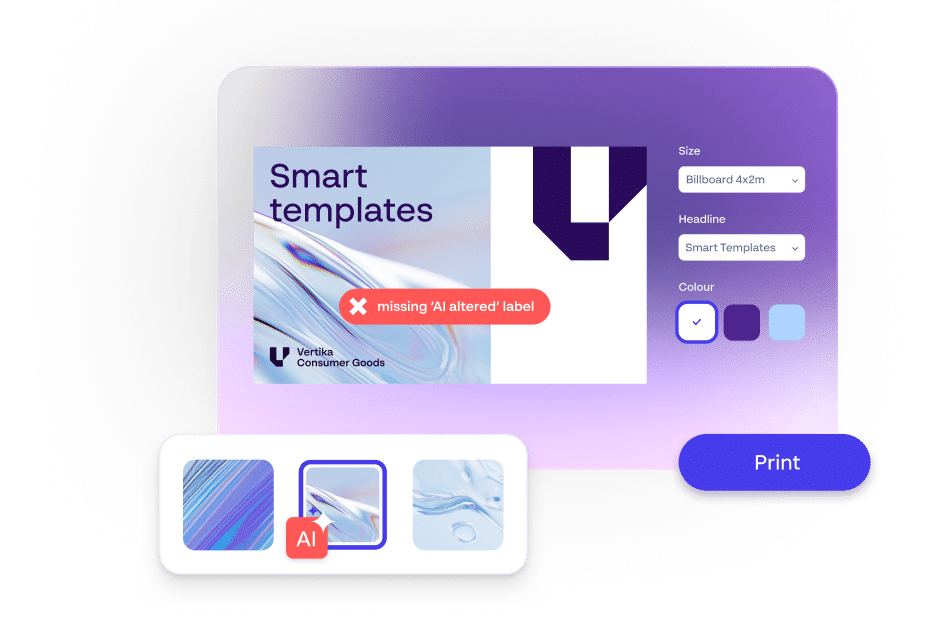
Graphic showing the missing AI label required by the AI EU Act

What we are doing about this at Papirfly

The questions reaching me from customers are rarely legal ones. They are operational: which of our assets involved AI, who recorded that, and whether the disclosure reaches the finished advertisement.

None of what follows is legal advice, and none of it decides anything on a customer’s behalf. Whether a specific asset needs a label is their own call, based on their own reading of the Act. What Papirfly provides is the mechanism.

Preservation comes first in how we have sequenced this. Where assets arrive carrying industry-standard content credentials, we keep that information intact as they move through the platform – because a system that discards provenance breaks the chain its customers depend on further downstream.

On top of that, teams can:

  • Flag AI involvement on any asset – AI generated, AI modified, or neither – with a clear visual indicator in the platform.
  • Filter the library to locate AI-involved assets for review or audit.
  • Map existing metadata across so assets are flagged automatically rather than by hand.
  • Add an AI label or disclaimer to documents produced in the platform, either using the EU icon, or in their own wording, design, and placement.
  • Identify every Papirfly feature that uses AI through an AI icon, so people always know when they are working with an AI tool.

Every organization interprets the Act slightly differently, so none of this is fixed. There are several ways to configure it depending on the workflow and how prominent labeling needs to be, and more of it becomes automatic over time.

Two commitments on our own content, neither of them required of us under Article 50. Any article on this blog produced with AI assistance carries a note saying so, and any image published here that has been materially altered with generative AI is identified as such.

Waiting for a legal floor to force that question is not a brand governance strategy.

Conclusion

Less landed on brand teams on August 2 than the headlines implied, and more will be asked of them than the law strictly requires. Both things are true at once, and planning for only one of them is the mistake.

The legal question – which specific assets trigger a disclosure duty – belongs with counsel. The operational question is whether the systems storing and producing brand content can reliably answer “was AI involved here,” and carry that answer through to whatever gets published.

The principle worth holding onto is that provenance is only useful if it survives into the output. Teams able to trace AI involvement from asset to published artifact will find every version of this question easier – the regulatory one and the commercial one alike.

See how compliance works inside your asset library

Consent status, automatic flagging, and audit trails.

See how compliance works inside your asset library

Consent status, automatic flagging, and audit trails.

Consent status, automatic flagging, and audit trails.

graphic showing ai feature for gdpr compliance

FAQs

What exactly changed on August 2, 2026 under the EU AI Act?

The transparency obligations in Article 50 became applicable, covering AI system disclosure, machine-readable marking of AI-generated content, notification for emotion recognition and biometric categorization, and visible disclosure of deep fakes. The penalty provisions became operative on the same date, with fines for Article 50 breaches reaching up to €15 million or 3% of worldwide annual turnover.

Does the EU AI Act require all AI-generated marketing content to be labeled?

The visible disclosure duty on deployers applies to deep fakes and to AI-generated text published to inform the public on matters of public interest, not to all AI-assisted marketing content. Machine-readable marking is a separate duty that falls on providers of generative AI systems rather than on the brands using them.

Was the AI Act’s transparency deadline delayed by the Digital Omnibus?

Almost entirely no. The Digital Omnibus moved high-risk obligations to December 2027 and August 2028, but left the Article 50 transparency duties applicable from August 2, 2026. The single exception is a short transition allowing providers of generative systems already on the market to implement machine-readable marking by December 2, 2026.

Who is responsible for labeling AI content, the brand or the AI vendor?

It depends on which duty is in question. Machine-readable marking of generated output is a provider obligation, so it sits with the AI tool vendor, while visible disclosure of deep fakes and certain public-interest text sits with the deployer publishing the content.

Does content created before August 2, 2026 need an AI label?

Content generated before that date does not need to be labeled retroactively. The European Commission encourages organizations to do so where possible, but it is not a requirement.

Brand Management

Franchise brand management software your franchisees will actually use

There is no greater test of your franchise marketing processes than a World Cup, when every round brings a new menu, a special cocktail, or a two-for-one offer to promote.

But let’s imagine a franchisee in one of your busiest locations puts together a match-day promotion for the weekend fixtures. To advertise it, they open a free design app, grab a logo they found on Google, pick a font that is not yours, and post the flyer to the location’s Facebook page by Friday lunchtime. It fills the bar. It also looks nothing like your brand.

By the time anyone at head office sees what these shadow tools have produced, forty other sites have run their own version. If you lead marketing for a franchise hospitality group, you know this is not a hypothetical. And the honest problem is that the franchisee did nothing wrong. They had the busiest weekend of the year to sell and no faster way to make the creatives.

The key franchise brand management issue is brand governance

Most of the platforms and frameworks sold to franchise brands were built for a different kind of company. They were designed for owned chains, where head office employs the people running each site and can require them to follow a process.

Franchise networks do not work that way. Your franchisees are independent operators who own their businesses. You can set standards in the franchise agreement, but you cannot mandate a workflow the way a corporate HQ directs staff on a payroll. Adoption has to be earned. This is not a fringe dynamic.

As of 2025, multi-unit operators, franchisees who run two or more sites, control 58.8% of all franchised locations (Source: IFA and FRANdata, 2026 Franchising Economic Outlook). The people carrying your brand into local markets are independent businesses with real scale, not staff you can direct.

That structural difference breaks three approaches that work perfectly well for owned chains:

  • PDF brand guidelines. Nobody running a bar on a Saturday night reads a forty-page document.
  • Searchable asset libraries. They only help operators who come looking, and busy operators do not come looking.
  • Centralized production, where head office designs everything and ships finished artwork to each site. It feels safe, but it creates dependency rather than capability, and it cannot move at the speed local marketing needs.

Every one of these assumes a level of compliance you are not structurally able to require.

What earned adoption actually looks like

If you cannot mandate adoption, you have to win it, the same way any product wins users: by being the easiest option in the room.

Picture the same franchisee with the match-day promotion. This time they log into a brand portal, pick a promotion template, drop in their offer and their date, and export a finished, on-brand flyer in under ten minutes. No designer. No brief to head office. No agency invoice.

They stayed on-brand not because a contract told them to, but because it was faster than the alternative. That is what earned adoption looks like, and it only holds if the experience itself is the incentive.

of high-performing multi-location brands run a dedicated local marketing strategy

of high-performing multi-location brands run a dedicated local marketing strategy

This is not a soft benefit. BrightLocal found that 94% of high-performing multi-location brands run a dedicated local marketing strategy, compared with 60% of average performers (Source: BrightLocal Brand Beacon Report, 2024). Enabling local marketing is not a threat to the brand. It is what the strongest brands already do.

Getting there depends on one decision: what you lock and what you leave open.

  • Lock what must never vary. Menus, logo, core identity, and legal disclaimers, built into the templates so they are correct by default and cannot be broken.
  • Leave open what needs local speed. Seasonal offers, a match-day promotion, a reactive post about a result or a local event, so operators can act without asking permission.

Get this balance wrong in either direction and you lose. A tool that locks everything kills local marketing, so operators go back to the free design apps. A tool that locks nothing kills the consistency you built the system to protect.

What this looks like in practice

This is not theory. One franchise network that has solved it well is O’Learys, the Swedish sports bar and restaurant franchise, with around 140 independently owned locations.

Head office could not dictate how sites marketed themselves, so rather than enforce adoption it earned it, through a year-long rollout with hands-on training that got every site creating in the portal. Today every location is actively producing on-brand content, and the network makes around 5,000 assets a year, without a designer sitting between the operator and the finished flyer.

What franchise marketing leaders should expect from their tools

So if you are evaluating what to put in front of your franchisees, judge it by their reality, not by a feature list. In my experience, a few questions separate the tools that get adopted from the ones that gather dust:

  • Can a site owner create a seasonal promotion in under ten minutes, without contacting head office? If not, they will find a faster route, and it will be off-brand.
  • Does the platform protect brand-critical elements automatically, rather than routing every asset through manual approval? Good Templated Content Creation builds the guardrails into the template, so on-brand is the default.
  • Is there role-based access, so a country manager sees something different from an individual site? That is where strong Digital Asset Management earns its place.
  • Does adoption come from ease of use, or does it depend on enforcement? If the honest answer is enforcement, the system fails the moment you stop pushing.

The takeaway is simple. You cannot police brand consistency across a network of independent operators. You can only make the on-brand choice the easiest one on the table.

For too long we have treated brand governance in franchising as policing, chasing down the bad flyer after it is already live. The brands pulling ahead treat it as infrastructure, and let consistency take care of itself.

Give franchisees a brand tool they’ll actually use

See Papirfly’s franchise brand management software in action.

Give franchisees a brand tool they’ll actually use

See Papirfly’s franchise brand management software in action.

See Papirfly’s franchise brand management software in action.

Custom brand portal interface surfacing legacy assets to showcase brand heritage interactively

FAQs

Why is brand consistency harder in a franchise than in an owned chain?

Because franchisees are independent business owners, not employees. HQ can set standards in the agreement but cannot mandate which tools sites use day to day. Consistency has to be earned through ease of use rather than enforced through a workflow.

Can independent operators create their own local content without going off-brand?

Yes, if the templates do the work. Lock the elements that must never change, such as menus, logo and legal lines, and leave seasonal and local content open. Anything a site creates then stays on-brand by default.

What is the difference between locked and flexible templates?

Locked templates protect brand-critical elements that must be identical everywhere. Flexible templates let sites move fast on time-sensitive local moments like a match-day promotion. The balance keeps both consistency and local speed intact.

How do you get independent franchisees to adopt a brand portal?

You make it the fastest way to get the job done. When creating an on-brand asset is quicker than opening a design app or briefing an agency, adoption follows without enforcement. Hands-on onboarding at rollout helps sites get comfortable early.

Does this work for both franchised networks and owned multi-site chains?

It works for both, but the governance approach differs. Owned chains can mandate process, while franchise networks have to earn adoption. The locked and flexible model, plus role-based access, supports either.

Brand Management

Local marketing: A guide for multi‑location and franchise brands

A single brand identity, playing out across dozens or hundreds of local markets, each run by a different manager, franchisee or store team. That’s the reality for most multi-location and franchise brands, and it’s also where most of the growth happens.

A small central marketing team cannot produce and approve everything every location needs, so locations fill the gap themselves and the brand starts to drift.

This guide covers what local marketing means for a network, the tension between central control and local speed, and how to close that gap without losing brand control.

What is local marketing?

Local marketing is the practice of promoting a business to customers in its immediate area, rather than to a national or global audience. For a single-location business, that’s the whole plan: one address, one community, one set of local channels.

World with location pin graphic

of consumers say they always or often add ‘near me’ to their local search queries

World with location pin graphic

of consumers say they always or often add ‘near me’ to their local search queries

In practice, a network runs local marketing on two layers: national campaigns that set positioning and creative direction, and local execution that adapts each campaign to its own market.

The difference between local marketing and multi‑location marketing

The two terms overlap but answer different questions. Local marketing is the activity itself: the SEO, social, ads and events that reach customers in one area.

Multi-location marketing is the challenge of running that activity consistently across many areas at once, under one brand. A network needs both: strong local marketing in every market, and multi-location marketing that keeps it all coordinated.

Central brand control vs local execution

Every multi-location and franchise brand sits somewhere on the same spectrum. Central wants to protect brand standards built over years of investment, while locations want to move at the speed their market demands: a local promotion, a same-week event, a timely social post.

Neither side is wrong. Central owns how the brand is perceived everywhere; locations own their own customers, right now. The goal is a system where staying on-brand is the easiest option, not an extra step that slows a location down.

What happens when that balance tips too far either way is predictable.

What happens when central controls everything

When every asset must be requested, reviewed and approved centrally, requests pile up faster than a small team can clear them. A national rollout slows because a hundred locations wait on the same handful of people, each risking a missed moment.

What happens when locations are left alone

When locations are free to create their own marketing without oversight, off-brand content spreads fast: mismatched logos, outdated messaging, inconsistent offers. Customers meet the brand at the location level, so that’s exactly where brand consistency across locations breaks first, undoing years of brand-building in one interaction.d treat it as infrastructure, and let consistency take care of itself.

Comparison showing how local marketing balances brand governance with local flexibility to avoid bottlenecks and off-brand content.

5 key local marketing channels

Most local marketing channels need a national layer and a local layer to work properly: national sets the standard, local adapts it. Here’s how that plays out across the five channels that matter most.

1. Local SEO and Google Business Profile

Local SEO covers everything that helps a location appear when someone searches nearby: an optimized Google Business Profile, consistent listings and location pages. A complete Business Profile makes a visit 70% more likely and a purchase 50% more likely (Source: Google, via BrightLocal, 2026).

2. Localized social media

National social builds brand affinity; local social builds community. Each location benefits from posting its own events and offers, provided the tone and imagery stay recognizably on-brand.

3. Geo‑targeted paid ads

Paid search and social ads can be targeted to a radius around a single location, making them one of the fastest ways to drive foot traffic for a specific store or franchise. The creative still needs the same brand standards as the campaign it’s built from.

4. Local content and email

Location-specific landing pages, offers and email sends convert better than generic national messaging, because they speak to a customer’s actual market. This is where templated content creation matters most, since a location rarely has time to build these from scratch.

5. Community events, sponsorships and reviews

Sponsoring a local team, hosting an event or responding to reviews all shape how a location is perceived locally. Reviews carry particular weight: 97% of consumers read reviews for local businesses before deciding where to spend (Source: BrightLocal, 2026).

4 common local marketing problems at scale

These channels only work if the system behind them holds together. Most multi-location and franchise brands run into the same four problems.

1. External creators making off‑brand content

Franchisees, local agencies and well-meaning store managers create their own flyers, posts and ads outside any central process. Without templates or guardrails, this content drifts from brand guidelines quickly.

2. The central team is a bottleneck

A small brand team cannot personally produce and approve content for hundreds of locations. Every request stuck in a queue is a local opportunity slipping past.

3. Consistency breaks across locations

Even with good intentions, manual processes produce inconsistent results: one location’s social feed looks nothing like another’s, and offer details drift out of sync. Customers notice these gaps.

4. No visibility into what each location publishes

Without a central system, brand and compliance teams often have no reliable way to see what’s been published, where or by whom. That makes it hard to catch problems early, or prove compliance if it’s ever challenged.

What is local marketing automation?

Local marketing automation is the system that lets a central team produce brand-approved templates once, so every location can localize, approve and publish its own version without starting from scratch. Done well, it combines templated assets, automated distribution and built-in approval workflows.

This differs from CRM or email automation, which focus on sending the right message to the right customer at the right time. Local marketing automation focuses on the creative itself, making sure what a location produces is on-brand before it’s published.

Multi‑location marketing software: what to look for

Multi-location marketing software is the category of tools built to let a central team govern local marketing at scale, rather than manage it location by location. The right platform combines asset control with the flexibility locations need to move fast:

  • A centralized asset library (Digital Asset Management) for approved brand assets.
  • Templated content creation so non-designers can localize campaigns without breaking brand guidelines.
  • A brand portal giving locations, franchisees and partners self-service access to what they’re allowed to use.
  • Role-based access and permissions, so each location sees only what’s relevant to them.
  • Approval workflows that keep central sign-off without it becoming the bottleneck.
  • Analytics and reporting showing what’s published, where and how it’s performing.

For a deeper look, see this digital asset management guide.

How Papirfly helps you run local marketing at scale

Papirfly’s DAM, Templated Content Creation and brand portal work together to solve these problems, connecting central brand control to local execution instead of forcing a trade-off.

One source of truth for every brand and local asset (DAM)

Papirfly’s DAM gives every location one governed library for brand and campaign assets, replacing the shared drives and outdated PDFs that usually stand in for a system.

Templated content locations can localize

Templated Content Creation lets a location build its own flyer, social post or local ad from a national template, without design skills or an agency. The output is on-brand by default, because the template only allows changes a location is permitted to make.

A brand portal every location can access

A brand portal gives each location, franchisee or partner self-service access to the assets and guidelines relevant to them, without opening up the whole brand library. It becomes the one place every local marketer starts from.

Lock what can’t change so off‑brand work isn’t possible

Locking functionality lets a central team fix elements that must never change, like the logo, colors or required disclaimers, while leaving locations free to localize everything else. Off-brand work stops being a risk to manage, because it isn’t possible to produce.

Local marketing for franchises

Franchises add a layer the standard multi-location model doesn’t have: the franchisee owns the location, but the franchisor owns the brand. Central can’t enforce standards on a business it doesn’t operate, so franchise marketing has to enable franchisees rather than police them.

A brand portal and templated content solve this, giving franchisees the same self-service access and ready-to-localize templates a central team would use itself. Locked brand elements and tracked publishing give the franchisor visibility over who’s published what, without approving every asset by hand.

Start running local marketing on‑brand with Papirfly

Every multi-location and franchise brand faces the same choice: build a system where staying on-brand is the easy option, or keep managing the fallout when it isn’t. Getting local SEO, social, ads, content and events right in every market depends on solving that system problem first.

Papirfly’s DAM, Templated Content Creation and brand portal are built for exactly this: control without becoming a bottleneck, and local speed without the risk of going off-brand. Explore Papirfly’s franchise marketing software to see how it fits your network.

See Papirfly in action

Discover the solution built around your network.

See Papirfly in action

Discover the solution built
around your network.

Discover the solution built around your network.

Frequently asked questions about local marketing

How do franchise brands keep local marketing on‑brand?

Franchise brands stay on-brand by giving franchisees templates and locked brand elements instead of relying on manual approval. A brand portal like Papirfly’s gives every franchisee self-service access to approved assets, so local campaigns stay on-brand by default.

What software do multi‑location brands use for local marketing?

Multi-location brands typically combine a Digital Asset Management (DAM) system, templated content creation tools and a brand portal. Papirfly brings all three together in one platform, giving central teams brand control while locations localize campaigns and publish for their own market.

What is an example of local marketing?

A store’s own social post about a weekend event, alongside the brand’s national campaign, is local marketing in action. So is a franchisee running a geo-targeted ad for a local offer, or a manager responding to local reviews.

Content Creation

How to empower field teams with Figma Design Templates

Over the past decade, Figma reshaped how brand and marketing teams in large enterprises design at scale. With more than 13 million monthly active users and 95% of the Fortune 500 on the platform (Source: Figma S-1 filing, 2025), it became the shared canvas for creating social assets, carousels, flyers, and campaign graphics.

But there’s a gap between where content is designed and where most of it is actually produced. The people creating day-to-day marketing — local offices, dealers, stores, franchise owners — rarely use Figma at all. So how do you give field teams the speed to adapt content locally without losing control of the brand? That is the question this article answers.

Why scaling content creation still breaks at the edges

Enterprise brand teams have mastered central design. The problem is volume: the majority of real-world content isn’t made at HQ — it’s made across hundreds or thousands of frontline teams who need localized versions fast.

Those teams don’t live in Figma. A store manager or regional rep adapting a campaign for their market has little to no design skill and no reason to learn a professional design tool. When the approved route feels too slow, they improvise in whatever is nearest — and off-brand content ends up in the field at scale.

Brand guidelines graphic

of companies have brand guidelines that are widely used and recognized throughout the organization.

Brand guidelines graphic

of companies have brand guidelines that are widely used and recognized throughout the organization.

For a Director of Brand, that gap between guideline and reality is a governance risk. For a marketing lead, it’s redundant work, slow campaigns, and inconsistent execution across markets.

What customers told us about the real bottleneck

In conversations with design leads at customer organizations, a consistent pattern emerged. Figma is their single source of truth for brand assets, but the handoff is manual: build every possible layout, meet with a project manager, then export a PDF to be templated.

That process keeps the designer in the loop for every regional variation. One team producing localized ads across multiple regions named the deeper issue — without enterprise-grade controls, everyone in their design files has to be a full editor.

So there is no way to separate who can edit from who can only review. Individually assigned editing and approval rights were the advantage they said they needed — the exact control gap that turns “we have brand guidelines” into “our field teams work around them.”

The unlock: put localization in the hands of the field

The answer isn’t more central production — it’s giving field teams a safe way to adapt content themselves. They know their own market, their own language, and their own customers better than HQ ever will.

Papirfly’s new Figma Design Templates capability makes that possible. It quickly turns any Figma design into a locked, on-brand, editable template. Central teams design once; local teams then create endlessly without design support, adapting copy, color, images, and calls to action inside a framework that can’t be broken.

This connects directly to Papirfly’s 2026 direction: empowering global brands with an AI-first Digital Asset Management (DAM) and content creation platform that delivers immediate ROI through intelligent automation and intuitive self-service.

Figma Design Templates advance the self-service goal by cutting templating onboarding time by reducing time-to-value by letting teams reuse the design files they already have rather than commissioning new builds. You can see the wider approach with Papirfly’s Templated Content Creation.

How HQ publishes a template in minutes

Rolling out a Design Template is a short, controlled workflow — not a development project. Three roles make it work, and each keeps its natural lane.

  1. The designer or agency prepares the file in Figma and exports it through the Papirfly plugin, optionally setting simple logic such as a dropdown that shows, hides, or recolors elements.
  2. The template administrator imports the file into Produce, maps the fonts, and sets the locking rules — deciding exactly which fields a content creator may edit and which stay fixed.
  3. The field team member opens the finished template in the Local Marketing Tool and localizes it to their needs, producing print-ready or post-ready output in minutes.
Figma design templates interface showing font mapping and locked brand elements for consistent content creation across teams.

The administrator retains full control over what’s locked versus editable, what asset to use in the template, and who can access each template. That combination — creative freedom inside firm brand rules — is what makes local production safe. For a wider view of enabling non-designers, see how Papirfly helps empower frontline employees to create content.

Who buys it, who runs it, and who wins

The buyer is typically the Director of Brand or CMO — accountable for brand consistency at scale and for the cost of design bottlenecks. The template administrator, often a marketing operations owner, runs the day-to-day: plugin access, locking, and approvals. The design lead keeps working in Figma, reusing existing files rather than rebuilding elsewhere.

The people who win most are the field teams and the enterprise as a whole. Local markets launch faster, HQ reclaims time lost to adaptation requests, and the brand shows up consistently across retail, banking, energy, automotive, healthcare, and every other multi-market operation.

Conclusion

Figma changed how enterprises design. Papirfly’s Figma Design Templates change who gets to use that design — extending it from a central team to every field team that needs to move fast and stay on-brand.

The result is measurable: less off-brand content, faster local execution, and design talent freed from repetitive requests. For brand leaders and marketing operations owners managing localization across regions, that’s the difference between guidelines that exist and guidelines that get followed.

Figma Design Templates are currently in beta with pilot customers, with a wider rollout planned for later in Q3. Reach out to your Papirfly contact to join the waiting list and get involved early.

FAQs

What are Figma Design Templates in Papirfly?

They are editable, on-brand templates created by importing a Figma design into Papirfly’s Produce tool. A central team designs once, and field teams adapt copy, images, and colors within locked brand rules — no design skills required.

How long does it take to turn a Figma file into a usable template?

What used to take weeks of consultation can now be done in a matter of hours or less. A designer exports the file through the Papirfly plugin, an administrator maps fonts and sets locking rules, and the template is ready for field teams to use.

Do field teams need to know how to use Figma?

No. The Figma work happens once, at HQ or with an agency. Field teams only interact with the finished template in Papirfly’s launcher, where editing is as simple as filling in the fields the administrator has unlocked.

Can administrators control what field teams are allowed to change?

Yes. The template administrator decides exactly which elements are locked and which are editable, and sets permissions for who can access each template — so local teams get creative freedom without any risk of breaking the brand.

When will Figma Design Templates be generally available?

The capability is in beta with pilot customers now, with a wider rollout planned for later in Q3 2026. Contact your Papirfly representative to join the waiting list.

Brand Management

The complete guide to hospitality branding

Central marketing publishes a refreshed brand manual. Six months later, half the sites across the network still use old logos, regional managers design posters in Canva, and franchisees have quietly invented their own visuals.

It’s a familiar scenario for anyone running marketing across a hotel group, food and beverage (F&B) brand, resort brand or franchise network.

This guide covers what hospitality branding involves, the common problems multi-location brands face, and how to build a marketing strategy that supports the brand at every location – plus the tools that make consistent execution possible at scale.

See how Thon Hotels manages the brand across 90+ properties with Papirfly

What is hospitality branding?

Hospitality branding is how a hotel group, food and beverage chain, or any type of hospitality franchise network expresses a consistent identity across every location a guest might encounter. It spans far more than a logo or color palette – it’s the sum of every signal a guest and employee experiences.

Hospitality branding typically includes five components:

  1. Brand strategy (the positioning and promise the group wants to be known for)
  2. Visual identity (logo, colors, typography and imagery)
  3. Guest experience (how the brand feels from check-in to a welcome email)
  4. Marketing execution (the campaigns and local promotions that bring it to life commercially)
  5. Location-level activation.

Location-level activation is where everything either holds together or falls apart – it’s the day-to-day reality of an on-site team producing a flyer, a social post or a seasonal offer.

Why hospitality branding matters

Guests choose brands they trust. In a category built on repeat visits and word-of-mouth, a recognizable, consistent brand shortcuts the decision when guests are comparing similar-looking properties or locations.

Brand strength drives direct demand. Whether it’s a hotel booking or a restaurant reservation, brands guests search for by name outperform those only discovered through a third-party platform.

Direct digital bookings are projected to generate more than $400 billion in hotel gross bookings by 2030, overtaking online travel agencies

Direct digital bookings are projected to generate more than $400 billion in hotel gross bookings by 2030, overtaking online travel agencies.

Brand consistency is harder when you scale. Top-performing hotel brands have achieved a cumulative RevPAR premium of 41% over weaker competitors (Source: CBRE, 2025), and that premium depends on every location delivering the same experience.

Brand drives employee alignment. A clear brand gives on-location teams and franchisees a shared reference point, reducing the guesswork that leads to off-brand decisions.

Common hospitality branding problems multi-location brands face

Most hospitality marketing leaders recognize the following problems:

  • Brand guidelines exist but aren’t followed. A polished brand book gets circulated once and sits unopened, because it isn’t built into the tools on-location teams use day-to-day.
  • Local teams create off-brand collateral. Without ready-made templates, on-site and regional teams turn to whatever software is on hand – often generic tools with no brand controls.
  • Central marketing is the bottleneck. Every local request for a poster, menu, or social asset routes through a small central team, who end up producing one-off collateral instead of developing the brand.
  • Franchisees have minimal control. Franchisees own and operate the location premises but don’t own the brand, leaving a gap between what they’re expected to represent and what they’re equipped to produce.

Assets are scattered across drives, agencies and email. Logos, photography and templates live across shared drives and inboxes, with no single source of truth for any location to draw from.

So what can your brand do to fix this?

How to build a hospitality branding and marketing strategy

Getting from a brand manual to consistent execution across every property or location takes a deliberate sequence.

  1. Define your brand strategy. Establish the positioning, guest promise and values that every other decision needs to support.
  2. Build a visual identity that travels. Design a visual system flexible enough to work across location sizes, markets and media, not just the flagship property.
  3. Showcase the brand identity in living brand guidelines. Move brand rules out of a static PDF and into a format that updates centrally and reflects instantly wherever teams work.
  4. Plan a hospitality marketing strategy that supports the brand. F&B calls for fast, promotional campaigns; hotels call for slower, experiential ones. Align campaigns, promotions and channel plans so marketing activity reinforces your target audience.
  5. Empower properties to execute locally. Give property, restaurant and franchise teams templates and self-service tools to produce their own on-brand marketing.
  6. Measure and adapt. Track which properties and locations are publishing on-brand content and which assets get used, so the strategy evolves.

How Papirfly helps hospitality brands stay consistent at scale

Each problem above has a practical fix, and it starts with connecting the brand to the systems location and franchise teams already work in.

A single source of truth for every brand asset

Digital Asset Management (DAM) replaces scattered drives, agency folders and email attachments with one governed library. Every location, region or franchisee pulls the current logo, photography and campaign asset – never an outdated version found in an old email.

A live brand portal every location can access

A brand portal gives every location, region and franchisee a self-service home for guidelines, assets and campaign context, accessible the moment they need it. This turns a brand manual from a document into something teams actually use.

Templated content creation for multi-location networks and franchise teams

Template-based content creation lets non-designers at location level produce studio-quality, on-brand marketing in minutes; a poster, a social post, a menu insert, and more. Central marketing builds the template once; every location localizes it correctly without being able to touch and tweak fundamentals like the logo or official color palette.

Made for multi-region and franchise hospitality groups

Together, a DAM, brand portal and templated content creation work as one system built for groups managing multiple brands, regions or franchise agreements from a lean central team. Brand consistency stops depending on head office chasing every location.

How Thon Hotels revamped its marketing operations with Papirfly

Papirfly’s customer Thon Hotels runs more than 90 properties across Norway, Belgium, Sweden, Denmark and the Netherlands with a small central brand team. Before Papirfly, the central team was buried in case-by-case asset requests, and some properties were resorting to Word to produce their own collateral.

Pernilla Eidslott

Marketing Advisor at Thon Hotels

“We can see that the consistency in the brand has greatly improved. Actually, my manager was told at a convention by a competitor that they also noticed the change – that it’s now very easy to see that it’s Thon Hotels because it always looks the same!”

Hospitality branding in the franchise model

Franchisees own and operate the location, but the brand belongs to the franchisor – and that tension sits at the center of every franchise hospitality group’s branding challenge. Brand consistency here can’t be enforced by central marketing alone; it has to be built into the system that franchisees work in every day.

A brand portal paired with templated content creation resolves this by design. It gives franchisees self-service access to the brand they signed up to represent, alongside ready-made campaign templates they can localize for their own market.

Franchise brand management teams must use templates in order to lock specific elements – logos, colors, fonts – to make off-brand work structurally impossible, rather than something a franchisee has to remember not to do. Central teams can also track which assets are used and which properties are publishing on-brand content.

See how O’Learys keeps 130+ restaurants on-brand globally with Papirfly

Get started with Papirfly for hospitality branding

Hospitality branding is a multi-location, multi-team execution problem, not just a strategy problem. Brand guidelines, a brand portal, DAM and templated content creation are what keep it consistent once it has to travel across dozens or hundreds of properties.

The unlock is empowering property and franchise teams to execute locally without breaking the brand. That’s the shift hotel groups and like Thon Hotels and F&B franchises like O’Leary’s have already made.

Achieve hospitality branding consistency

See how Papirfly scales across your network.

Achieve hospitality branding consistency

See how Papirfly scales across your network.

See how Papirfly scales across your network.

FAQs

What is hospitality branding?

Hospitality branding is how a hotel group, restaurant chain, resort brand or franchise network expresses a consistent identity across every location, covering brand strategy, visual identity, guest experience, marketing execution and property-level activation.

What is the difference between hospitality branding and hotel marketing?

Hospitality branding is the identity and promise a hotel group builds and protects. Hotel marketing is the campaigns and channels used to promote that brand commercially – marketing should support the brand, not define it independently.

How do hotel groups keep branding consistent across multiple properties?

They pair clear, living brand guidelines with tools that make on-brand execution easy at every property. A DAM, a brand portal and templated content creation together remove the guesswork that leads to off-brand collateral.

Does hospitality branding apply to restaurants and F&B brands?

Yes — the same brand governance challenges (off-brand local marketing, franchisee inconsistency, scattered assets) apply to restaurant chains and F&B franchises, and are solved the same way: a brand portal, DAM and templated content creation.

How do you manage brand consistency with franchisees?

Give franchisees self-service access to approved assets and templates through a brand portal, with locked elements like logos and colors. This home for brand consistency ensures off-brand variations aren’t possible, and track which properties are executing on-brand.

What tools do hospitality brands use to manage branding at scale?

Most multi-location groups rely on Digital Asset Management for a single source of truth, a brand portal for self-service access, and templated content creation so non-designers can produce on-brand marketing locally.

How often should a hospitality brand refresh its branding?

Most hospitality groups review their brand every 3–5 years, or sooner if guest expectations or a merger shift what the brand needs to represent. Guidelines themselves should be updated continuously as campaigns and properties are added.