

This content has been automatically translated and may include minor variations.
Every franchise brand has a presence in hundreds of local markets, and each account is run by a different franchisee or location manager. Social media is where local customers actually engage with the brand, but a small central marketing team can’t post for every location.
So franchisees post their own content, and the brand starts to look different everywhere: different fonts, tone, photos, sometimes different logos altogether.
This guide covers why franchise social media matters, how to structure accounts and guidelines that hold up across a network, and how templated content keeps every location on-brand without creating a bottleneck at head office. If you’re weighing up franchise marketing software, the sections below cover what to look for.
Why social media matters for franchises
Social is where local discovery happens. A customer choosing between nearby options is more likely to check a location’s Instagram or Facebook page than a national homepage, which is exactly where a well-run local account earns trust a national campaign cannot.
Approximately 806,270 franchise establishments operate in the US alone,
employing 8.7 million people and generating more than $800 billion a year.
Source: International Franchise Association, 2024
A network that gets this right can outperform independent competitors. Pairing a recognized national brand with a real, locally-run presence gives customers both the reassurance of a known name and the authenticity of a business that feels part of their community, which is why social sits at the center of most franchise marketing plans today.
The core tension: brand consistency vs local relevance
Central marketing wants the brand protected on every account: consistent colors, tone and messaging, wherever a customer encounters it. Local teams want to post quickly and speak to their own community, without waiting on approval from head office.
Both goals are legitimate, and the tension is structural rather than a sign either side is doing something wrong. The question is not which side wins, but how much freedom locations get and within what boundaries.
When the balance tips too far toward local freedom, off-brand posts creep in: mismatched logos, inconsistent photography, a different voice from one location to the next. Left unchecked, this is what rogue posting looks like at scale, and it affects how much a customer trusts the brand overall.
How to structure franchise social media accounts
Most franchise networks run a hybrid structure: a national or brand-level account that carries flagship campaigns, alongside individual location pages that handle local offers, events and community engagement.
Facebook and Google Business Profile are generally the easiest platforms to structure this way, since both offer native tools for managing multiple linked location pages under one parent brand. Instagram and TikTok need more judgment about whether a standalone local account is worth the investment.
A useful test: does this location have enough distinct local interest, operator capacity and content to sustain its own page?
If not, it’s often better served by a shared regional account than a page that goes quiet after a few weeks. The pay-off for getting this right is real:
Choosing the right social platforms
Not every platform deserves equal investment. Facebook and Instagram tend to carry the most weight for local discovery and community engagement, while LinkedIn matters more for franchisee recruitment than local customer engagement.
Prioritize based on where your audience spends time and what content locations can realistically produce.
A network of gyms or restaurants may lean harder into Instagram and TikTok, while a professional services franchise may get more from LinkedIn and Google Business Profile updates.
Social media brand guidelines for franchises
Social-specific brand guidelines are the governance layer that keeps every account recognizable, even when hundreds of different people are posting. They need to go further than a general brand book, because social moves faster and involves far more contributors.
At minimum, guidelines should cover visual consistency, such as logo use, color palette and photography style, plus tone of voice for captions and comment replies. They should also state which elements a location can and cannot change, what hashtags to use, and how to handle complaints in public replies.
Framed this way, guidelines aren’t a restriction; they’re the reason a customer can walk into any location and recognize the brand immediately, whether they found it through a national ad or a local post. See how brand consistency across locations affects customer trust.
Social media marketing templates for locations
Templates turn brand guidelines into something a busy franchisee can actually use. Instead of interpreting a brand book, a location manager opens a pre-built template, edits only the fields they’re allowed to change, and publishes something on-brand in minutes.
This is where speed and consistency stop competing. Locked elements, such as the logo, color palette and layout, stay untouched, while editable fields, like the local offer or event date, give each location room to speak to its own audience.
Well-designed templated content creation removes the need for local teams to have design skill, and removes the need for central marketing to manually review every post before it goes live.
Building a franchise social media content strategy
A workable content strategy blends national and local content on a shared calendar, so head office campaigns and local activity never clash. National content typically covers flagship promotions and brand-wide announcements, while local content covers community events and location-specific offers.
Coordinating this doesn’t mean controlling every post. Build the calendar around fixed national moments, then leave defined space around them for local customization, whether that’s a seasonal offer, a partnership or a community shout-out.
Common franchise social media mistakes
Most of the problems franchise networks run into on social media come down to a handful of recurring issues.
- Inconsistent posting across locations, where some accounts post daily and others haven’t updated in months, damages the network’s credibility as a whole, not just the quiet location’s reputation.
- Ignoring local relevance by pushing only national content leaves locations feeling like an afterthought, and gives customers no reason to follow a local page over the national one.
- Off-brand or rogue posts, from mismatched logos to an inconsistent tone, chip away at the recognizability that makes a franchise brand valuable in the first place.
- No approval process for what gets published means problems are caught after they’ve already reached customers, rather than before.
- Missing user-generated content (UGC) rights, where a location reposts a customer photo or video without permission, creates real legal exposure for the whole organization, not just the local branch.
If you’re comparing platforms to fix these issues, our roundup of the best franchise marketing software is a good next stop.
How Papirfly helps franchises stay on-brand on social
Every pain above comes down to the same root problem: a small central team cannot manually govern what hundreds of locations post. Papirfly’s Digital Asset Management (DAM), Templated Content Creation and brand portal work together to solve that without slowing local teams down.
One source of truth for social and brand assets (DAM)
A Digital Asset Management system gives every location access to the same approved logos, photography and campaign assets, instead of sourcing their own images or reusing outdated files. When the source of truth is centralized, off-brand assets stop entering the network at all.
Templated social posts locations can localize
Locations use ready-made templates for offers, events and seasonal campaigns, editing only the fields they’re permitted to touch. This is the practical version of the earlier balance: national marketing keeps brand elements locked, while local teams still speak to their own community.
A brand portal every location can access
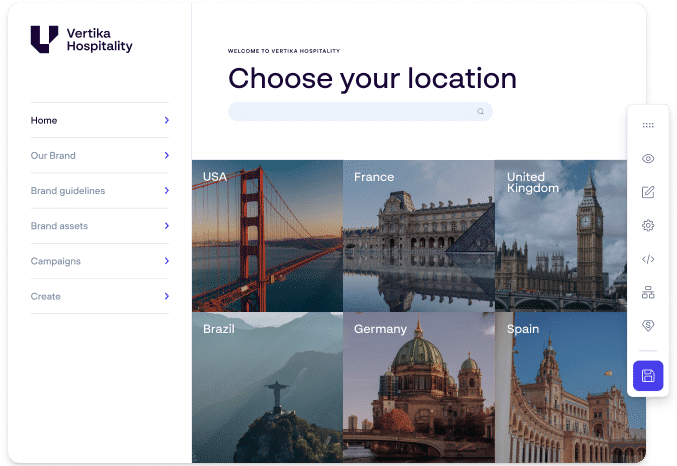
A brand portal gives every franchisee, regardless of location or team size, one place to find approved templates, guidelines and assets, rather than chasing head office for the right file. That single point of access often determines whether guidelines actually get followed.
Lock brand elements so off-brand posts aren’t possible
Locking functionality means a franchisee simply cannot edit the logo, brand colors or core layout, even if they wanted to. It replaces manual review with a structural safeguard, so off-brand output stops being a risk that has to be caught.
Run franchise social media on‑brand with Papirfly
Getting franchise social media right means resolving the tension between central control and local relevance, not picking a side. That means clear account structure, usable guidelines, and templates that let local teams move fast without going off-brand.
Brands that manage this well protect what makes their name recognizable while letting every location feel genuinely local. The ones that don’t end up with a network that looks like dozens of different businesses loosely wearing the same logo.
Papirfly brings DAM, Templated Content Creation and a brand portal together so franchisors don’t have to choose between speed and consistency. See it in action with a personalized demo.
See franchise social media done on‑brand
Let everyone create in an instant.
See franchise social media done on‑brand
Let everyone create in an instant.
Let everyone create in an instant.
Frequently asked questions about franchise social media
Should each franchise location have its own social media account?
It depends on the platform and the location’s capacity. Facebook and Google Business Profile support linked location pages well, but a standalone account only makes sense with enough local interest and someone to run it consistently. Smaller or newer locations are often better served by a shared regional page.
How do you keep franchise social media on-brand?
Combine clear social media guidelines with templates that lock core brand elements, such as logos and colors, while leaving room for local editable fields. A shared DAM system and brand portal ensure every location works from the same approved assets.
What should social media brand guidelines include?
They should cover visual consistency, tone of voice, which elements locations can and cannot change, hashtag use and how to respond to comments and complaints. Together, these form the governance layer that keeps a network recognizable across hundreds of accounts.
How do social media templates help franchise locations?
Papirfly templates let non-designers produce on-brand posts in minutes, without waiting on head office. Locked brand elements stay protected, while editable fields let each location speak to its own community and local offers.
Table of contents:
- Why social media matters for franchises
- The core tension: brand consistency vs local relevance
- How to structure franchise social media accounts
- Choosing the right social platforms
- Social media brand guidelines for franchises
- Building a franchise social media content strategy
- Common franchise social media mistakes
- How Papirfly helps franchises stay on-brand on social
- Run franchise social media on‑brand with Papirfly
- Frequently asked questions about franchise social media