

This content has been automatically translated and may include minor variations.
I expect most central marketers can name what is wrong with brand consistency in their network. Far fewer can say which part to address first.
In my own conversations with brand and marketing leads running franchised, dealer, branch and managed networks, I kept hearing the same answers. At first I treated the answers as competing explanations, depending on sector, network size, or how independent the sites were. But it led me to dig a little deeper and what I realised is that what sounded like five separate problems is one problem at five different points.
Following my instincts, I looked to the data to accurately assess my observations. We went back over a full year of discovery conversations with distributed networks and classified each one against these five points. The result was actually more lopsided than I expected.
This is where the brand management maturity model was born, and what can help when you’re trying to decide where to start taking control of your brand consistency challenge.
What is the brand management maturity model?
The brand management maturity model describes five stages at which brand consistency breaks down across a distributed network. The stages run in sequence, and each only becomes visible once the one before it has been resolved.
A network cannot have a template flexibility problem until it has templates, or an approval bottleneck until the templates are good enough that sites want to use them. Most networks recognize all five and assume they are dealing with several at once. We’ve visualised this below:
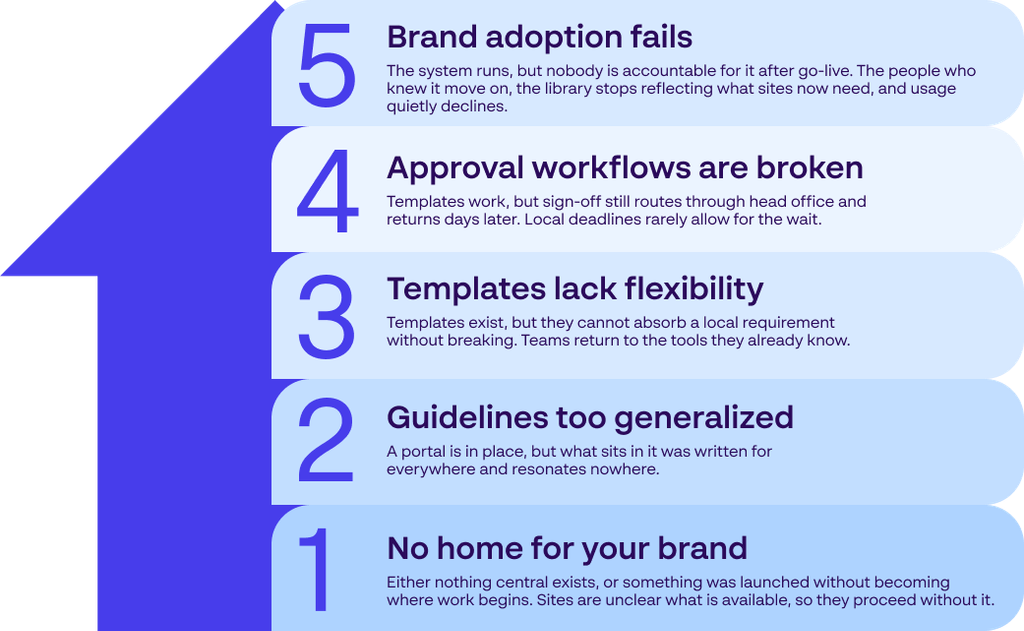
The practical consequence is that effort spent on a later stage while an earlier one is unresolved returns almost nothing. A network at stage one that invests in sophisticated approval routing has built a fast process for content nobody is producing centrally in the first place.
This happens more often than it should, and it is rarely a failure of judgment. The later stages are simply more visible to the people making decisions — an approval delay generates complaint emails that reach head office, while a site that never adopted the brand hub generates silence.
Stage one is where most networks actually are
84% of the distributed networks we spoke with over the past year were at stage one when the conversation started (Source: Papirfly new business discovery analysis, 2025–2026). Around one in ten were at stages two or three. A small minority were at stage five.
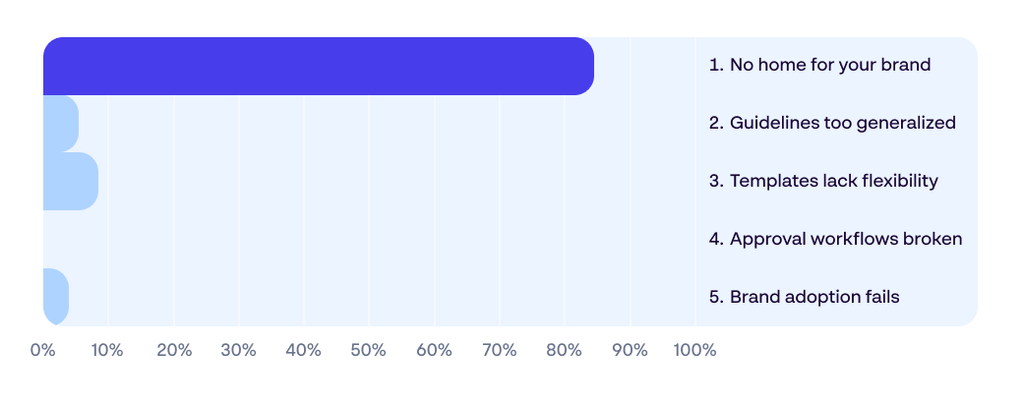
Almost none were at stage four. Approval delay is one of the most commonly voiced brand complaints in the category, and it was virtually never the thing actually holding a network back at the point it came to us.
Stage one is also the stage networks are least likely to place themselves in. They describe themselves as working on localization or approval speed, but on examination they do not yet have a place where the brand lives.
Stage one has two forms. Either nothing central exists at all, or something was launched and never became where work begins — which produces the same outcome and is harder to admit. Site Managers and their teamsare unclear what is available to them, so they proceed without it.
Drew Croeses, Account Manager at Papirfly, speaks to these networks at the point they begin looking for a solution, and continues working with them once the platform is live. In a recent webinar, I asked him what they report happening on the ground before a central home exists.
“It’s usually not framed as a brand problem when they first come to us. It shows up as an operations complaint. Someone on the marketing team tells me they had a request for the same file from three different locations in the space of a week, or a market manager who requested the same logo four times over the last quarter.”

Drew Croeses
Account Manager at Papirfly
What is needed at this stage is a single place where the brand is explained, not simply stored. The distinction that matters is between a repository location managers are told to use and a platform or folder they choose to open. This is decided by context — what an asset is for, when to use it, and the reasoning behind the rules of where to find it.
The clearest test is what a new site manager encounters in their first week. A link to a shared folder teaches them the brand is paperwork. A place that answers their questions teaches them it is something they are part of, and that difference determines whether they return.
This is where organizations with a mature Digital Asset Management (DAM) system are most often caught out. Assets are cataloged, rights are managed, metadata is clean — and the conclusion drawn is that stage one is behind them.
It usually is not. A DAM is built for people who already know what they are looking for, which describes the central team and its agencies rather than a site manager in their first week. Access frequently stops well short of the network edge, and even where it does not, an asset library explains nothing about the brand it holds.
Organized is not the same as understood. A network can have every file in the right place, correctly tagged and version-controlled, and still have no destination where individual locations can learn what the brand stands for, which campaign applies to them, or why a rule exists.
A creative director at a consumer products brand, already running a DAM, put it more plainly than I could:
“We have a brand book, but nobody reads it. It’s in a Google Drive.”
Developing brand guidelines had been a significant piece of work. They turned it into a PDF, and then nobody opened it — which left him wondering what the point had been. His description of his own job was trying to act as a brand gatekeeper in an environment that is fluid and constantly changing.
This shows up repeatedly. Close to one in ten of the networks arriving at stage one already run an established enterprise DAM, with assets governed and brand guidelines sitting inside it as a PDF (Source: Papirfly new business discovery analysis, 2025–2026). The DAM had solved a real problem.
What do stages two to five need?
At stage two a central home exists, but the guidelines governing how campaign content gets made were written for the whole network and land in no particular market. A marketing lead at a multi-site healthcare group described what follows:
“We see clinics go rogue with their own content.”
A colleague on the same call added that anything campaign-related, the sites tend to get very creative with. What they wanted was not tighter control — it was freedom for sites within a framework HQ had set.
What is needed is campaign material assembled by market rather than distributed to everyone — the idea, the assets, the guidance and the templates on one page, already relevant to the site opening it. Region and role determine what appears, but relevance is the outcome rather than the mechanism.
At stage three templates exist and break at the first local requirement. What is needed is templates that absorb local reality without failing: copy that runs long, a language that expands, a requirement nobody anticipated. That is decided element by element when the template is built, which is why some hold and others do not.
Ben Ruffel, Project Manager at Papirfly, builds and launches these systems for large decentralized networks. I asked him how he decides what stays locked and what stays open.
“There are two failure modes. Under-locking is where a central team gives away too much control, and a dealership manager can recolor the primary logo or swap a high-res photo for a grainy camera shot. The result is material no central brand team would ever approve.
Over-locking is the more common mistake. The team gets nervous about brand integrity, locks everything down, and the local operator abandons the system within five minutes and builds something off-brand in another tool instead.”

Ben Ruffel
Project Manager at Papirfly
At stage four the templates work but sign-off still routes through head office and returns days later. What is needed is review that happens where the content is made, and an explicit decision about what requires review at all. Most networks have never written that down; it lives in habit and in a few individuals, and separating what genuinely needs sign-off from what does not is where the delay disappears.
Around 81% of companies report dealing with content that does not follow their brand guidelines, and only 30% of organizations with guidelines say they are consistently enforced (Source: Lucidpress, now Marq, State of Brand Consistency Report, 2019; Marq, 2026). Those figures have barely moved in the years since.
Stage five arrives after everything appears to be working and the launch of the system is touted as a success by HQ. Here is where the central team can be blind sided by the same issue they tried solving from the get go – consistent usage. Usage does not collapse, it erodes — the people who knew the system move on, the library stops reflecting what sites now need, and activity quietly declines.
Drew’s first observation when a network raises a decline is that the decline is a visibility problem before it is an activity problem:
“Just because people stop using the system doesn’t mean they stop producing content. It hasn’t changed. We just can’t see it anymore.”
Drew Croeses
Account Manager at Papirfly
What stage five needs is a named owner and visibility of who is actually using the system. A decline noticed early indicates a need for action rather than a failure in the system itself, and it usually describes something the network now needs that nobody has built yet. Only once someone has been assigned to own the system, can those continued changes be made and local teams encouraged to stay on brand.
How do you find your starting point?
The fastest diagnostic is not a survey of your sites. It is a question about your own central team: what did the majority of their week actually consist of?
- Fielding requests for files that already exist somewhere points to stage one.
- Hearing nothing from the sites at all, while off-brand local material appears anyway, also points to stage one.
- Rewriting or adapting central material for particular markets points to stage two.
- Fixing broken layouts and handling exceptions to templates points to stage three.
- Clearing a review queue points to stage four.
- None of the above, but usage falling, points to stage five.
This works because a central team’s workload is the most reliable record of where the system is failing. Whatever the network cannot do for itself arrives at head office as a request, and the shape of those requests describes the stage precisely.
Marketers already spend substantial time on asset management, with 37% spending five to ten hours a month on it and 27% spending more than ten (Source: Storyblok, global survey of 500 marketers, 2023). Those hours are the most honest brand consistency data most organizations hold.
A second check is worth running alongside it. Ask what proportion of your sites produced anything at all through the central system last quarter — networks that assume they are at stage three or four routinely discover that a substantial share never reached stage one.
Conclusion
The five stages are not a maturity score to be reported upward. They are a way of converting a problem everyone discusses in general terms into one specific enough to act on.
Most networks are further back than they believe, and that is not a criticism of the teams running them. The stages are genuinely difficult to see from the center, because each is hidden behind the one before it.
If you take one thing from this, take the diagnostic rather than the model. Look at what your central team spent last week doing, and your starting point will identify itself.
Discover the reasons networks go off‑brand in our webinar
Learn more about the brand management maturity model.
Discover the reasons networks go off‑brand in our webinar
Learn more about the brand management maturity model.
Learn more about the brand management maturity model.

FAQs
What is the brand management maturity model?
It is a five-stage model describing where brand consistency breaks down across a distributed network. The stages run from having no central home for the brand through to having a system that runs but nobody owns, and each stage only becomes visible once the previous one has been resolved.
How do I know which stage my network is at?
Look at what your central marketing team spends most of its time doing. Requests for files that already exist point to stage one, adapting central material for local markets points to stage two, fixing broken templates points to stage three, and clearing review queues points to stage four.
We already have a DAM. Does that mean we are past stage one?
Not necessarily. A Digital Asset Management system organizes and governs files for people who already know what they are looking for, which is usually the central team rather than the sites. Stage one is only cleared when the network has a destination that explains the brand, not simply a library that stores it.
Why does the order of the stages matter?
Because effort spent on a later stage while an earlier one is unresolved produces very little return. Building fast approval routing for a network whose sites cannot find anything centrally solves a problem that network does not yet have.
Does this apply to networks that are not franchises?
Yes. The model applies to any structure where a central team holds authority over the brand but not over the people executing it — dealer networks, branch networks, managed sites, country offices and tied agents all encounter the same five stages.
Related resources
A guide for multi‑location and franchise brands
See how multi‑location and franchise brands can run local marketing on‑brand at scale.


Create unlimited on‑brand content
Explore how templated content creation helps global teams move faster while staying on brand.

Achieve brand consistency with DAM
Enable teams to use approved, compliant assets at scale.