

This content has been automatically translated and may include minor variations.
There is no greater test of your franchise marketing processes than a World Cup, when every round brings a new menu, a special cocktail, or a two-for-one offer to promote.
But let’s imagine a franchisee in one of your busiest locations puts together a match-day promotion for the weekend fixtures. To advertise it, they open a free design app, grab a logo they found on Google, pick a font that is not yours, and post the flyer to the location’s Facebook page by Friday lunchtime. It fills the bar. It also looks nothing like your brand.
By the time anyone at head office sees what these shadow tools have produced, forty other sites have run their own version. If you lead marketing for a franchise hospitality group, you know this is not a hypothetical. And the honest problem is that the franchisee did nothing wrong. They had the busiest weekend of the year to sell and no faster way to make the creatives.
The key franchise brand management issue is brand governance
Most of the platforms and frameworks sold to franchise brands were built for a different kind of company. They were designed for owned chains, where head office employs the people running each site and can require them to follow a process.
Franchise networks do not work that way. Your franchisees are independent operators who own their businesses. You can set standards in the franchise agreement, but you cannot mandate a workflow the way a corporate HQ directs staff on a payroll. Adoption has to be earned. This is not a fringe dynamic.
As of 2025, multi-unit operators, franchisees who run two or more sites, control 58.8% of all franchised locations (Source: IFA and FRANdata, 2026 Franchising Economic Outlook). The people carrying your brand into local markets are independent businesses with real scale, not staff you can direct.
That structural difference breaks three approaches that work perfectly well for owned chains:
- PDF brand guidelines. Nobody running a bar on a Saturday night reads a forty-page document.
- Searchable asset libraries. They only help operators who come looking, and busy operators do not come looking.
- Centralized production, where head office designs everything and ships finished artwork to each site. It feels safe, but it creates dependency rather than capability, and it cannot move at the speed local marketing needs.
Every one of these assumes a level of compliance you are not structurally able to require.
What earned adoption actually looks like
If you cannot mandate adoption, you have to win it, the same way any product wins users: by being the easiest option in the room.
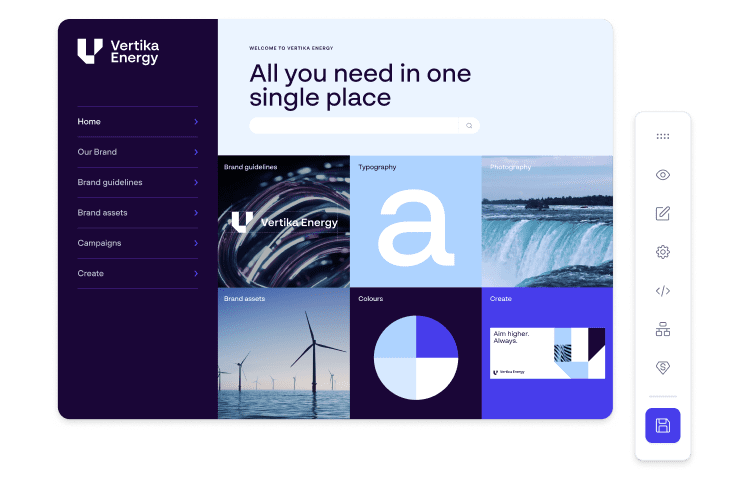
Picture the same franchisee with the match-day promotion. This time they log into a brand portal, pick a promotion template, drop in their offer and their date, and export a finished, on-brand flyer in under ten minutes. No designer. No brief to head office. No agency invoice.
They stayed on-brand not because a contract told them to, but because it was faster than the alternative. That is what earned adoption looks like, and it only holds if the experience itself is the incentive.

94%
of high-performing multi-location brands run a dedicated local marketing strategy
Source: BrightLocal Brand Beacon Report, 2024
94%
of high-performing multi-location brands run a dedicated local marketing strategy
Source: BrightLocal Brand Beacon Report, 2024
This is not a soft benefit. BrightLocal found that 94% of high-performing multi-location brands run a dedicated local marketing strategy, compared with 60% of average performers (Source: BrightLocal Brand Beacon Report, 2024). Enabling local marketing is not a threat to the brand. It is what the strongest brands already do.
Getting there depends on one decision: what you lock and what you leave open.
- Lock what must never vary. Menus, logo, core identity, and legal disclaimers, built into the templates so they are correct by default and cannot be broken.
- Leave open what needs local speed. Seasonal offers, a match-day promotion, a reactive post about a result or a local event, so operators can act without asking permission.
Get this balance wrong in either direction and you lose. A tool that locks everything kills local marketing, so operators go back to the free design apps. A tool that locks nothing kills the consistency you built the system to protect.
What this looks like in practice
This is not theory. One franchise network that has solved it well is O’Learys, the Swedish sports bar and restaurant franchise, with around 140 independently owned locations.
Head office could not dictate how sites marketed themselves, so rather than enforce adoption it earned it, through a year-long rollout with hands-on training that got every site creating in the portal. Today every location is actively producing on-brand content, and the network makes around 5,000 assets a year, without a designer sitting between the operator and the finished flyer.
What franchise marketing leaders should expect from their tools
So if you are evaluating what to put in front of your franchisees, judge it by their reality, not by a feature list. In my experience, a few questions separate the tools that get adopted from the ones that gather dust:
- Can a site owner create a seasonal promotion in under ten minutes, without contacting head office? If not, they will find a faster route, and it will be off-brand.
- Does the platform protect brand-critical elements automatically, rather than routing every asset through manual approval? Good Templated Content Creation builds the guardrails into the template, so on-brand is the default.
- Is there role-based access, so a country manager sees something different from an individual site? That is where strong Digital Asset Management earns its place.
- Does adoption come from ease of use, or does it depend on enforcement? If the honest answer is enforcement, the system fails the moment you stop pushing.
The takeaway is simple. You cannot police brand consistency across a network of independent operators. You can only make the on-brand choice the easiest one on the table.
For too long we have treated brand governance in franchising as policing, chasing down the bad flyer after it is already live. The brands pulling ahead treat it as infrastructure, and let consistency take care of itself.
Give franchisees a brand tool they’ll actually use
See Papirfly’s franchise brand management software in action.
Give franchisees a brand tool they’ll actually use
See Papirfly’s franchise brand management software in action.
See Papirfly’s franchise brand management software in action.
FAQs
Why is brand consistency harder in a franchise than in an owned chain?
Because franchisees are independent business owners, not employees. HQ can set standards in the agreement but cannot mandate which tools sites use day to day. Consistency has to be earned through ease of use rather than enforced through a workflow.
Can independent operators create their own local content without going off-brand?
Yes, if the templates do the work. Lock the elements that must never change, such as menus, logo and legal lines, and leave seasonal and local content open. Anything a site creates then stays on-brand by default.
What is the difference between locked and flexible templates?
Locked templates protect brand-critical elements that must be identical everywhere. Flexible templates let sites move fast on time-sensitive local moments like a match-day promotion. The balance keeps both consistency and local speed intact.
How do you get independent franchisees to adopt a brand portal?
You make it the fastest way to get the job done. When creating an on-brand asset is quicker than opening a design app or briefing an agency, adoption follows without enforcement. Hands-on onboarding at rollout helps sites get comfortable early.
Does this work for both franchised networks and owned multi-site chains?
It works for both, but the governance approach differs. Owned chains can mandate process, while franchise networks have to earn adoption. The locked and flexible model, plus role-based access, supports either.