

This content has been automatically translated and may include minor variations.
A small central marketing team supporting a large franchise network knows the feeling well: requests pile up faster than the team can handle, and franchisees start making their own materials just to keep local marketing moving.
The usual next step is to call a franchise marketing agency. But that is no longer the only option available to a lean team trying to protect the brand.
This guide compares hiring a franchise marketing agency against bringing franchise marketing in-house with software, and looks honestly at where a hybrid of the two makes sense. Along the way, we’ll cover what franchise marketing software should include if you go that route, and how a small central team decides between the three paths.
What is a franchise marketing agency?
A franchise marketing agency is a specialist firm that manages some or all of a franchise network’s marketing on the franchisor’s behalf. Services typically span brand strategy, paid media, local SEO, content production, and franchisee support and training.
Agencies exist because franchise marketing has a structural problem: one brand identity has to work across dozens or hundreds of locations, each with its own local audience and competitive context. That’s a lot of ground for a small in-house team to cover alone.
Why franchise marketing teams look for outside help
The tension at the heart of this decision is simple. A central team wants to protect brand standards, but a handful of people cannot realistically service an entire network on demand.
When requests outpace capacity, franchisees start creating their own flyers, posts, and local ads just to keep business moving. Consistency breaks down at the exact point where the customer meets the brand.
This is precisely the problem 47% of franchisors cite as their biggest challenge: managing brand reputation consistently across multiple markets (Source: Constant Contact, State of Franchise Marketing, 2025). It’s also why 59% of franchisors say consistency, not local performance, is the main reason they set the level of marketing control they do (Source: Constant Contact, State of Franchise Marketing, 2025). Faced with that pressure, hiring an agency is the instinctive first move — but it isn’t the only one.
Option 1: Hiring a franchise marketing agency
Bringing in a franchise marketing agency gives a stretched central team immediate access to specialist skills and hands-off delivery. It’s a well-worn path for a reason, but it comes with real trade-offs for a brand that wants to keep tight control.
Pros of a franchise marketing agency
An agency arrives with strategists, designers, and media buyers already in place, so campaigns can launch in weeks rather than months. There’s no recruitment, onboarding, or tooling to sort out first.
That breadth of expertise also means access to specialisms a small team is unlikely to have in-house, from paid media optimization to franchise-specific local SEO. For a network without the budget or the appetite to build a full team, this is often the fastest route to professional-grade output.
Cons of a franchise marketing agency
The trade-off is control. Decisions, timelines, and day-to-day priorities sit with a partner outside the business, and few agencies understand the brand as intimately as the people living it every day.
Cost is the other factor. A full-service agency retainer can run comprehensive marketing support for $50,000 to $150,000 a year, and that spend continues indefinitely rather than converting into an owned asset (Source: Chariot Creative, 2025). Over time, dependency on an external partner can also limit how quickly the central team can flex or bring work back in-house.
Option 2: Bringing franchise marketing in-house with software
The alternative is for a lean central team to run franchise marketing themselves, using software built for the job rather than handing the work to an agency.
This isn’t about doing more manually — it’s about giving a small team the tools to produce, control, and distribute local marketing at a scale that would otherwise need a much bigger headcount.
Pros of the in-house software model
The right platform lets non-designers in every location create on-brand materials in minutes, without waiting on the central team or an outside partner. Control stays entirely with the brand, and every asset produced is a reusable part of the business rather than a one-off agency deliverable.
It’s also considerably cheaper at scale. Building a comparable in-house agency-style team costs $450,000 to $550,000 a year for just four people once salaries, benefits, and tools are counted, against a fraction of that for a software platform (Source: Chariot Creative, 2025).
Cons of the in-house software model
Software doesn’t replace strategic thinking. A central team still needs to set direction, build the initial template library, and manage rollout, which takes time upfront even if it saves time later.
There’s also a learning curve for franchisees who are used to making their own materials from scratch. Getting them to adopt locked templates rather than choosing quick shadow tools (that often take you off-brand) instead requires some change management, not just a login.
The hybrid approach
Many franchise brands don’t choose one route exclusively. A common pattern is to use an agency for strategy, brand campaigns, and big creative swings, while software handles the day-to-day local execution and keeps every market on-brand between those campaigns.
This division of labour plays to each model’s strengths: the agency’s outside perspective and campaign firepower, and the platform’s speed and control for everything franchisees need day to day. It also explains why hybrid setups are becoming the norm rather than the exception — the share of B2B companies combining in-house and external marketing resources is projected to climb from 36% to 46% between 2025 and 2026 (Source: Sagefrog B2B Marketing Outlook, 2026).
Franchise marketing software: what to look for
If you’re leaning towards the in-house or hybrid route, the software you choose does most of the heavy lifting. A handful of capabilities matter more than the rest when you’re supporting a large, dispersed network.
- A portal for franchisee access: a single, intuitive brand portal for every location to find what they’re approved to use.
- Templated content creation for localization: ready-made design templates that let franchisees swap in local details without touching locked brand elements.
- Centralized asset library: the backend Digital Asset Management platform as a home for logos, imagery, and approved materials – so franchisees are never working from outdated files.
- Role-based access and permissions: the right level of control for head office, regional teams, and individual franchisees.
- Approval workflows: a clear, auditable path for anything that needs sign-off before it goes live.
- Analytics and reporting: visibility into what’s actually being produced and used across the network.
For a fuller comparison of platforms against this checklist, see our guide to the best franchise marketing software on the market today.
How Papirfly helps a small central team scale
Papirfly’s suite maps directly onto the pains a stretched central team faces, without turning day-to-day marketing into a design bottleneck.
One source of truth for every brand asset
Papirfly’s DAM gives the central team a single, governed library for every logo, image, and approved asset. Franchisees always pull from the current version, so outdated or off-brand files stop circulating.
Templated content franchisees can localize
Templated Content Creation lets franchisees build their own local materials from pre-approved templates, without needing design skills or the central team’s time. Output stays on-brand because the templates are built that way from the start.
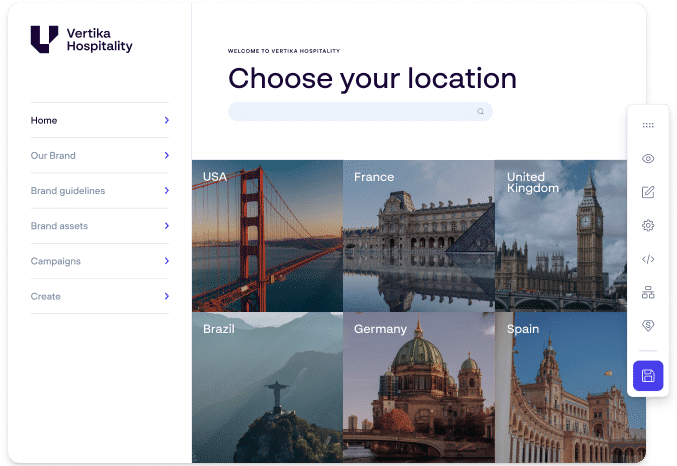
A brand portal every franchisee can access
The brand portal gives every location one intuitive place to find guidelines, campaigns, and approved templates. It replaces the scattered folders and PDF brand books that push franchisees toward off-brand shortcuts in the first place.
Lock what can’t change so off-brand work isn’t possible
Locking functionality protects the elements that matter — logos, colors, fonts — while leaving room for franchisees to customize local details. It’s how a small team enforces brand consistency across locations without reviewing every single asset by hand.
How to decide: marketing agency, templating software, or both?
Reach for an agency when the network needs strategic firepower or major campaign work that the central team genuinely doesn’t have the bandwidth or expertise to produce itself.
Lean toward software when the bulk of the workload is repeatable local execution — local versions of existing campaigns, everyday social content, in-store materials — that a locked template can handle safely. And consider a hybrid when both are true: strategy needs an outside partner, but volume demands a platform.
Franchisors who pair the right technology with clear guardrails are 2.5 times more likely to run an adaptive, best-in-class marketing operation than those who don’t (83% versus 44%) (Source: Constant Contact, State of Franchise Marketing, 2025). That gap is the clearest signal of which lever actually moves the needle for a lean team.
Scale your franchise marketing with Papirfly
A small central team can protect the brand and keep pace with a growing network, but not by absorbing every request manually or by handing the whole problem to an agency indefinitely. The right mix of strategic support and the right platform is what makes that possible.
For most lean teams, that means software that lets every franchisee produce on-brand content independently, with the central team setting the guardrails rather than doing the work by hand. Papirfly’s DAM, Templated Content Creation, and brand portal are built for exactly that job.
See how Papirfly keeps every franchise on‑brand
Scale with best‑in‑class portals and templates.
See how Papirfly keeps every franchise on‑brand
Scale with best‑in‑class portals and templates.
Scale with best‑in‑class portals and templates.
Frequently asked questions about franchise marketing agencies
Can software replace a franchise marketing agency?
For day-to-day local execution, yes — templated software lets franchisees produce on-brand content without an agency’s involvement. For strategy, major campaigns, or specialist skills like paid media, many brands still value an agency’s outside expertise.
What should franchise marketing software include?
Look for a centralized asset library, templated content creation for localization, a brand portal for franchisee access, role-based permissions, approval workflows, and analytics. Together, these let a small team govern a large network without reviewing every asset manually.
Is franchise marketing software cheaper than an agency?
Usually, yes, especially at scale. A comprehensive agency retainer typically costs $50,000–$150,000 a year on an ongoing basis, while software is a one-time investment in a reusable system rather than continuous spend on external production.
Table of contents:
- What is a franchise marketing agency?
- Why franchise marketing teams look for outside help
- Option 1: Hiring a franchise marketing agency
- Option 2: Bringing franchise marketing in-house with software
- The hybrid approach
- Franchise marketing software: what to look for
- How Papirfly helps a small central team scale
- How to decide: marketing agency, templating software, or both?
- Scale your franchise marketing with Papirfly
- Frequently asked questions about franchise marketing agencies