

This content has been automatically translated and may include minor variations.
A single brand identity, playing out across dozens or hundreds of local markets, each run by a different manager, franchisee or store team. That’s the reality for most multi-location and franchise brands, and it’s also where most of the growth happens.
A small central marketing team cannot produce and approve everything every location needs, so locations fill the gap themselves and the brand starts to drift.
This guide covers what local marketing means for a network, the tension between central control and local speed, and how to close that gap without losing brand control.
What is local marketing?
Local marketing is the practice of promoting a business to customers in its immediate area, rather than to a national or global audience. For a single-location business, that’s the whole plan: one address, one community, one set of local channels.
46%
of consumers say they always or often add ‘near me’ to their local search queries
Source: BrightLocal, Consumer Search Behavior, 2025
46%
of consumers say they always or often add ‘near me’ to their local search queries
Source: BrightLocal, Consumer Search Behavior, 2025
In practice, a network runs local marketing on two layers: national campaigns that set positioning and creative direction, and local execution that adapts each campaign to its own market.
The difference between local marketing and multi‑location marketing
The two terms overlap but answer different questions. Local marketing is the activity itself: the SEO, social, ads and events that reach customers in one area.
Multi-location marketing is the challenge of running that activity consistently across many areas at once, under one brand. A network needs both: strong local marketing in every market, and multi-location marketing that keeps it all coordinated.
Central brand control vs local execution
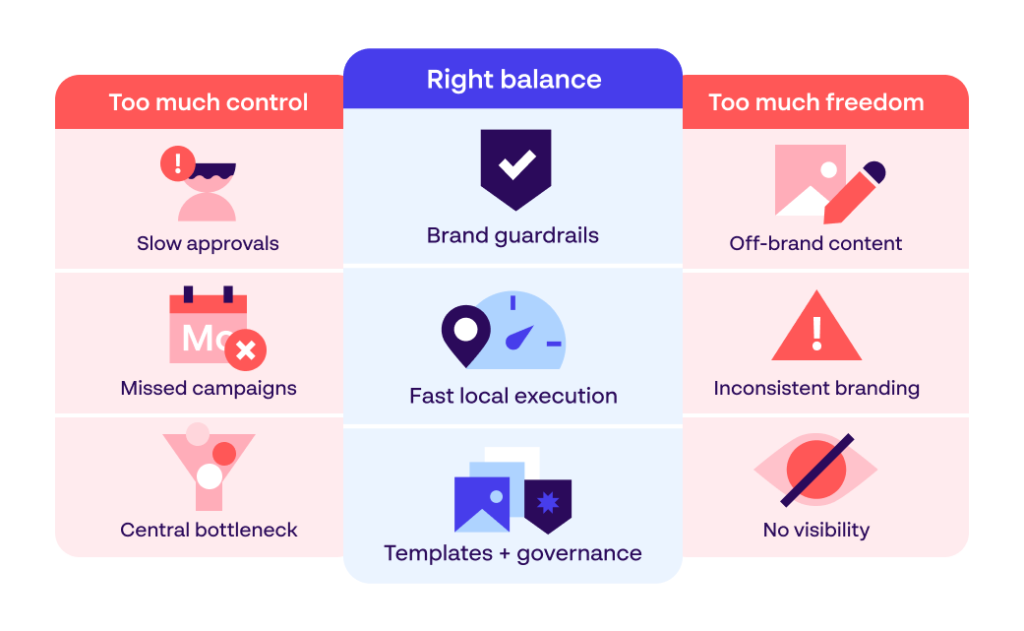
Every multi-location and franchise brand sits somewhere on the same spectrum. Central wants to protect brand standards built over years of investment, while locations want to move at the speed their market demands: a local promotion, a same-week event, a timely social post.
Neither side is wrong. Central owns how the brand is perceived everywhere; locations own their own customers, right now. The goal is a system where staying on-brand is the easiest option, not an extra step that slows a location down.
What happens when that balance tips too far either way is predictable.
What happens when central controls everything
When every asset must be requested, reviewed and approved centrally, requests pile up faster than a small team can clear them. A national rollout slows because a hundred locations wait on the same handful of people, each risking a missed moment.
What happens when locations are left alone
When locations are free to create their own marketing without oversight, off-brand content spreads fast: mismatched logos, outdated messaging, inconsistent offers. Customers meet the brand at the location level, so that’s exactly where brand consistency across locations breaks first, undoing years of brand-building in one interaction.d treat it as infrastructure, and let consistency take care of itself.
5 key local marketing channels
Most local marketing channels need a national layer and a local layer to work properly: national sets the standard, local adapts it. Here’s how that plays out across the five channels that matter most.
1. Local SEO and Google Business Profile
Local SEO covers everything that helps a location appear when someone searches nearby: an optimized Google Business Profile, consistent listings and location pages. A complete Business Profile makes a visit 70% more likely and a purchase 50% more likely (Source: Google, via BrightLocal, 2026).
2. Localized social media
National social builds brand affinity; local social builds community. Each location benefits from posting its own events and offers, provided the tone and imagery stay recognizably on-brand.
3. Geo‑targeted paid ads
Paid search and social ads can be targeted to a radius around a single location, making them one of the fastest ways to drive foot traffic for a specific store or franchise. The creative still needs the same brand standards as the campaign it’s built from.
4. Local content and email
Location-specific landing pages, offers and email sends convert better than generic national messaging, because they speak to a customer’s actual market. This is where templated content creation matters most, since a location rarely has time to build these from scratch.
5. Community events, sponsorships and reviews
Sponsoring a local team, hosting an event or responding to reviews all shape how a location is perceived locally. Reviews carry particular weight: 97% of consumers read reviews for local businesses before deciding where to spend (Source: BrightLocal, 2026).
4 common local marketing problems at scale
These channels only work if the system behind them holds together. Most multi-location and franchise brands run into the same four problems.
1. External creators making off‑brand content
Franchisees, local agencies and well-meaning store managers create their own flyers, posts and ads outside any central process. Without templates or guardrails, this content drifts from brand guidelines quickly.
2. The central team is a bottleneck
A small brand team cannot personally produce and approve content for hundreds of locations. Every request stuck in a queue is a local opportunity slipping past.
3. Consistency breaks across locations
Even with good intentions, manual processes produce inconsistent results: one location’s social feed looks nothing like another’s, and offer details drift out of sync. Customers notice these gaps.
4. No visibility into what each location publishes
Without a central system, brand and compliance teams often have no reliable way to see what’s been published, where or by whom. That makes it hard to catch problems early, or prove compliance if it’s ever challenged.
What is local marketing automation?
Local marketing automation is the system that lets a central team produce brand-approved templates once, so every location can localize, approve and publish its own version without starting from scratch. Done well, it combines templated assets, automated distribution and built-in approval workflows.
This differs from CRM or email automation, which focus on sending the right message to the right customer at the right time. Local marketing automation focuses on the creative itself, making sure what a location produces is on-brand before it’s published.
Multi‑location marketing software: what to look for
Multi-location marketing software is the category of tools built to let a central team govern local marketing at scale, rather than manage it location by location. The right platform combines asset control with the flexibility locations need to move fast:
- A centralized asset library (Digital Asset Management) for approved brand assets.
- Templated content creation so non-designers can localize campaigns without breaking brand guidelines.
- A brand portal giving locations, franchisees and partners self-service access to what they’re allowed to use.
- Role-based access and permissions, so each location sees only what’s relevant to them.
- Approval workflows that keep central sign-off without it becoming the bottleneck.
- Analytics and reporting showing what’s published, where and how it’s performing.
For a deeper look, see this digital asset management guide.
How Papirfly helps you run local marketing at scale
Papirfly’s DAM, Templated Content Creation and brand portal work together to solve these problems, connecting central brand control to local execution instead of forcing a trade-off.
One source of truth for every brand and local asset (DAM)
Papirfly’s DAM gives every location one governed library for brand and campaign assets, replacing the shared drives and outdated PDFs that usually stand in for a system.
Templated content locations can localize
Templated Content Creation lets a location build its own flyer, social post or local ad from a national template, without design skills or an agency. The output is on-brand by default, because the template only allows changes a location is permitted to make.
A brand portal every location can access
A brand portal gives each location, franchisee or partner self-service access to the assets and guidelines relevant to them, without opening up the whole brand library. It becomes the one place every local marketer starts from.
Lock what can’t change so off‑brand work isn’t possible
Locking functionality lets a central team fix elements that must never change, like the logo, colors or required disclaimers, while leaving locations free to localize everything else. Off-brand work stops being a risk to manage, because it isn’t possible to produce.
Local marketing for franchises
Franchises add a layer the standard multi-location model doesn’t have: the franchisee owns the location, but the franchisor owns the brand. Central can’t enforce standards on a business it doesn’t operate, so franchise marketing has to enable franchisees rather than police them.
A brand portal and templated content solve this, giving franchisees the same self-service access and ready-to-localize templates a central team would use itself. Locked brand elements and tracked publishing give the franchisor visibility over who’s published what, without approving every asset by hand.
Start running local marketing on‑brand with Papirfly
Every multi-location and franchise brand faces the same choice: build a system where staying on-brand is the easy option, or keep managing the fallout when it isn’t. Getting local SEO, social, ads, content and events right in every market depends on solving that system problem first.
Papirfly’s DAM, Templated Content Creation and brand portal are built for exactly this: control without becoming a bottleneck, and local speed without the risk of going off-brand. Explore Papirfly’s franchise marketing software to see how it fits your network.
See Papirfly in action
Discover the solution built around your network.
See Papirfly in action
Discover the solution built
around your network.
Discover the solution built around your network.
Frequently asked questions about local marketing
How do franchise brands keep local marketing on‑brand?
Franchise brands stay on-brand by giving franchisees templates and locked brand elements instead of relying on manual approval. A brand portal like Papirfly’s gives every franchisee self-service access to approved assets, so local campaigns stay on-brand by default.
What software do multi‑location brands use for local marketing?
Multi-location brands typically combine a Digital Asset Management (DAM) system, templated content creation tools and a brand portal. Papirfly brings all three together in one platform, giving central teams brand control while locations localize campaigns and publish for their own market.
What is an example of local marketing?
A store’s own social post about a weekend event, alongside the brand’s national campaign, is local marketing in action. So is a franchisee running a geo-targeted ad for a local offer, or a manager responding to local reviews.
Table of contents:
- What is local marketing?
- Central brand control vs local execution
- 5 key local marketing channels
- 4 common local marketing problems at scale
- What is local marketing automation?
- Multi‑location marketing software: what to look for
- How Papirfly helps you run local marketing at scale
- Local marketing for franchises
- Start running local marketing on‑brand with Papirfly
- Frequently asked questions about local marketing