

This content has been automatically translated and may include minor variations.
Why GDPR still slows marketing teams down
Despite being in place for years, GDPR compliance is still often handled manually.
Teams rely on disconnected processes to:
- Check consent before using content
- Track where and how assets are used
- Monitor expiry dates and usage rights
- Reconfirm approvals across teams and markets
This becomes especially complex when working with:
- Visual content featuring individuals
- Multi-market campaigns with local adaptations
- High volumes of assets across channels
As discussed in a recent webinar we took part in with SWEDMA, uncertainty around how GDPR applies to images, video, and personal data is still a major challenge for marketers.
The result? Delays, inefficiencies, and increased risk.
AI is accelerating marketing — but also raising new questions
AI is already transforming how marketing teams operate. It enables faster content production, simplifies localization, and makes it easier to find and reuse assets across channels. Tasks that once took hours can now be completed in minutes.
But this increased speed also introduces new complexity. As more content is created and distributed at scale, it becomes harder to maintain control over how assets are used — especially when personal data is involved.
Teams need to be confident that the content they are activating is not only on-brand, but also compliant. That means knowing whether consent has been given, whether usage rights are still valid, and whether assets are being used within the correct context.
Without this level of visibility and control, AI risks amplifying existing challenges — making it easier to move fast, but also easier to make mistakes.

Shifting from manual consent checks to built-in compliance
To keep pace with modern content demands, marketing teams need to move beyond reactive compliance processes.
Traditional approaches rely on manual checks — reviewing consent, validating usage rights, and confirming approvals before content goes live. While necessary, these steps often create friction and slow down campaign execution.
Leading organisations are now taking a different approach by embedding compliance directly into their workflows. Instead of relying on last-minute checks, they build governance into the systems and processes used every day.
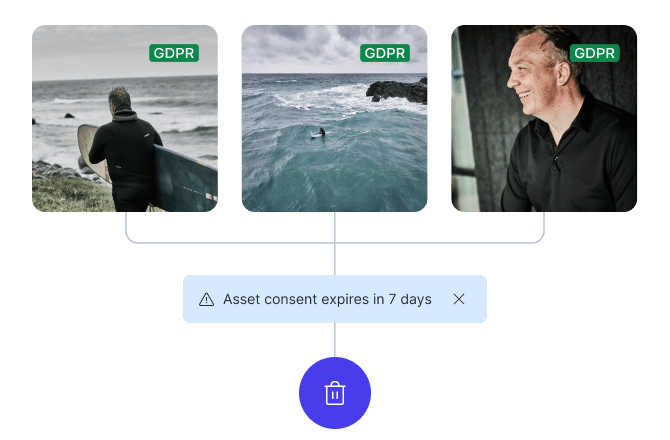
This shift allows teams to work more efficiently, with compliance handled automatically in the background. Consent data is connected to assets, usage rights are clearly defined, and controls are applied consistently across markets.
The result is a more scalable way of working — where teams can move faster, without compromising on control.
How can AI support GDPR compliance?
When combined with the right structure, AI becomes a powerful enabler of compliant, scalable marketing.
Smarter asset management
AI helps organize and tag content, making it easier to identify where personal data is used and how assets can be reused safely.
Faster content discovery
Teams can quickly find approved, compliant assets — reducing reliance on outdated or risky content.
Reduced manual admin
Automation replaces repetitive checks, improving consistency while saving time.
Scalable governance
AI supports large-scale content operations, while governance rules ensure compliance is maintained across markets.

Operationalizing GDPR with GDPR Manager
To truly embed compliance into your workflow, you need more than policies — you need the right infrastructure.
Papirfly’s GDPR Manager is designed to help marketing teams stay compliant without slowing down.
With GDPR Manager, you can:
- Centralize and manage consent data alongside your assets
- Automatically control asset usage and expiry
- Ensure compliant use of images, video, and personal data
- Reduce manual admin across teams and regions
- Enable faster, safer campaign activation
This allows teams to move quickly — with confidence that compliance is already built in.
Turning compliance into a competitive advantage
GDPR is often seen as a limitation.
But when embedded into your workflow, it becomes a driver of better marketing performance:
- Faster time-to-market
- More consistent brand execution
- Reduced risk exposure
- Greater confidence across teams
And as AI continues to accelerate content creation, this shift becomes even more critical.
Make GDPR part of your workflow
Compliance should not slow your team down.
With the right setup, you can stay in control of personal data while moving faster, scaling content, and activating campaigns with confidence.
Move faster without losing control
Built-in GDPR compliance for modern marketing teams
Move faster without losing control
Built-in GDPR compliance for modern marketing teams
Built-in GDPR compliance for modern marketing teams

FAQs
Can AI be used in a GDPR-compliant way?
Yes — but only with the right governance in place. AI should support structured workflows where consent, usage rights, and asset control are clearly defined and enforced.
What is the biggest GDPR risk for marketing teams?
Using assets without proper consent or beyond their permitted usage. This often happens due to lack of visibility or manual processes.
How can marketing teams reduce manual GDPR work?
By centralizing consent data, automating expiry management, and embedding compliance into content workflows rather than relying on manual checks.
Does GDPR apply to images and videos?
Yes. Any content that can identify an individual is considered personal data and must be handled according to GDPR requirements.
How does GDPR Manager help?
It connects consent, assets, and workflows in one place — making it easier to manage compliance automatically while enabling faster content activation.
Table of contents:
- Why GDPR still slows marketing teams down
- AI is accelerating marketing — but also raising new questions
- Shifting from manual consent checks to built-in compliance
- How can AI support GDPR compliance?
- Operationalizing GDPR with GDPR Manager
- Turning compliance into a competitive advantage
- Make GDPR part of your workflow
- FAQs