

This content has been automatically translated and may include minor variations.
This June, several hundreds customer experience, marketing, and digital leaders gathered in Amsterdam for Forrester’s CX Summit EMEA. The theme was deliberately provocative: Build the experience AI can’t.
It’s a sharp framing for the moment we’re in. As Forrester put it, CX, marketing, and digital teams are racing to build smarter journeys, automate service, deploy agents, and personalize at scale — all while consumer trust sits at an all-time low.
The summit’s argument was that beneath every intelligent experience lies something AI cannot invent, infer, or repair: a foundation of human creativity, trust, context, and quality data. One keynote line stuck with the whole room — distrust is now consumers’ default.
As AI-generated content, deepfakes, and automation blur what’s real, trust is no longer assumed. It has to be earned. That backdrop is exactly why Papirfly was there as a Forrester partner — and why my spotlight session focused on one specific, uncomfortable consequence of this shift for anyone who owns a brand.
The Forrester model: three layers that make up Total Experience
Forrester frames the discipline around Total Experience; the idea that what a customer ultimately feels about a brand is the sum of three overlapping layers, not any single department’s output.
This year Forrester expanded its Total Experience Score with a new Employee Experience Index, making the link between those layers measurable for the first time.
Employee experience and customer experience get most of the airtime.
But the third layer — brand experience — is where the AI story really bites in 2026.
Brand experience is no longer just what your audience sees in a campaign. It’s what every system, every channel, and increasingly every machine understands about you. That is the AI brand experience problem most brand teams haven’t yet built a framework to address.
As you can’t control the AI customer journey you must at least guide it
The premise of my spotlight session was simple to state and hard to act on. The customer journey — discover, evaluate, buy, onboard, use, renew — is increasingly mediated by an AI assistant that brands don’t own and can’t see into.
You cannot control that journey anymore. What you can do is guide it, by being deliberate about every signal the machine reads.
A decade ago, almost every journey started in a browser and a search box. Today it increasingly starts inside ChatGPT, Claude, or Gemini. The assistant has become the new interface. The layer customers and colleagues meet a brand through before they ever reach a page that brand built.
And here’s the shift that matters for CX: the assistant doesn’t just retrieve a homepage. It reads everything: comparison pages, pricing, onboarding flows, support articles, product notes. Then it — and synthesizes one answer.
The customer journey | What you own
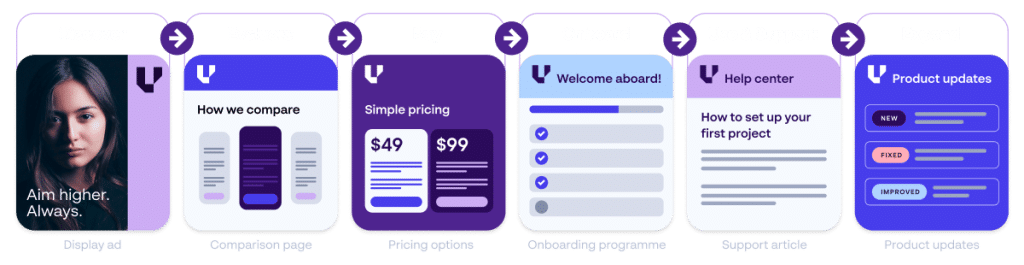
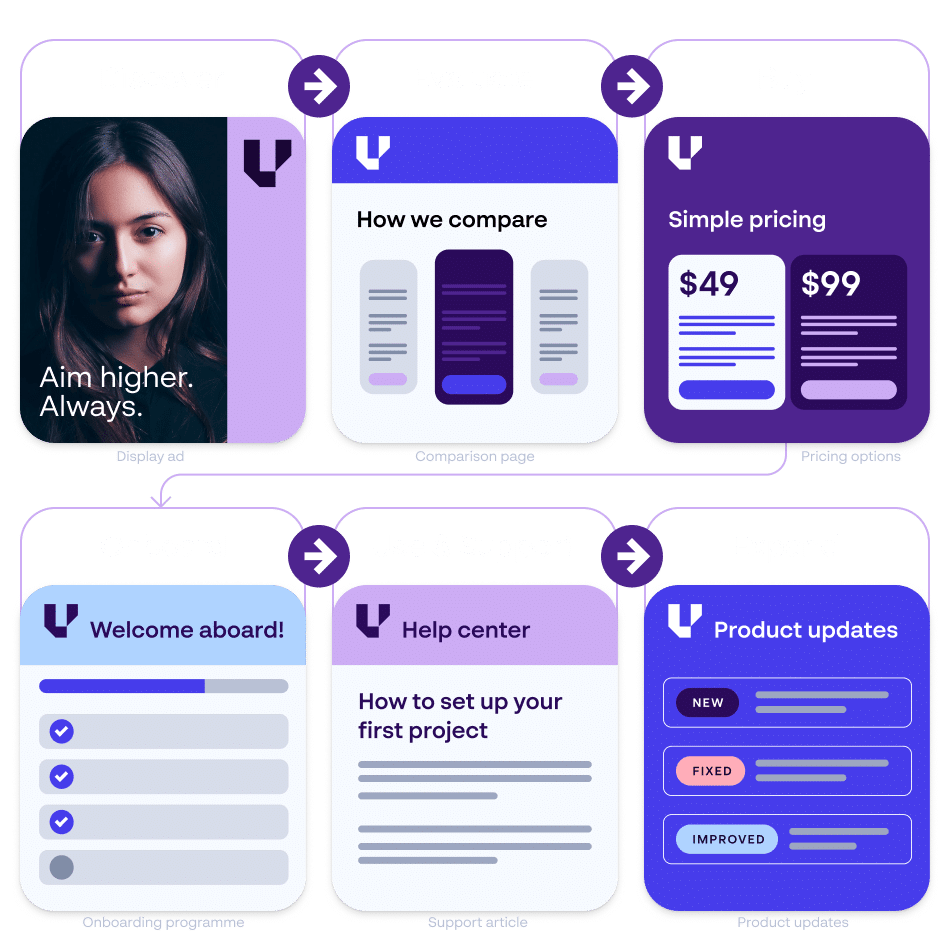
That changes who owns the brand. The content feeding these systems isn’t produced only by brand and marketing teams. It’s produced across the entire organization by support, by product, by sales, and by partners. For an AI to understand anything coherent about a brand, no matter who published the underlying signal, there has to be a layer beneath the journey that is genuinely consistent: a brand consistency layer that can be read and understood by machines.
Why brand consistency is what AI trusts
Why does this consistency layer matter so much? Because of how these systems actually decide what to say about a brand. An AI assistant doesn’t look a company up in a single tidy record. It reconstructs an entity — a picture of who you are — from fragments scattered across everything it has read.
Consistency is what lets it resolve those fragments into one confident, coherent answer. Inconsistency does the opposite: it forces the machine to guess, and it guesses confidently.
A growing body of research on how large language models select and cite sources points to the same mechanism. A model’s confidence in surfacing a brand rests on whether its signals are consistently structured across its entire digital footprint.
When they are, the model’s threshold for citing and recommending that brand rises. The practical version of that idea breaks into four layers:
- Identity: the non-negotiable facts: who you are, what you’re called, what you do, stated the same way everywhere so you’re recognizable as one distinct entity rather than several blurry ones.
- Relationships: how you connect to people, products, parent and sister brands; the machine-readable graph that stops an assistant confusing you with a similarly named competitor.
- Offering: a clear, consistent description of what you actually sell, in language that maps cleanly to how customers ask; vague positioning doesn’t get extracted, specific repeated claims do.
- Reputation: the third-party corroboration — reviews, coverage, mentions — that confirms the story you tell about yourself; consistent signals across independent sources read as a trustworthy brand reputation.
When those layers line up, the consequence is a ladder every brand is somewhere on: consistency creates brand clarity; a clear brand gets referenced; strong presence across all channels earns recommendations; absence from the signal means absence from the answer. In one large analysis of how assistants cite sources, a brand’s strength as a recognized entity was the single strongest predictor of being cited — ahead of every traditional technical SEO signal.
Brands showing up consistently across four or more independent sources were meaningfully more likely to appear in an AI answer than those present only on their own site. The lesson isn’t “publish more.” It’s “be the same, everywhere.”
Every touchpoint is training data for your customer’s AI brand experience
It’s tempting to think AI only reads the “official” brand assets — the website, the campaign, the polished deck. It doesn’t. It reads everything. The obvious things: website, product UI, display ads, social posts, press coverage
And the non-obvious things most teams never think of as brand: onboarding emails, support docs, chatbot replies, invoices, reward-program terms, packaging copy, newsletters, the forum thread where someone described what a company does, a single sentence a sales rep once put in writing to a customer.
All of it feeds the machine. And all of it gets compressed into one synthesized sentence handed to the customer. If those thousands of signals point in slightly different directions, the machine resolves the contradiction for you — and the brand may not like the answer it lands on.
Every touchpoint is now training data
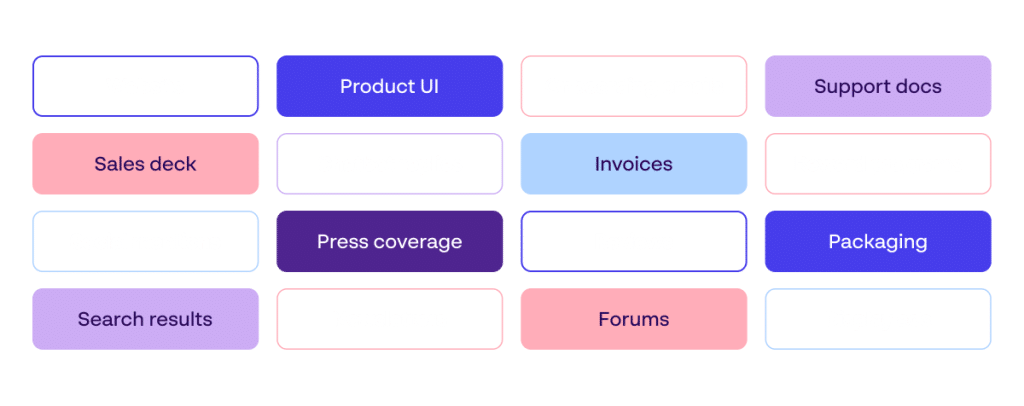
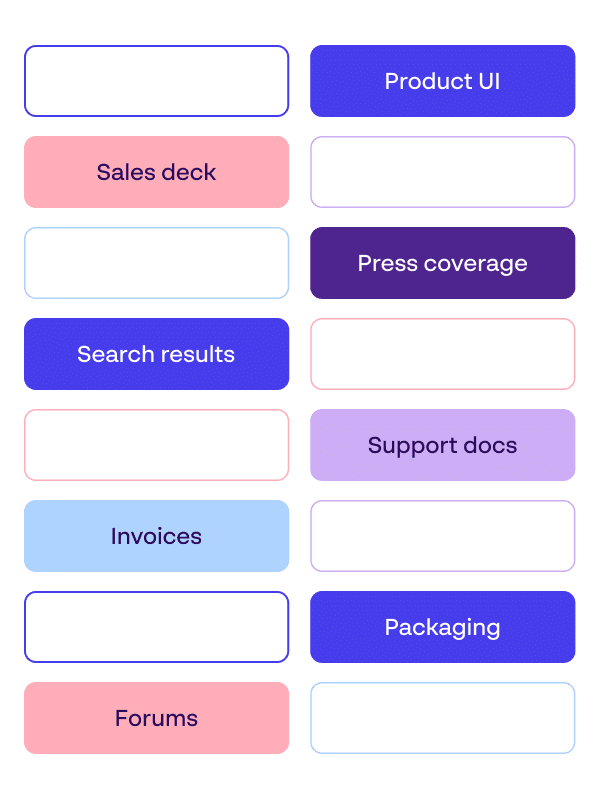
The old world forgave inconsistency. When customers found, compared, and decided for themselves, inconsistency was annoying but humans did the synthesis. They filled the gaps and gave brands the benefit of the doubt. The new world doesn’t extend that grace. An AI reads everything ever published, then decides for the customer. The one-sentence synthesis of every signal a brand has put out means inconsistency is no longer dilutive — it’s disqualifying.
How to scale brand consistency: enable anyone to create content
The reflex response to a consistency problem is to centralize — to funnel everything through a small brand team that checks every asset. That doesn’t scale, and it never will, because the volume of touchpoints is exploding faster than any central team can review.
The only way to scale AI brand experience is to do the opposite: enable absolutely anyone to create content — every team, every region, every partner, and increasingly AI agents acting on behalf of the brand — while making it almost impossible for them to go off-brand.
The way to reconcile “anyone can create” with “everything stays consistent” is to build every output from a single source of truth: the brand, expressed as structured, governed brand data. When the brand is the foundation everything is built from, consistency stops being a manual check at the end and becomes a property of the system itself.
That single source of truth rests on two capabilities working as one system. First, a future-proof enterprise Digital Asset Management (DAM) platform — not just storage, but the governed home for every approved asset, with structured metadata, role-based access, and compliance built in. Second, that DAM connected natively to intelligent, dynamic Templated Content Creation that understands the brand’s logic.
The connection is the point. In the Papirfly Suite, the DAM feeds directly into creation: anyone can pull an approved asset into a smart template and produce studio-quality, on-brand material in minutes — without design skills, and without the risk of working from an outdated or off-brand file.
Templates are built once, for every use case, audience, channel, and format needed — social posts, emails, flyers, catalogues, digital banners, video. Each template carries the brand inside it, so the person filling it in is choosing content, not redesigning the brand.
Four capabilities that make that create an on-brand experience
Enabling anyone to create without losing the brand only works if four capabilities are genuinely in place. This is the difference between a template tool and a consistency engine.
Enforce brand rules. Lock what must never change — logo, clear space, colors, typography — while leaving defined room to flex within the brand framework. Off-brand simply becomes impossible, not just discouraged.
Localize at scale. Adapt language, format, and size to local needs — from one master — so local teams get autonomy and the center keeps control. Every market, every channel ratio, every language, from a single governed source.
Support every channel. Social, email, print, web, video — one source produces every output a modern journey needs, so the brand stays coherent no matter where the customer or the machine encounters it.
Integrate with your martech. Tight upstream and downstream integration with the tools teams already use — so consistency lives inside the day-to-day workflow rather than bolted on as an extra step.
Put those four pieces together and something important becomes possible: content creation scales across the whole organization and its partners without scaling chaos. Every asset, in every language, on every channel, made by anyone, still reads as one coherent brand. That coherence is precisely the consistency layer the machines now require. Speed and control are no longer a trade-off — the system delivers both.
The customer relationship belongs to you
The customer relationship belongs to the brand. That hasn’t moved. The new responsibility is owning the signal: every touchpoint the machine reads on its way to a recommendation. An AI brand experience built on consistent, governed signals isn’t a defensive play — it’s the foundation for being present, credible, and recommendable in every AI-mediated journey your customers take.
Consistent brand signals don’t happen by accident. They happen when every team, every region, and every partner is building from the same governed source — the same approved assets, the same brand-aware templates, the same locked rules that make going off-brand structurally unlikely.
If your brand teams are still relying on manual review to catch inconsistency after the fact, the Papirfly Suite is built to change that. Explore what a governed creation system makes possible.
Build the best brand experience for the AI era
Create on-brand content for the entire customer journey.
Build the best brand experience
for the AI era
Create on-brand content for the entire customer journey.
Create on-brand content for the entire customer journey.

FAQs
What is AI brand experience and why does it matter now?
AI brand experience is the impression AI assistants form of a brand from every digital signal it has published — website, reviews, support docs, partner content, and beyond. It matters now because AI assistants have become a primary interface between brands and customers. If those signals are inconsistent, AI systems reconstruct a blurry or inaccurate picture of the brand and may leave it out of their answers entirely — without the customer ever knowing.
How does an AI assistant decide which brands to recommend?
AI assistants reconstruct brands as entities from signals found across the entire web. Brands that present consistent identity, positioning, and reputation across multiple independent sources are easier for these systems to describe with confidence — which makes them more likely to be cited and recommended. Inconsistent signals force the model to guess, and it often resolves that uncertainty by leaving the brand out of the answer.
Why is brand inconsistency more damaging now than it was five years ago?
Five years ago, customers did their own synthesis — filling gaps and giving brands the benefit of the doubt. Today, AI assistants do that synthesis instead, reading everything a brand has ever published and collapsing it into a single answer. When a machine synthesizes, gaps and contradictions don’t get forgiven — they get resolved against the brand. Inconsistency has moved from being dilutive to being disqualifying.
What does Forrester’s Total Experience model mean for brand teams?
Forrester’s Total Experience framework identifies brand experience as one of three layers — alongside employee experience and customer experience — that together determine how customers feel about a brand. The AI shift makes brand experience newly urgent: because AI assistants mediate more of the customer journey, the consistency of every brand signal now directly determines whether a brand gets referenced, recommended, or left out of the answer.
How does a governed DAM help protect AI brand experience?
A governed Digital Asset Management (DAM) system ensures every team and partner works from approved, up-to-date assets — not outdated files or unofficial versions. When a DAM connects directly to Templated Content Creation, it becomes an active consistency engine: approved assets flow into brand-aware templates, and anyone in the organization can produce on-brand material without the risk of working from the wrong source. That’s how thousands of consistent signals go out across every touchpoint the machine reads.
Table of contents:
- The Forrester model: three layers that make up Total Experience
- As you can’t control the AI customer journey you must at least guide it
- Why brand consistency is what AI trusts
- Every touchpoint is training data for your customer’s AI brand experience
- How to scale brand consistency: enable anyone to create content
- Four capabilities that make that create an on-brand experience
- The customer relationship belongs to you
- FAQs