

This content has been automatically translated and may include minor variations.
Brand governance rarely fails overnight. It erodes gradually — a regional team using an old logo because the right one is buried, an agency working from a PDF brand book that has not been updated since the rebrand, a market launching with imagery that has not been rights-cleared.
For brand directors managing campaigns across multiple markets, the problem is structural. Assets sit in SharePoint. Guidelines sit in a PDF, and templates get emailed back and forth — with no single source of truth and no visibility into what local teams produce.
The cost is measurable: redundant photo shoots, agency adaptation fees, PR risk from off-brand content, and the slow erosion of brand equity in the markets leadership is counting on to grow.
That is where brand management software comes in. This guide is for marketing leaders, brand directors, and operations teams evaluating platforms that replace fragmented tools with a single governed environment. We compare 10 platforms worth shortlisting in 2026.
What is brand management software?
Brand management software is a centralized, governed platform that gives organizations a single place to store brand assets, communicate brand standards, and control brand execution across teams, markets, and partners. It is the platform layer that makes consistent brand execution possible at enterprise scale.
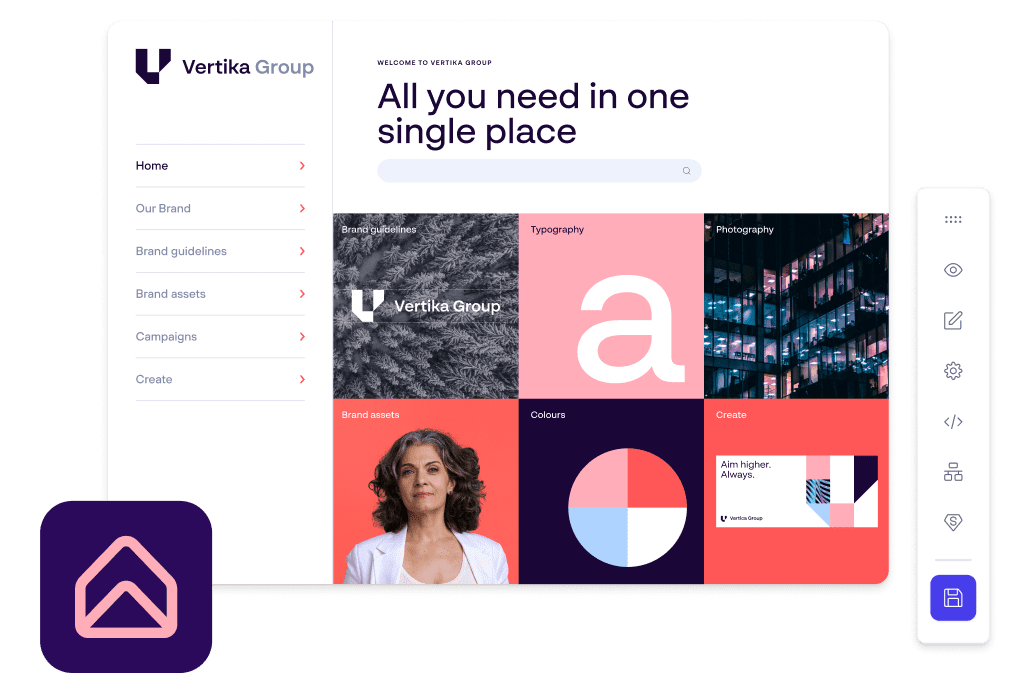
At its most complete, brand management software brings together three connected layers — Digital Asset Management to store and govern approved files, a brand portal to surface those assets with context and guidelines, and Content Creation to let decentralized teams produce on-brand materials without going through HQ.
It is not a project management tool, generic file storage, or a content management system. Those tools each solve adjacent problems, but none was built to govern how a brand is executed at scale across markets, partners, and channels.
Without it, most organizations rely on a patchwork of SharePoint folders, outdated PDFs, and manual approvals over email. The result is predictable: local teams bypass guidelines, central teams spend half their time on adaptation, and leadership has no visibility into what is going into market.
ale.
10 best brand management software platforms in 2026
Platforms in this list were selected on category leadership, enterprise deployment evidence, breadth of brand management capability, and relevance to organizations managing multi-market or multi-brand complexity. Where vendors focus on a single layer — DAM only, portal only, or templating only — we have noted it.
Platform comparison overview
| Platform | Best for | Key features | Notable strengths | Pricing tier |
|---|---|---|---|---|
| Papirfly | Enterprise brand control end‑to‑end | DAM, brand portal, Templated Content Creation in one suite | The only platform combining DAM, portal, and templated creation in a single integrated system | $$$–$$$$ |
| Bynder | Large enterprises with mature DAM needs | Enterprise DAM, brand templates, 121+ integrations | Market‑leading DAM functionality with strong UX and integration ecosystem | $$$$ |
| Frontify | Brand guidelines and portal experience | Brand portal, asset management, design file import | Highly usable brand portal with strong designer and agency workflows | $$$–$$$$ |
| Brandfolder | Creative teams needing DAM plus embedded guidelines | AI tagging, asset analytics, in‑document search | Clean interface, strong search, now part of the Smartsheet ecosystem | $$$–$$$$ |
| Lytho | In-house creative teams combining workflow and brand governance | DAM, smart templates, workflow automation, brand center | Uniquely positioned for creative operations plus asset management | $$–$$$ |
| Canto | Mid-market teams needing accessible DAM with AI capability | AI Library Assistant, Brand Studio, Approval Hub | Strong mid‑market recognition and recent AI‑irst product reinvention | $$–$$$ |
| Acquia DAM (Widen) | Organizations embedded in the Acquia digital experience stack | Metadata management, 200+ integrations, branded portals | Deep integration ecosystem and strong permissions model | $$$$ |
| Marq | Distributed teams producing high-volume templated print and digital | Lockable templates, CRM integrations, web‑to‑print | Accessible for non‑designers with strong print automation | $$–$$$$ |
| MediaValet | Microsoft‑centric enterprises with large media libraries | Azure-based DAM, Teams and SharePoint integration, branded portals | Native fit for Microsoft environments and Forrester-recognized enterprise DAM | $$$$ |
| IntelligenceBank | Marketing teams in regulated industries managing compliance workflows | DAM, marketing workflow, compliance approvals, brand guidelines | Combines asset management with compliance‑ready marketing operations | $$$–$$$$ |


1. Papirfly – Best for enterprise brand control end‑to‑end
Best for: Enterprise organizations that need to govern brand assets, drive consistent campaign execution across markets, and enable local content production from a single integrated platform.
Pricing: $$$–$$$$
Papirfly is built for organizations that need to govern brand assets, maintain campaign consistency across markets, and enable local content production without stitching together three separate platforms. The Papirfly Suite combines Digital Asset Management, a fully customizable brand portal, and Templated Content Creation in one integrated system.
The DAM layer uses AI for auto-tagging, digital rights management, and natural language search. The brand portal supports multi-brand and multi-region architectures from a single interface, and Templated Content Creation lets non-designers produce studio-quality materials from centrally locked templates. Customers include BMW, IHG, and Goldman Sachs, with deployments built on AWS and certified to ISO 27001 and SOC 2 Type II.
This combination matters because most brands do not have one problem — they have three. Assets are hard to find, guidelines are not followed because they are hard to access, and local content production is either too slow or too risky. Papirfly is one of the few platforms designed to address all three from the same system.
Key features:
- Integrated DAM, brand portal, and Templated Content Creation in one suite
- AI-powered auto-tagging and natural language asset search
- Customizable brand portal with role-based, multi-region permissions
- Locked-field Templated Content Creation for non-designers
- Multi-brand, multi-tenant architecture for enterprise governance
- ISO 27001 and SOC 2 Type II security certifications
Pros:
- Only platform combining DAM, brand portal, and Templated Content Creation in a single integrated suite
- 90%+ of users access assets through the portal — adoption higher than typical DAM-only deployments
- Enterprise customer base including BMW, IHG, and Goldman Sachs validates scale
- Cuts central team adaptation workload while protecting brand integrity at the local level
Cons:
- Best suited to enterprises evaluating against a 3-year brand execution roadmap, not a quick point fix
2. Bynder – Best for large enterprises with mature DAM requirements
Best for: Large enterprises whose primary need is a category-leading DAM with strong UX and broad integration support.
Pricing: $$$$
Bynder is a Netherlands-based DAM platform with over 580 employees and consistent recognition as a leading enterprise DAM, including inclusion in Forrester Wave evaluations. It centralizes digital assets across complex enterprise environments, with a strong emphasis on DAM functionality and integration breadth.
The DAM capability handles large libraries with reliable metadata management, version control, and digital rights management. Digital brand templates allow on-brand content creation inside the platform, and 121+ integrations connect it to most martech, CMS, and creative stacks. Workflow modules support distributed review and approval.
Where Bynder has less depth is in the brand portal experience — customization is more constrained than dedicated portal products. The templating layer is functional but less sophisticated than platforms built specifically around high-volume local content production.
Key features:
- Enterprise DAM with metadata management, DRM, and version control
- Digital brand templates for on-brand content creation
- Creative workflow with review and approval routing
- 121+ integrations including Adobe Creative Cloud and Salesforce
- Brand guidelines module
- Asset usage analytics
Pros:
- Mature, well-supported DAM with a strong enterprise track record
- Excellent UX relative to legacy DAMs, driving higher adoption
- Forrester Wave recognition supports formal procurement
- Broad integration ecosystem fits most enterprise martech stacks
Cons:
- Brand portal customization is limited compared to dedicated portal platforms
- Templated content creation is less suited to high-volume local production at scale
- Pricing positions it at the higher end of the category
See why Papirfly is the best Bynder alternative for brand management.
3. Frontify – Best for brand guidelines
Best for: In-house creative teams and brand managers prioritizing a clean, navigable home for brand identity over deep enterprise DAM functionality.
Pricing: $$$–$$$$
Frontify is a Swiss-based brand management platform with around 300 employees, positioned squarely in the brand portal and guidelines space. Its core proposition is a well-designed, accessible interface for surfacing brand standards.
The brand portal is Frontify’s standout strength, using a building-block approach that gives design teams a structured way to create brand hubs. A desktop application improves day-to-day access for creative professionals, and around 50 integrations connect to common design tools which require additional investment and user-training.
The platform is less strong as a DAM, with no major analyst recognition in that category. Templating relies on importing design files rather than offering native content creation, which limits its use for organizations scaling local production across non-designer audiences.
Key features:
- Customizable brand portal with drag-and-drop building blocks
- Brand guidelines hosting with rich media
- Asset management with version control
- Design file import for brand templates
- Desktop application for Mac and Windows
- 50+ integrations including Figma and Sketch
Pros:
- Among the cleanest portal experiences in the category
- Strong designer and agency workflows
- Free-tier integrations widen accessibility for smaller teams
- Building-block approach makes portal construction structured and accessible
Cons:
- Building-block portal structure can limit flexibility for complex brand architectures
- Not suited to organizations with large, governance-heavy asset libraries
- No native templated content creation for non-designers
See why Papirfly is the best Frontify alternative for brand management.
4. Brandfolder – Best for creative teams needing DAM with embedded guidelines
Best for: Enterprises invested in the Adobe ecosystem running owned digital experiences at scale.
Pricing: $$$$
Best for: Mid-to-large creative and marketing teams wanting a searchable, governed asset library with brand guidelines and analytics built in.
Pricing: $$$–$$$$
Brandfolder, now part of Smartsheet, is a DAM with strong reputation among creative and marketing teams for its clean interface and capable search. It centralizes brand assets with AI-powered auto-tagging and smart search that surfaces keywords inside documents.
The Smartsheet acquisition has broadened Brandfolder’s ecosystem positioning, connecting it more closely with project and work management workflows. The platform includes collaboration tools, annotation and approval workflows, and asset editing capabilities. Analytics provide usage insights that help brand managers identify which assets are performing.
Brandfolder is less focused on local content production at scale or the multi-portal, multi-region brand architecture larger enterprise organizations typically require. Roadmap alignment with Smartsheet is still evolving post-acquisition.
Key features:
- AI-powered auto-tagging with in-document keyword search
- Brand guidelines embedded alongside assets
- Asset editing and manipulation
- Annotation and approval workflows
- Asset usage analytics
- Smartsheet ecosystem integration
Pros:
- Intuitive interface drives strong adoption among non-technical users
- In-document keyword search differentiates it for document-heavy libraries
- Embedded guidelines reduce off-brand asset usage
- Smartsheet ecosystem extends reach into project management
Cons:
- Less suited to multi-region brand portals or complex global governance
- Limited templated content creation for non-designer audiences
- Post-acquisition roadmap alignment with Smartsheet still evolving
5. Lytho – Best for in‑house creative teams combining workflow and brand governance
Best for: In-house creative departments managing high volumes of internal content requests and looking to combine workflow, asset management, and brand governance in one platform.
Pricing: $$–$$$
Lytho positions itself at the intersection of creative operations and brand management. Rather than leading purely with DAM or portal functionality, it combines asset management, brand guidelines, smart templates, and workflow automation in one platform. The focus is helping in-house creative teams cut repetitive work without manual review overhead.
The Asset Manager handles storage, tagging, and retrieval, with advanced filters including color and similar-image search. The Brand Center houses guidelines alongside assets, and Lytho Tempo enables non-designers to create on-brand content from locked templates. In 2025, Lytho added AI capabilities aimed at reducing administrative and compliance overhead.
Lytho is a strong fit for in-house creative departments that are the primary bottleneck in their organization’s content pipeline. It is less established in large enterprise deployments with multi-brand, multi-region complexity.
Key features:
- Asset Manager with color and image similarity search
- Brand Center for guidelines
- Lytho Tempo smart templates
- Creative workflow automation
- Consent management for people imagery
- AI teammates for compliance and admin tasks
Pros:
- Uniquely positioned for in-house creative teams managing internal requests
- Combines workflow with brand governance more deeply than DAM-first platforms
- Consent management is a useful differentiator for people-heavy libraries
- AI teammates address real admin overhead
Cons:
- Less proven at large enterprise scale or with multi-brand, multi-region complexity
- Review interface ergonomics receive mixed user feedback
- Smaller integration footprint than dedicated DAM leaders
6. Canto – Best for mid‑market teams needing accessible DAM with growing AI capability
Best for: Mid-sized marketing organizations and product-led brands that want a reliable DAM with growing brand management and AI capabilities.
Pricing: $$–$$$
Canto is a DAM with strong mid-market presence and consistent recognition on platforms such as G2, where it ranked as a top DAM provider in the 2025 Best Software Awards. It is valued for ease of use, strong permission controls, and a clean interface.
In October 2025, Canto launched Canto XI — a product reinvention positioning the platform as an intelligent content hub for the AI era. The release introduced four products: Brand Studio for templated creation, Approval Hub for review workflows, AI Library Assistant for AI tagging, and Media Publisher for direct asset delivery. Canto PIM connects product data and assets in one environment.
Canto is a practical mid-market choice. Enterprise depth is less proven than larger platforms, and multi-region brand portal capability is more limited for global governance scenarios.
Key features:
- AI Library Assistant for auto-tagging and content enrichment
- Brand Studio for templated content creation
- Approval Hub with annotations and audit trails
- Media Publisher for direct asset delivery
- Canto PIM for unified product data
- Digital rights management
Pros:
- Strong mid-market reputation for ease of use and fast adoption
- Canto XI represents meaningful AI-first product evolution
- G2 Best Software Awards recognition supports buyer confidence
- Suite breadth covers more than asset management alone
Cons:
- Enterprise brand governance at global scale is less mature than dedicated enterprise platforms
- Canto XI breadth is still accruing real-world enterprise validation
- Multi-region portal architecture is limited compared to portal specialists
7. Acquia DAM (Widen) – Best for organizations embedded in the Acquia digital experience stack
Best for: Enterprises operating inside the Acquia DXP and CMS ecosystem that need a DAM at the center of their martech stack.
Pricing: $$$$
Acquia DAM, formerly Widen Collective, is an enterprise DAM that Acquia has steadily expanded since acquisition. The platform offers metadata management, version control, review and approval workflows, and branded portals for distributing assets to external stakeholders.
Since acquisition, Acquia has grown integrations from a small base to over 200 connectors spanning marketing, design, e-commerce, and AI tools. AI capabilities include auto-tagging, video transcription, alt text generation, and translation. The REST API and integration breadth make it workable for enterprises with complex martech stacks.
Acquia DAM is best suited to organizations already operating inside the Acquia digital experience ecosystem. Outside that stack, the interface receives consistent criticism for feeling dated, and initial setup and integration work can be substantial.
Key features:
- Metadata management with taxonomy controls
- Review and approval workflows with annotations
- Branded portals for external distribution
- AI auto-tagging and video transcription
- 200+ integrations across marketing and design
- REST API for custom integration
Pros:
- Genuinely extensive integration breadth covers most enterprise martech scenarios
- Strong fine-grained permissions and metadata governance
- Native fit for organizations already on Acquia DXP and CMS
- AI transcription and translation widen multimedia value
Cons:
- Interface design receives consistent criticism for feeling dated
- Setup complexity is significant
- Full martech integration can require specialist resource
8. Marq – Best for distributed teams producing high‑volume templated print and digital
Best for: Franchise networks, field sales, and distributed marketing teams producing high volumes of personalized print and digital collateral.
Pricing: $$–$$$$
Marq, formerly Lucidpress, is a brand content and sales enablement platform that rebranded in 2022 to reflect its focus on brand templating and creative automation. It enables distributed teams to produce on-brand print and digital materials without design skills, using lockable templates that enforce brand standards.
CRM integrations with Salesforce and HubSpot allow data to auto-populate templates, which is useful for sales teams producing personalized materials at volume. Marq integrates with DAM systems including Bynder, Acquia, and Canto, positioning it as a content creation layer on top of an existing asset library. Web-to-print is a practical differentiator for high-volume physical collateral.
Marq is strongest as a templated content creation tool for distributed non-designer teams. It is not a DAM or full brand portal — organizations needing governed asset storage or multi-region governance will need to pair it with a dedicated platform.
Key features:
- Lockable smart templates with configurable brand guardrails
- CRM integrations with Salesforce and HubSpot
- Web-to-print for physical collateral
- Creative automation for high-volume repetitive content
- DAM integrations including Bynder and Canto
- Template usage analytics
Pros:
- Strong fit for franchise and distributed sales networks producing personalized collateral
- Accessible UX for non-designers
- Practical CRM data integration for personalized output
- Web-to-print supports physical and digital execution from one template
Cons:
- Not a DAM or brand portal — must integrate with a separate system for governed asset storage
- Less suited to complex multi-brand or multi-region governance
- Brand guidelines hosting is lighter than dedicated portal platforms
9. MediaValet – Best for Microsoft‑centric enterprises with large media libraries
Best for: Enterprises operating on a Microsoft tech stack with large media libraries and a primary need for governed asset storage and distribution.
Pricing: $$$$
MediaValet is a cloud-native DAM built on Microsoft Azure, with strong footprint in retail, entertainment, sports, and corporate communications. Azure foundations give it natural proximity to Microsoft-native organizations, and it integrates cleanly with Teams, SharePoint, and Microsoft 365.
Core DAM functionality is well-developed: AI-powered auto-tagging, facial recognition, and OCR support fast, accurate ingestion across large libraries. The Portals feature lets administrators create branded, permissioned asset portals for partners, agencies, and regional teams without exposing the full library. MediaValet has been recognized in Forrester Wave reports for enterprise DAM.
MediaValet is strongest for media-heavy, Microsoft-centric organizations. Brand portal customization is more limited than dedicated portal platforms, and local content creation requires integration with additional tools.
Key features:
- Cloud-native DAM on Microsoft Azure
- Teams and SharePoint integration
- AI tagging with facial recognition and OCR
- Branded Portals for permissioned distribution
- Adobe Creative Cloud integrations
- 99.9% uptime SLA with global CDN
Pros:
- Natural fit for Microsoft-centric organizations
- Deep Teams and SharePoint integration reduces friction for everyday users
- Forrester Wave recognition supports formal procurement
- AI tagging and OCR perform well on large media libraries
Cons:
- Brand portal customization is more limited than dedicated portal platforms
- Local content production requires integration with additional tools
- Less suited to organizations not on a Microsoft tech stack
10. IntelligenceBank – Best for marketing teams in regulated industries managing compliance workflows
Best for: Marketing teams in regulated industries — financial services, healthcare, legal, insurance — that need compliance workflow alongside asset and brand governance.
Pricing: $$$–$$$$
IntelligenceBank is an Australian-headquartered brand management platform with strong presence in marketing operations. It combines DAM, brand guidelines, marketing workflows, and approval routing in a single environment, with specific emphasis on content compliance — including legal and regulatory sign-off.
The marketing operations capability is what distinguishes IntelligenceBank from most platforms in the category. Content request management, automated approval routing, and workflow sequencing sit inside the same system as the asset library, reducing the coordination overhead on marketing operations teams. The platform integrates with major CMS, CRM, and marketing automation tools.
IntelligenceBank is the strongest fit when compliance workflow is as important as asset governance. For organizations whose primary need is enterprise-scale DAM, multi-region brand portals, or high-volume local content production, the platform has less depth than specialist alternatives.
Key features:
- DAM with AI auto-tagging and digital rights management
- Marketing workflow with compliance approval routing
- Brand guidelines module
- Content request management for structured briefing
- CMS and CRM integrations
- Audit trail for compliance sign-off
Pros:
- Strongest compliance workflow functionality on this list
- Combines asset management with marketing operations in one platform
- Audit trail supports regulatory review out of the box
- Workflow depth reduces coordination overhead for regulated marketing teams
Cons:
- Less internationally recognized than US- and European-headquartered competitors
- Local content production for distributed teams is more limited than localization specialists
- Multi-region brand portal architecture has less depth than dedicated portal platforms
5 main reasons why businesses need brand management software
1. Centralized asset management ends content chaos and slow campaigns
The biggest cause of off-brand content is not poor judgment at the local level — it is that finding the right asset takes longer than producing something from scratch. When a regional manager cannot locate the approved campaign kit, the path of least resistance is Canva. Brand management software removes this failure mode by making the governed path the fastest path.
- Assets, guidelines, and templates sit in the same environment, permissioned to the right teams
- AI-powered search surfaces the right asset by description, not file name
- Local teams stop bypassing guidelines because finding the approved version is finally faster
2. Brand governance enforces on‑brand consistency across local teams
Research consistently shows central marketing teams at global brands spend 40–60% of their time on local adaptation work. That time has a direct opportunity cost in strategy, planning, and high-value creative work. Templated Content Creation reverses the flow by letting local teams produce within locked brand guardrails.
- Locked-field templates ensure non-negotiable brand elements stay intact
- Approval routing and audit trails replace ad hoc email sign-offs
- HQ refocuses on strategy rather than resizing assets for individual markets
3. Brand analytics turn governance from aspiration into measurable discipline
A brand director who cannot answer “what creative is running in Spain this quarter?” cannot govern the brand. Brand management platforms provide usage analytics, campaign reporting, and audit trails that make governance measurable. Leadership can see adoption, measure consistency, and intervene when a market drifts.
- Asset usage analytics show which assets perform and which sit unused
- Adoption metrics surface markets that bypass the platform entirely
- Audit trails support compliance review and stakeholder reporting
4. Brand portals turn rebrands and M&A into managed transitions
A rebrand stresses the entire brand system. So does a merger that brings two sets of brand assets and guidelines into one organization. Without a single source of truth, outdated logos persist for years and the rebrand agency’s work erodes within months.
- Brand portals give the new identity a permanent, governed home
- Multi-tier portal architecture supports sub-brands, regions, and partners from one UI
- Adoption metrics prove rebrand rollout success rather than relying on hope
5. Templated content creation drives measurable commercial impact
Consistent brand presentation has been linked to revenue uplifts of up to 23% across markets and touchpoints (Lucidpress, 2021). The commercial case is not abstract — it shows up in agency adaptation fees avoided, redundant photo shoots prevented, and PR risk reduced.
- Lower PR risk from off-brand local execution
- Reduced agency spend as templated content replaces repeat adaptation work
- Faster campaign launches across markets — days, not weeks
4 key features to look for in brand management software
1. A fully customizable brand portal that reflects the brand itself
A generic portal undermines the thing it is meant to protect. The best brand management platforms offer portals that look and feel like extensions of the brand and support multi-brand, multi-region architectures from a single environment.
- Multi-tenant architecture for sub-brands, regions, and partners
- Role-based permissions per market, function, and partner role
- Customization deep enough to match brand identity, not templated SaaS aesthetic
2. AI‑powered search and asset intelligence
When asset libraries reach tens of thousands of files, file-name search stops working. Look for natural language search, AI auto-tagging at ingestion, and content enrichment that reduce the metadata burden on central teams.
- Natural language search (“hero image, autumn campaign, no people”)
- AI auto-tagging at ingestion with confidence scoring
- Facial recognition, OCR, and content enrichment for richer search
3. Templated Content Creation with configurable locking
Not all templating is equal. Look specifically for platforms that let HQ configure which fields are locked, editable, or open per element — the difference between a template that protects the brand and one that breaks it.
- Field-level lock, edit, and open permissions
- AI compliance check before any human reviewer
- Multi-channel output (print, social, email, video) from one template
4. Integration depth across the marketing and creative stack
A platform that does not connect to Adobe, Figma, Canva, your CMS, and your CRM creates new silos rather than closing old ones. Evaluate integration depth honestly: how many connectors, how bidirectional, how well maintained.
- Native creative tool integrations (Adobe Creative Cloud, Figma, Canva)
- CMS, CRM, PIM, and marketing automation connectors
- API-first architecture for custom builds
How to choose the right brand management software
- Assess your current brand governance challenges. Pinpoint whether consistency is breaking down at the storage layer, the access layer, or the production layer — most organizations think they have a DAM problem when they actually have a portal and templating problem.
- Define your requirements across asset, brand, and production. Translate the audit into measurable business outcomes — adoption, adaptation reduction, off-brand incidents — and rank capabilities against those outcomes rather than feature lists.
- Evaluate team and organizational scale. Map every user population — central, regional, partner, franchisee, agency — and verify the platform handles your 3-year growth scenario, not just today’s headcount.
- Consider integration requirements. Validate the platform’s depth of integration against your specific Adobe, CMS, CRM, PIM, and ERP tools rather than against a generic logo wall.
- Calculate total cost of ownership. Add license, implementation, metadata architecture, template build, change management, and ongoing administration — and weigh that against the agency fees, redundant shoots, and PR risk the platform replaces.
Brand management software use cases by industry
1. Retail and consumer brands: Seasonal campaign execution across markets
Retail and consumer brands run two to four major campaigns a year, each rolled out across dozens of markets and partner retailers. Without a governed campaign environment for retail marketing teams, the rollout becomes a logistical patchwork. Brand management software centralizes the campaign kit, permissions it per market, and lets local teams produce on-brand collateral in days, not weeks.
2. Financial services: Compliant content at scale
Financial services marketing operates under continuous regulatory scrutiny — every asset may need brand, legal, and compliance sign-off before distribution. Brand management software enforces compliance workflow alongside brand governance, with templates that lock regulated disclosures and audit trails that hold up under regulatory review. The result is faster time to market without compromising compliance.
3. Automotive: Dealer network enablement
Automotive brands face thousands of franchised dealers producing local marketing independently, each with their own interpretation of brand standards. Templated Content Creation solves automotive dealer marketing pains directly: dealers select pre-approved templates, personalize within locked fields, and export print-ready files in minutes. HQ protects the brand; the dealer gets local relevance and speed.
4. Hospitality and franchise networks: Multi‑property marketing consistency
Hotel groups, restaurant chains, and franchise networks need every property to market locally without breaking brand consistency at group level. Brand management software lets franchisees produce flyers, menus, social posts, and emails from centrally approved templates. The brand stays intact across hundreds of properties without HQ becoming a bottleneck.
Get started with brand management software
Brand management is no longer a discipline that can be governed by a PDF and a shared drive. The cost of fragmentation is measurable: wasted central team time, off-brand content at the edges, agency adaptation fees, and the slow erosion of brand equity in growth markets. The right platform closes all three governance gaps — storage, access, and production — from one system.
If you are evaluating platforms to solve the storage, access, and production problem in one integrated environment, Papirfly is worth a closer look. The Papirfly Suite combines Digital Asset Management, a fully customizable brand portal, and Templated Content Creation as a single system rather than a stitched-together stack.
See Papirfly in action
Ready to see what end‑to‑end brand governance looks like across your markets?
See Papirfly in action
Ready to see what end‑to‑end brand governance looks like across your markets?
Ready to see what end‑to‑end brand governance looks like across your markets?
Frequently asked questions about brand management software
What is brand management software?
Brand management software is a centralized platform that gives organizations a single place to store brand assets, communicate brand standards, and govern brand execution across teams, markets, and partners. The most complete platforms unify Digital Asset Management, a brand portal, and Templated Content Creation.
What is the difference between a DAM and brand management software?
A DAM organizes, tags, and governs digital assets at scale. Brand management software typically includes a DAM at its foundation but adds layers that connect assets to brand execution — guidelines, portals, approval workflows, and Templated Content Creation. See our best Digital Asset Management platforms guide for a deeper comparison.
What features should I look for in brand management software?
Prioritize a fully customizable brand portal, AI-powered search, Templated Content Creation with field-level locking, and broad integration depth. For enterprise use, add ISO 27001 and SOC 2 Type II security, SSO support, and multi-brand or multi-region architecture as non-negotiable requirements.
How does brand management software improve marketing efficiency?
It cuts time wasted searching for assets, frees central teams from adaptation requests, and gives leadership visibility into what local teams are producing. The combined impact is faster campaign launches, lower agency spend, and measurable gains in on-brand consistency across markets.
How much does brand management software cost?
Mid-market platforms typically run from a few thousand to tens of thousands of dollars annually. Enterprise platforms — Papirfly, Bynder, Frontify, and Acquia DAM — use custom pricing, with annual agreements typically ranging from $25,000 to well over $100,000 depending on scale, users, and brands.
How long does it take to implement brand management software?
Implementation runs from four weeks for a simple DAM deployment to six months or more for a multi-brand, multi-region rollout with custom templating and integration. Success depends less on the software than on metadata, template logic, and portal architecture scoped before go-live.
Table of contents:
- What is brand management software?
- 10 best brand management software platforms in 2026
- 5 main reasons why businesses need brand management software
- 4 key features to look for in brand management software
- How to choose the right brand management software
- Brand management software use cases by industry
- Get started with brand management software
- Frequently asked questions about brand management software