This content has been automatically translated and may include minor variations.
Your corporate communications team plays a critical role in shaping how the world sees your brand – yet their contributions are often misunderstood or undervalued.
In the last couple of decades, we’ve seen an explosion of choice in available marketing channels. Combine that with increasing competition and rising pressure to maintain strong, consistent brand equity across customers, employees and the general public, and the role of communicators has never been more important.
Think about the breadth of what your corporate communications function covers:
Maintaining and translating your brand across all audiences
Managing media relations – from press releases to interviews
Monitoring mentions across platforms and responding to misinformation
Shaping your online brand image across web and social
Managing crisis communications if serious issues emerge
Connecting internal teams to your brand and each other
That is a lot of responsibility placed on one department. It is no surprise the industry is valued in the billions – and that teams are growing to keep pace. But without clear, focused objectives, even the best communicators can lose focus or direction.
That’s why setting tangible, business-aligned goals is vital to helping your communications team drive brand equity. Below, we explore five core goals to guide their strategy, along with practical metrics to track progress and performance.
What does a corporate communications team do?
Your communications team defines how your brand is seen – both internally and externally. It’s about more than delivering updates or managing media. It’s about creating clarity, building customer loyalty and trust, and protecting reputation in a fast-changing world.
This function typically splits into two core responsibilities:
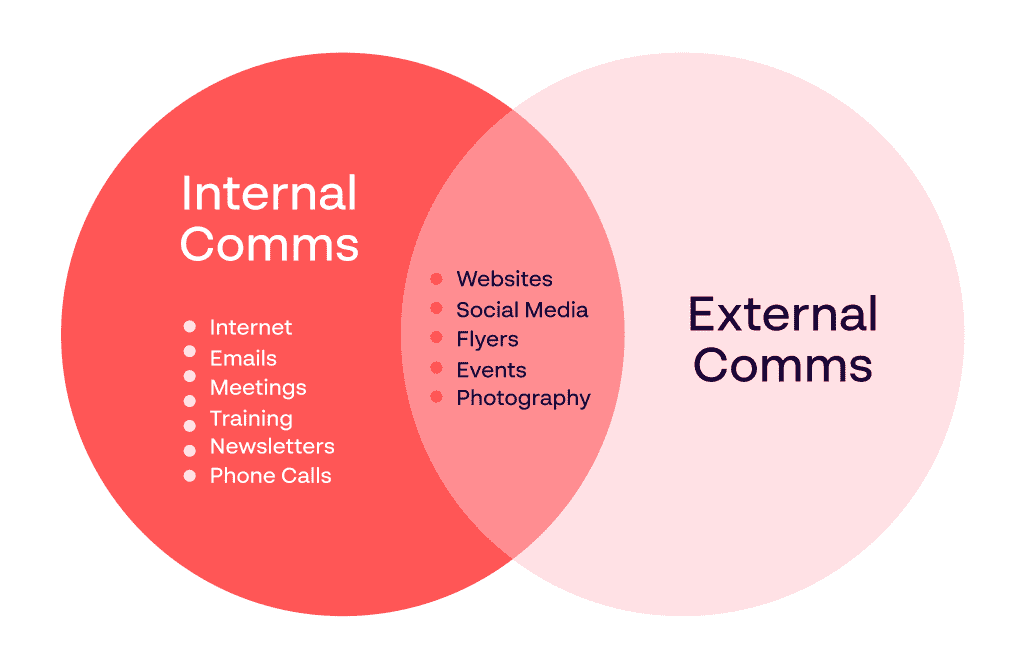
External communication focuses on messaging for customers, media, and the wider public. It’s the foundation of your brand reputation on local, national and global stages.
Internal communication centers on what’s shared inside your company. It’s about aligning leadership, employees and stakeholders through consistent updates and a unified brand experience.
It’s a high-stakes balancing act. As channels multiply and expectations rise, the ability to shape culture, reinforce values, and respond in real time has never been more important – or more challenging.
Yet Gartner reports that only 9% of today’s communication leaders believe they can shape company culture effectively. That’s a critical gap, especially in globally distributed teams.
Setting the right objectives is essential. It’s also critical to align them with business strategy and give your Director of Communications a seat at the executive table to ensure every message reflects your brand identity, vision, and long-term goals.
Here are some clear communication goals and metrics to help your team stay focused, impactful and aligned.
5 brand communication goals for corporate comms teams
1. Strengthen your brand equity
Your communications strategy should always have brand reputation at its core. Ensuring this goal is front and center helps embed it into every message and channel your team manages.
Metrics to track
Brand mentions on social media
Google Trends data linked to your brand
Number of press releases being picked up by external websites
Online reviews and public sentiment
2. Deepen employee engagement
Increasing employee engagement should be one of the key objectives of your internal communications team. Employees perform better when they feel a strong emotional connection to your organization and brand.
Metrics to track
Employee retention rates
Open and click-through rates on internal emails
Responses on employee surveys and feedback forms
Participation in training, company events, and team activities and after-work social activities
3. Encourage employee advocacy
Your people are your most powerful storytellers. A key goal for your corporate communications team should be to inspire employees to share company news, successes, and more. It’s one of the most effective ways to get people outside your organization to listen and respond.
Metrics to track
Brand mentions on social media
Posts featuring employees and company activities
Likes and shares on employee-led content
4. Increase traffic and leads for your company
Corporate communications should contribute to overall brand marketing performance. By aligning messages with strategic campaigns, your team can help attract the right attention and drive action.
Metrics to track
Website traffic numbers
Marketing- or sales-qualified leads generated
Growth of email database
Website analytics goals attributed to the corporate communications team
5. Accelerate crisis communication response
In a digital world, issues spread fast. Having a goal focused on improving the speed and clarity of crisis responses ensures your team can protect your brand image when it matters most.
Metrics to track
Time taken from incident to initial response
Public and media reaction to statements or press releases
How DAM software helps produce more consistent brand communications
These five goals offer a practical framework to help your corporate communications team focus their efforts and measure their impact. With a fast-evolving media landscape and growing global footprints, their role is only set to become more central to business success.
But objectives alone aren’t enough. To realize these goals, teams need the right infrastructure – tools that support clarity, consistency and speed at scale.
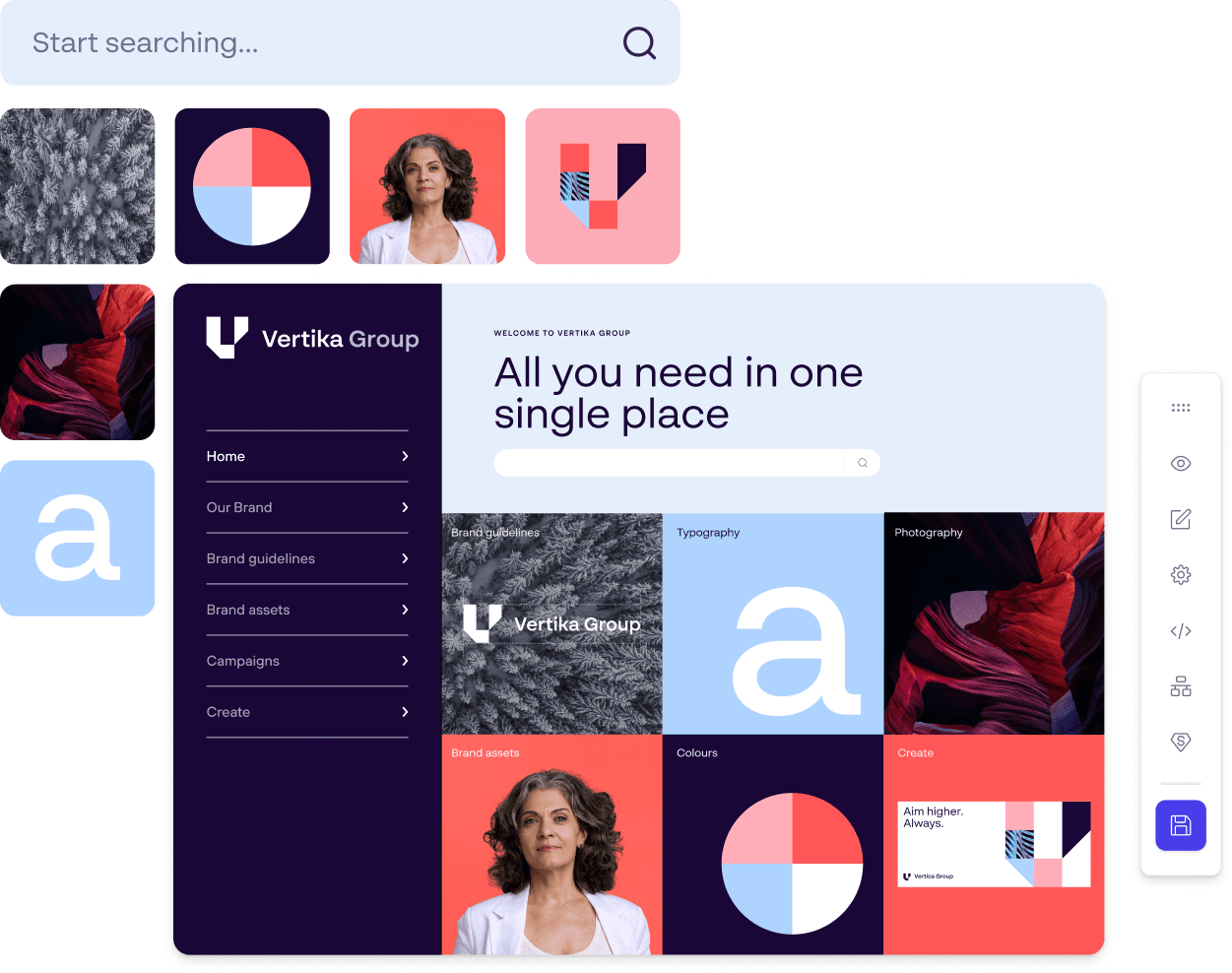
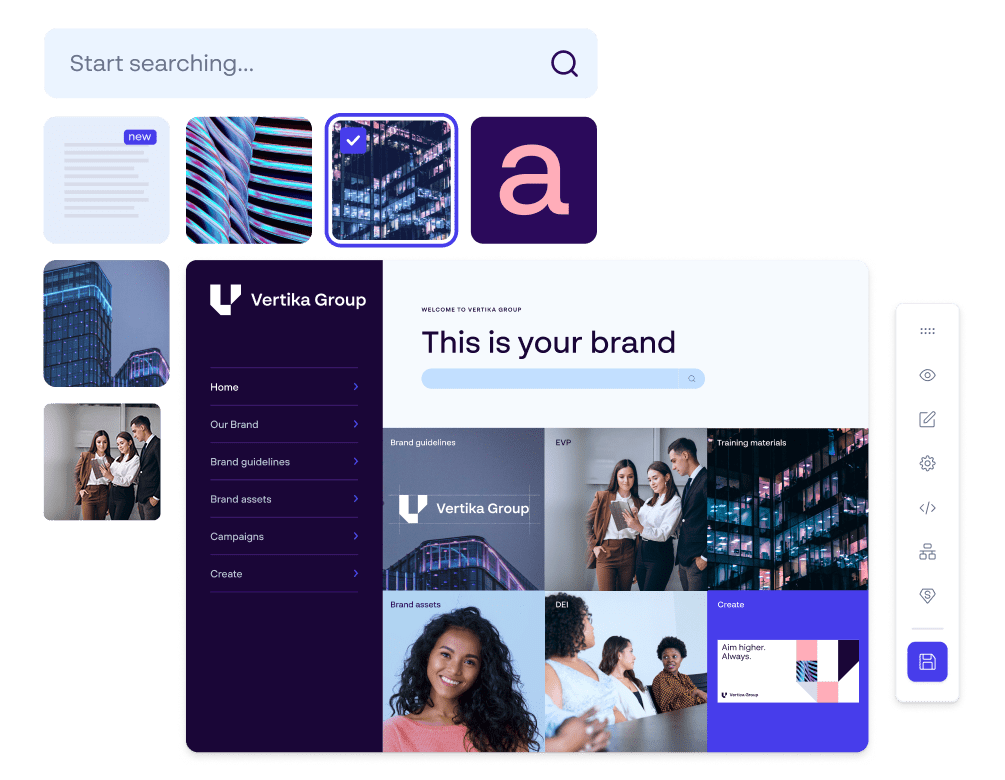
It starts with a Digital Asset Management software. By centralizing brand guidelines and assets, and allowing users to access them through a global brand portal, you’ll make it easy for everyone to visualize, understand, and follow your corporate brand.
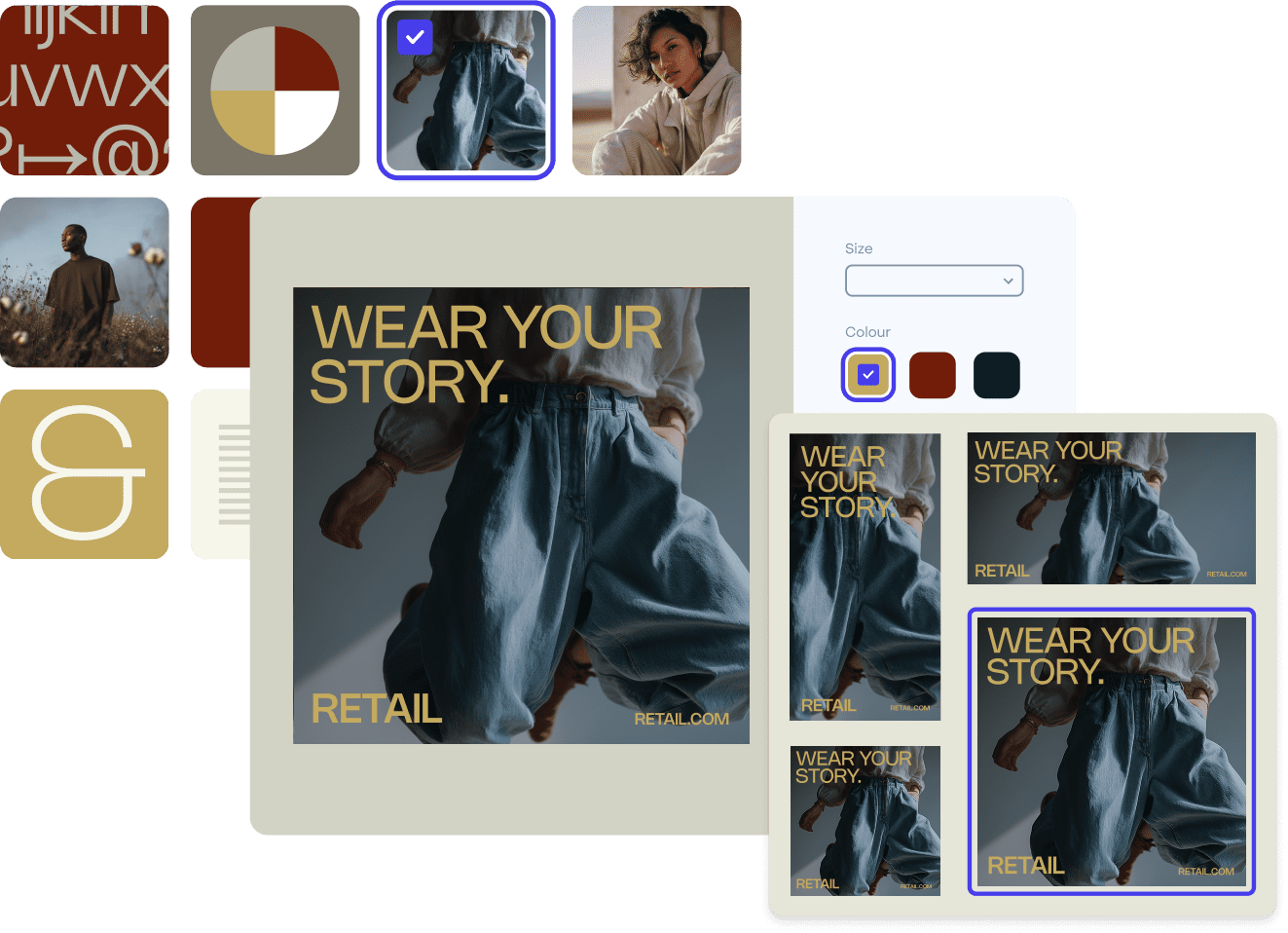
Next you need effective content creation tools. The only way to achieve all five goals above is if your teams are empowered to create studio-quality content – without ever straying off brand. This is exactly what Papirfly’s templated content creation solution is designed for, ensuring every corporate communications message is on-point and on-brand.
A corporate brand communication team manages how a brand is perceived both internally and externally. They handle media relations, brand messaging, crisis response, and internal updates. They also ensure brand consistency across all touchpoints.
Why is brand equity a key goal for corporate communications?
Strengthening brand equity builds brand recognition, customer loyalty and long-term brand value. By aligning communications with brand reputation goals, teams ensure every message contributes to a unified and credible brand identity.
How can internal communications improve employee engagement?
Effective internal comms help keep employees informed, aligned, and connected to the brand’s purpose. This boosts retention and morale – and ultimately drives performance.
How does employee advocacy impact corporate brand communication strategy?
When employees share brand messaging authentically, it expands the reach and credibility of your brand. As brand ambassadors, your team members help to amplify news, culture, and values with trusted voices.
What tools can corporate communications teams use to achieve their goals?
Corporate comms teams can use Digital Asset Management (DAM) systems and templated content creation tools to streamline communication workflows, ensure brand consistency, and enable rapid, on-brand responses – especially during crises.
This content has been automatically translated and may include minor variations.
In retail, one truth always remains: the customer defines the journey. No matter how big a brand grows, success depends on understanding how people think, shop, and connect.
For today’s consumers, personalization is key. Shoppers want and expect tailored retail experiences – and are increasingly likely to respond to them. In fact, research shows that 49% of consumers have made an unplanned purchase after receiving a personalized recommendation.
This is why retail content personalization is a top priority for modern retail marketers. Done well, it transforms every interaction into a meaningful connection that builds trust, loyalty, and lifetime value.
Personalization in retail: what it really means
Think of each personalized moment as a building block in a relationship. Every recommendation, message, or tailored experience tells your customer: we know you and value you for who you are.
Over time, that familiarity becomes confidence. Confidence leads to repeat purchases. And when personalized engagement continues beyond the sale, it evolves into loyalty.
The key is knowing how to use personalization effectively — and where to draw the line between helpful and intrusive.
Guide to creating personalized retail experiences online
When data is used responsibly and transparently, it enables brands to create retail experiences that feel effortless and intuitive. The goal isn’t to overwhelm customers with offers, but to make them feel recognized and understood throughout their journey.
Here are five practical ways retailers can personalize the online experience:
1. Personal greetings – Including a customer’s name in navigation or account pages instantly signals that their journey is unique to them.
2. Retargeting ads – Give customers a second chance to engage with products they viewed but didn’t purchase.
3.Value-driven emails – Send product updates, restock alerts, or tailored offers based on individual preferences.
4. Localization – Adjust offers and messaging to reflect regional conditions, seasons, or cultural events, ensuring relevance from first click to checkout.
5. Pick up where they left off – Save customer baskets and browsing history to make returning seamless.
Every small touchpoint reinforces recognition, which strengthens both trust and conversion.
The rise of hyper‑personalization in retail
Personalization in retail is evolving — and artificial intelligence is driving the next step forward. According to Salesforce, 51% of consumers expect brands to anticipate their needs and make relevant suggestions before they even ask.
This is the essence of hyper-personalization.
By using real-time insights from browsing behavior, CRM data, and purchase history, brands can tailor retail content marketing and in-store experiences to each individual. But hyper-personalization doesn’t happen overnight. It requires unified data, responsible governance, and the right tools to manage content dynamically.
One solution is to adopt Digital Asset Management and Templated Content Creation systems. These make centralizing and delivering brand assets much easier. And with automated updates, retailers can turn turning complex personalization workflows into streamlined, scalable processes.
Result? Faster campaign delivery, fewer errors, and customer experiences that feel genuinely one-to-one.
Bringing personalization in‑store
Digital personalization is essential. But it’s not the be-all and end-all. In-store personalization is also key. By connecting human experience with technology, retail brands can deepen their relationship with customers and convert curiosity into loyalty.
Here are our top five tips for in-store personalization marketing:
1. Localize your in‑store approach
Each store has its own audience, culture, and context. Empowering teams to tailor local retail marketing while staying on-brand ensures relevance without losing consistency. With templated content creation, store managers can personalize signage and POS materials using pre-approved templates that reflect local insights. Learn more about the power of using print in retail marketing.
2. Continuously measure and refine your displays
Encourage staff to observe how customers move through the store and interact with displays. Use data, feedback, and A/B testing to continuously improve store layouts and promotions.
3. Connect mobile and in‑store engagement
Retail apps and loyalty programs make it possible to send personalized offers when a customer enters the store – a great way to convert online behavior into real-world action.
4. Link offline activity to online channels
Digital receipts and loyalty cards create opt-in opportunities for ongoing, personalized communication. In this way, retailers can use in-story activity to inform improvements to digital marketing plans.
5. Mirror online insights in‑store
If a trend is performing well online, replicate that success in physical spaces. This doesn’t just boost sales – it also strengthens your brand by ensuring every retail touchpoint tells the same story.
Why personalization in retail matters now more than ever
Personalization is no longer a competitive edge — it’s a baseline expectation.
Every interaction, from an email subject line to a store greeting, shapes how customers perceive your brand. A single poor experience can damage trust, but personalized relevance can build it back stronger.
Papirfly helps retailers do personalization right. Our Digital Asset Management and Templated Content Creation solutions empower global and local teams to personalize retail marketing campaigns responsibly, ensuring every asset is on-brand, relevant, and delivered with precision.
Personalization made possible
At Papirfly, we help marketers create scalable personalization strategies that balance creativity with brand governance in retail.
With our retail marketing tools, you can:
Create customizable, on-brand content at scale with speed and accuracy.
Personalization in retail means tailoring every interaction to reflect each customer’s preferences and behaviors, from online recommendations to in-store experiences. It’s about creating relevance at every touchpoint, turning routine transactions into meaningful brand relationships.
Why is personalization so important for today’s retail brands?
Modern consumers expect brands to recognize and anticipate their needs. Personalization builds trust, drives retail customer engagement, and increases conversions. In fact, 49% of consumers say they’ve made an unplanned purchase after receiving a personalized recommendation.
What is hyper-personalization in retail
Hyper-personalization is the next evolution of retail marketing. It uses AI, behavioral data, and CRM insights to deliver real-time, one-to-one experiences that feel genuinely individual. This could include everything from personalized web content to dynamic in-store promotions.
How can retailers personalize the in-store experience?
Retailers can connect human experience with technology through localized messaging, mobile offers, digital loyalty programs, and data-driven store layouts. Tools like Templated Content Creation allow local teams to personalize signage and POS materials while staying fully on-brand.
What role does technology play in scaling retail content personalization?
Tools like Digital Asset Management (DAM) and Templated Content Creation make it possible to manage and personalize retail marketing campaigns efficiently. They centralize approved assets, automate updates, and ensure that every personalized message aligns with brand standards.
How can retailers balance personalization with consistency?
The key is to use personalization responsibly, guided by clear brand governance. By combining creative flexibility with centralized retail marketing tools, retailers can deliver personal, localized experiences that stay true to their brand identity and values.
This content has been automatically translated and may include minor variations.
There is a significant amount of value in your communications – but how do you determine how much?
Identifying the key corporate communication metrics that an organisation should be judged against has been an ongoing challenge across the marketing industry. During a PRWeek Breakfast Briefing in late 2018, Allison Spray, Head of Data and Insight at Hill & Knowlton Strategies, explained the situation quite clearly:
“I’ve worked across a lot of different (marketing) disciplines, particularly on the media-buying side, and when I look at how drastically they’ve moved in the past ten years compared to us, that’s when the gulf really becomes apparent”
While she was specifically referring to PR, this is arguably a constant across all forms of corporate communications. This is how your organisation communicates with its various audiences both internally and externally, from your employees and stakeholders to customers and the general public.
The days of evaluating the effectiveness of different communication systems on column inches and Advertising Value Equivalent (AVE) no longer apply. But, it is still highly important that you are using meaningful corporate communications metrics to track its usefulness to your brand.
Why is knowing your communication metrics important?
But what is less emphasised is the importance of tracking how effectively it is fulfilling those goals, or how substantial the cost of poor communications can truly be. A survey of 400 multinational corporations in the US and the UK revealed that communication barriers cost an average of $64.2m in lost productivity.
Unquestionably, that is money that can be put to better use, as well as an illustration of the hours wasted by employees as a result of ineffective communications. In fact, according to research by Mitel, ineffective communication amounts to 1 DAY of working time lost per week. Their report also revealed that:
In addition, a survey by Hollinger Scott revealed that 41% of teams don’t have any means to track their corporate communications in relation to user activity and how much content is being seen and interacted with.
Just having a corporate communications strategy in place is not enough – measuring the effectiveness of communications is essential to ensure that this monumental part of your day-to-day life is functioning as efficiently as possible.
Why is measuring communications such a challenge?
While the ability to measure effective communication is crucial, that doesn’t mean that a settled way to track these metrics has been fixed in place. The Barcelona Principles have attempted to offer a benchmark for measuring communications, but it is not comprehensive.
That is largely because the aims of communications aren’t exactly definitive – it is all about brand perception. And while communications metrics like email opens, event sign-ups and the columns you receive in an industry magazine can indicate your strategy is delivering results, it is difficult to be certain.
This has led some to argue the necessity of tracking internal communication metrics in particular, as this is above all a role designed to drive behaviors to fulfill business outcomes. That can be difficult to quantify through typical marketing KPIs.
Other potential barriers facing teams struggling to track their corporate communications metrics include:
Not having access to the right tools to measure relevant data
Fear that bad metrics will put communicators’ job security at risk, even if these numbers aren’t directly caused by their actions
Lack of time/resources – communicators cover so much ground that tracking results can feel like another burden on an already stressful job
But what corporate communications metrics and KPIs will signify if you’re reaching your targets or falling below expectations? As noted earlier, this is still a question which is yet to have a fixed answer.
Fundamentally, how you choose to measure effective communication within your organisation will depend on your specific business objectives. An effective approach to judging the quality of your communications is to place them in the context of what your business and its partners are looking for and judge against those, using these to identify any issues and barriers to these aims.
This places the measuring of communications at the doorstep of your senior leadership team – when both key executives and your communications team are in-sync in terms of what they intend to accomplish, it makes the job of tracking metrics far more straightforward.
It could be that your company wants to foster a stronger sense of brand identity within your workforce? Or that there’s less dependence on email with a stronger emphasis on your intranet or social networking tools? It will depend on what you are seeking from your communications efforts.
However, we can safely say that in order to effectively assess these, there is a mix of quantitative and qualitative corporate communication metrics you should incorporate into your analyses.
Essential key performance indicators for corporate communications
Employee awareness and feedback
Open, read and click rates
Page visits and logins
Peak times of staff intranet use
Corporate video views
Mobile usage levels
Platform adoption rates
Employee advocacy
Employee turnover
Event and benefit sign-ups
Media outreach and digital trends
Speed and effectiveness of crisis communications
1. Employee awareness and feedback
Did you know that 74% of employees feel they miss out on company news and information? Establishing how aware your teams are to the communications processes you have in place or how knowledgeable they are of the content you’re putting out there is a critical internal communication metric to track.
Establish a benchmark and then survey and talk to your employees to gain a consensus on whether they’re receiving the communications you are sending out, and if not, why? By measuring awareness and interest, you get an understanding of where your communications might be lacking.
2. Open, read and click rates
Plus, incorporate elements like event sign-ups and other links onto your communications to help determine if employees are actively engaging with them. While they might open an email, this will allow you to track if people are following the actions you’ve suggested and truly engaging with your content.
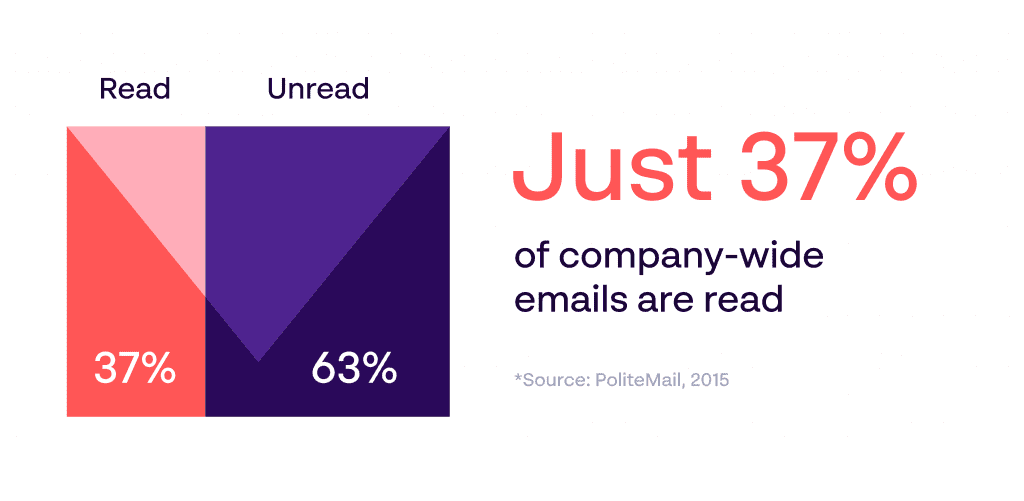
While on their own these do not paint a complete picture of the effectiveness of your approach to communications, the open, read and click rates of your emails and other messages will illustrate if people are paying attention to what you have to say. With the average read-rate of company-wide emails sitting at around 37%, this will provide an indicator of the success of your internal communications.
3. Page visits and logins
Similar to email opens, reads and clicks, used as standalone corporate communications metrics visits to a company-wide intranet can only tell you so much. But tracking unique page views, how often employees log in to the platform, how long they stay on there, and so on, provides an indication of how valuable your staff view these and if a change of approach is required. Remember – only 13% of employees strongly agree that their company communicates effectively with them…
4. Peak times of staff intranet times
Alongside how often your employees are logging into and engaging with your intranet or shared company platform, it can also be valuable to identify the peak times they are using it. Knowing the times of highest traffic will indicate when’s the right time to schedule company announcements or news updates in the hope of getting the greatest engagement.
Across all forms of marketing, timing is essential – to attract the largest possible audience to your internal communications, it benefits you to release them when they’re most active on your platforms.
5. Corporate video views
Another quantitative measure. If you have one or several corporate videos on your site or as part of your communications, following their play-rate and view counts will inform you as to whether they are resonating with and appealing to your audiences. Gathering this and other data at regular intervals (weekly, monthly, quarterly, etc.) will allow you to spot any trends and react to these in a timely fashion to protect your ROI.
6. Mobile usage levels
As well as how often employees and customers are engaging with your communications content, it’s important to determine where they’re coming from. With Brits spending in excess of two-and-a-half hours every day on their smartphones, knowing if they’re following this trend when engaging with your materials will highlight whether a mobile-first approach will appeal to your audiences more than focusing on an alternate avenue.
7. Platform adoption rates
If you’ve recently introduced a new social app for your employees, how many have downloaded it? Consider this if you’ve also introduced an employee recognition programme – how many people have actually signed up? Checking the adoption rates of these platforms designed to improve productivity and the effectiveness of communications will give an indication as to whether they’re actually providing a return, and also how well your communications are received overall.
It might mean that an alternative approach is required, or that the processes involved in setting up this platform are too complex or time-consuming for employees to get involved with. Again, it’s about identifying any issues early and reacting to them appropriately.
8. Employee advocacy
The power of transforming your employees into impassioned brand advocates cannot be overstated – it is a natural, sociable way to connect audiences to your company’s identity. Tracking how often your content is being shared, liked, and spread out by your team members is a powerful demonstrator of how connected they feel to your brand, as well as how familiar they are with your various communication platforms.
Identifying any issues with these corporate communication metrics will inform where, when and how you post content going forward, and hopefully lead to you utilising this powerful resource to its fullest.
9. Employee turnover
People who maintain a strong bond with their place of work are unlikely to want to leave it. And, judging how one of the primary reasons employees depart is due to a poor relationship with their manager, it stands to reason that your employee turnover numbers will be a useful communication KPI. The more turnover you endure, the less likely your staff are engaged with your company-wide communications.
When employees feel informed and understand what is going on in their company, they feel a deeper level of respect and trust towards it. This leads to better productivity, efficiency and achievement. If your communications are not as effective as they could be, you stand to miss out on those benefits.
10. Event and benefit sign-ups
If your company has a benefits programme or regularly holds workplace events, tracking how many of your team has signed up to these, and how quickly they do so, will provide insight into how effective your communications are. If the benefit is useful and doesn’t require a great deal of employee effort to get involved with, if enrolments are still low, this corporate communications metric can illustrate your current approach isn’t reaching people, or engaging them properly.
11. Media outreach and digital trends
Both the number of press releases and other external communications your company is sending out and the response to them can be a strong indicator of how effective they are. If they are getting into well-respected publications and websites with high domain authority, you will gain a clearer sense of how strong your content is on these platforms.
Furthermore, whether it’s the trending hashtags page on Twitter or you’re featured on Google Trends, that is another (if not, aspirational) way to determine if your communications are having the desired impact.
12. Speed of crisis communications
Finally, often the effective measure of your communications team is how quickly they can respond and handle difficult situations. Crisis communications form a central component of your overall communications strategy, and so it’s crucial you are tracking how quickly this content is reaching your audiences, and if their response to this is as you’d hope for.
Staying on top of your corporate communications metrics
This is just an indication of some of the communication KPIs that you should refer to when you are judging how the value of your communications to your organisation. The all-encompassing nature of these messages and their relationships with your various audiences, both within and outside your company, places a high priority on whether these are working as effectively and efficiently as possible.
The bottom line is that the quality of your corporate comms directly affects your bottom line. The question is, can you afford to NOT be tracking the impact your corporate communications strategy is having? Hopefully, these 9 examples will help to point you in the right direction when figuring out how solid your approach is.
This content has been automatically translated and may include minor variations.
Employee turnover is a familiar challenge for every organization – no matter the size, sector, or ambition. People change roles more frequently than ever, and research shows the trend is unlikely to slow. While some departures are unavoidable, many stem from internal issues that push talented people to look elsewhere.
Understanding why this happens is the first step toward building a workplace where great people choose to stay and employees become loyal brand ambassadors. Below are 14 of the most common reasons why employees leave — and what they signal about your culture, leadership, and employee experience.
Why employees leave for competitor organizations
1. Lack of trust and autonomy
High performers thrive when they feel trusted to deliver quality work – and almost nobody enjoys being micromanaged. If you’re placing too many restrictions on autonomy, and signaling a lack of confidence and trust, then that can be one of the fastest routes to high employee turnover.
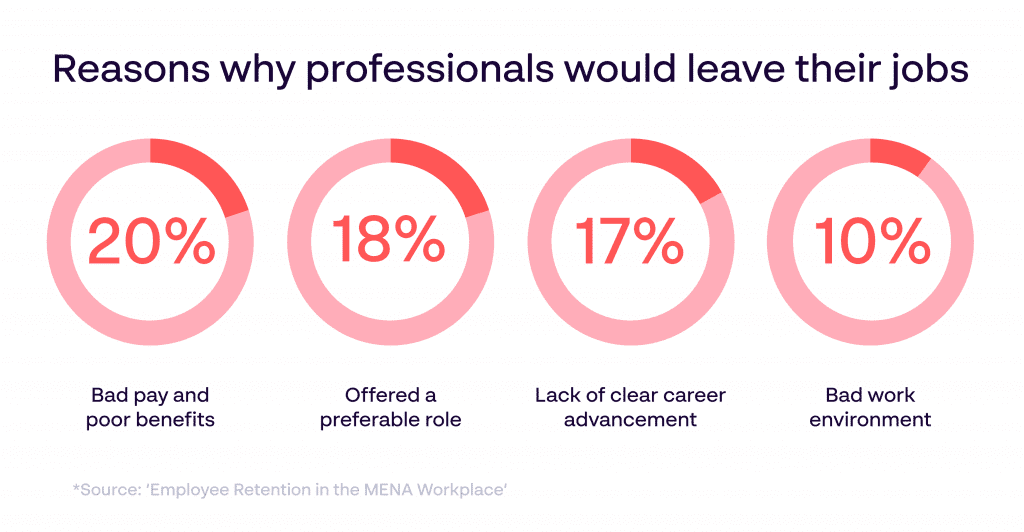
2. An uncompetitive offer
Compensation may not be the only factor in someone’s decision to stay, but it’s still an important one. Employees want to know their contribution is valued. If your package does not feel competitive, fair, or progressive, talented people will be open to outside offers.
3. Poor onboarding experience
Retention begins on day one. Without a clear and structured onboarding process, new hires feel disoriented, unsupported, and unsure where they fit. A poor first impression often leads to early disengagement – and early exits
4. Feeling underutilized
Employees want you to put their skills and expertise to good use. When their strengths are overlooked or their role feels too narrow, they begin to disconnect. Underutilization reduces motivation and encourages people to search for opportunities where their abilities matter.
5. Feeling underappreciated
Meaningful recognition makes a difference. When great work is ignored or taken for granted, even the most committed employees question their value. Over time, this lack of appreciation turns employee engagement into frustration – and frustrated employees are much more likely to leave.
6. Feeling disrespected
Respect is critical for workplace wellbeing. When employees feel dismissed, excluded, or treated unfairly – whether by leadership or peers – they will seek out other environments where they feel properly valued for who they are.
7. Weak leadership
Managers influence day-to-day experience more than any other factor. When leadership lacks direction, clarity, empathy, or inspiration, employees feel unsupported. Not only does this impact their ability to perform effectively – it also reduces their willingness to stick around.
8. Limited communication
People want to share concerns, ask questions, and contribute ideas without fear of being ignored. When communication is inconsistent or absent, employees feel untrusted and unheard – a surefire way to accelerate their departure.
9. Unhealthy company culture
Toxic or unbalanced cultures push talent away fast. Whether the environment feels rigid, negative, or disconnected, employees won’t stay where they don’t feel comfortable. Culture is more than atmosphere – it’s the experience people live every day.
10. No connection to your values
Your employer brand is central to whether you keep or lose good employees. If it’s consistent, authentic and built on strong values, then people are much less likely to quit. But they will always struggle to build that level of commitment if they don’t buy into your goals, missions, and principles.
11. No room for growth or development
Stagnation is one of the biggest drivers of turnover. Ambitious employees want to progress. And when opportunities for training, learning, and advancement are unclear or inaccessible, people leave to find environments that support their aspirations.
12. Feeling overworked
Workload pressure is common — but chronic overload leads to burnout. When employees consistently carry too much responsibility with too little support, they prioritize their own wellbeing and move on.
13. Poor work-life balance
Flexibility matters more with every generation. If your workplace culture expects long hours, limited boundaries, or rigid schedules, employees look elsewhere for roles that support their life outside work. Balance is now a business priority.
14. Seeing other good employees leaving
Turnover can be contagious. When people see respected peers leaving, they begin to question their own experience. Even if the reasons are unrelated, the perception of decline can lead to further departures – and suddenly your employee retention issue has escalated into a full-blown crisis.
The cost of losing good employees
Replacing a valuable team member is expensive – often between six and nine months’ salary when you factor in recruitment, onboarding, and lost productivity. For many companies, that number is even higher when roles remain unfilled or when departing employees take institutional knowledge with them.
Beyond cost, turnover disrupts your company culture and weakens your competitive edge. When experienced employees leave, teams lose continuity – and rebuilding that capability takes time, energy, and significant investment.
How to retain good employees who want to leave
We’ve looked at some of most common reasons why good employees want to leave. Now let’s examine the proactive steps organizations can take to keep top talent and position themselves as an employer of choice.
To improve retention, you can:
Regularly check in on wellbeing
Consistent conversations help employees feel seen and supported, whether you do it through official reviews or informal discussions with supervisors. Regular check-ins also ensure you address concerns early – before they escalate.
Encourage learning and growth
Offer opportunities for self-improvement both inside and outside of work – and recognize and celebrate progress wherever it occurs. When people feel their careers – and lives – are moving forward, they’re more motivated to stay.
Support flexible working
Flexible working is quickly becoming the norm, and organizations that don’t adapt risk losing employees to those that do. Providing workforce flexibility can also help you boost productivity and reduce the risk of burnout.
Strong managers shape the everyday experience for your employees. Because poor leadership is a major driver of turnover, it’s essential to equip managers with the skills, tools, and confidence to support their teams effectively. When leaders know how to welcome new talent, guide performance, and foster healthy collaboration, you reduce unnecessary friction and create an environment where people feel supported and understood.
Provide clear paths for progression
Employees want to see a future for themselves inside your organization – and they need clarity on what that future can look like. Make progression pathways visible, structured, and achievable so people understand how their role can evolve. For high-performing employees, this transparency reinforces their motivation to grow with you rather than seek opportunities elsewhere.
Protect your talent with strong employer branding
Employer branding plays a powerful role in both talent attraction and talent retention. With Papirfly, all your teams can maintain brand consistency and communicate what makes your organization a place people want to stay.
Papirfly empowers teams to:
Create on-brand, high-quality marketing content at scale through Templated Content Creation.
Access all employer brand guidelines, documents, and assets in a dedicated brand space.
Plan and activate recruitment marketing campaigns with ease.
Store, organize, and distribute brand assets through enterprise-grade Digital Asset Management.
When every employee can express your brand clearly and confidently, you build a workplace that people believe in – and one they choose to stay part of.
Why do high-performing employees leave even when the role seems right?
Often, the issue isn’t the work itself – it’s the environment around it. A lack of trust, recognition, communication, or development opportunities can push even the strongest performers to consider other options.
How much does a poor onboarding experience impact employee retention?
Significantly. A weak onboarding experience creates early misalignment and uncertainty, leading many new hires to disengage within their first few months. A structured, supportive start is one of the most effective retention tools you have.
What role does culture play in keeping good employees?
Culture shapes how employees feel day to day. If the environment is rigid, negative, or disconnected, people simply won’t stay – regardless of compensation or benefits. Culture must feel supportive, inclusive, and aligned with your values.
Why does employer branding matter for retention?
Employer branding helps employees understand and believe in your purpose, values, and expectations. A clear, authentic employer brand strengthens belonging and loyalty. When it’s weak or inconsistent, people struggle to connect.
How can organizations prevent top talent feeling like they’re stagnating?
By offering clear, accessible pathways for growth. Employees want to see how their role can evolve and what success looks like long term. When progression is visible and supported, people are far more likely to stay and grow with you.
This content has been automatically translated and may include minor variations.
In today’s connected world, more brands are stepping onto the global stage – but with international visibility comes greater complexity. That’s why maintaining brand consistency across platforms and markets isn’t just important – it’s essential.
The 2025 brand consistency numbers speak for themselves:
Companies that maintain consistent branding across all channels see up to 23% revenue growth compared to those with inconsistent identities. [Source: Amra & Elma]
About 33% of businesses report that consistent presentation of their brand has driven revenue increases of 20% or more. [Source: Shapo]
Around 68% of organizations experience 10–20% revenue growth directly linked to prioritizing brand consistency efforts. [Source: Capital One Shopping Research]
Brands that maintain long-term consistency achieve twice the profit gains of those with frequently changing messages. [Source: Funnel.io]
A striking 90% of consumers expect a seamless and consistent brand experience across all marketing channels. [Source: We Are Tenet]
Global brand consistency directly influences how people perceive your business – externally and internally. It strengthens trust, builds brand awareness, and helps you stand out in increasingly competitive markets.
Why brand consistency counts – and what it delivers
Gives your global teams a shared identity and direction to move toward
Makes it easy for people to follow and interpret your brand
However, maintaining brand consistency is easier said than done. With so many employees sharing content across so many channels, inconsistencies can naturally creep in if you’re not careful or lack a clear brand strategy.
This can be problematic even for a small, domestically focused business. Expand to a global scale and the risk of inconsistency increases dramatically, especially when you factor in differences in culture and language.
You’ve likely seen some of these famous missteps:
Braniff Airlines translating their “fly in leather” into the Spanish slang for “fly naked”
KFC’s “finger-lickin’ good” slogan becoming “eat your fingers off” in China
The Arabic translation turning “Jolly Green Giant” into “Intimidating Green Ogre”
And while these examples highlight how easy it is to get brand messaging wrong, they are also just the tip of the iceberg. So, with the stakes as high as they have ever been, how can companies maintain brand consistency on their global stage?
Your global brand consistency checklist
Here are five key steps to maintaining brand consistency worldwide:
1. Audit your existing brand materials
Start by assessing what’s already out there. Do your marketing materials reflect your true brand identity in terms of color, tone, imagery and brand messaging? Or are there inconsistencies?
This audit helps you pinpoint gaps and get a clear picture of where alignment is needed.
2. Develop brand guidelines
Clear, accessible brand guidelines are your brand’s north star. These should cover:
Brand mission and values
Logo usage
Color palettes
Brand messaging and tone of voice examples
Iconography
Your brand guidelines will be vital in keeping your entire team on the same page – and helping to ensure you show up in a consistent way through all your content and in every market.
3. Make guidelines accessible to all
Having great brand guidelines is one thing. Making them easily accessible is another. From your marketing team to local employees to agency partners, everyone needs to be able to work from the same brand book – because if people can’t find or follow your rules, you can’t expect consistent results. A brand portal is the perfect way to achieve this.
4. Align internal and external branding
Consistency starts from within. If employees aren’t aligned with your brand values, it’s difficult for them to deliver your message authentically to the outside world.
From onboarding and internal training to office signage and internal comms, reflect your brand identity inside as well as out.
5. Empower your people to create, with control
Your people are closest to their local audiences. Giving them the tools to create high-quality assets is a powerful step on the way to building brand equity – as long as you can ensure everyone stays consistently on-brand.
This is exactly what our Templated Content Creation tools make possible. Teams are given templates with key brand elements locked in, empowering them to produce localized content with confidence and consistency. Also, making sure you use enterprise templates above consumer design tools gives you total brand governance.
How DAM software helps maintain brand consistency
At Papirfly, we know maintaining brand consistency globally is a complex task. That’s why we’re committed to giving organizations the power to showcase, manage, create and share digital brand assets – across every market and every team. With Digital Asset Management and templated content creation at your fingertips, you can equip global teams to act locally without ever going off-brand. And that really matters – because when your brand speaks with one voice, people listen.
Does everyone create content that’s on‑brand, every time?
Find peace of mind with better brand governance.
Does everyone create content that’s on‑brand, every time?
Why is brand consistency important for global companies?
Brand consistency builds trust, drives recognition, and boosts brand equity. Globally consistent brands are 5 times more likely to be remembered and can see up to 23% more revenue growth by aligning messaging across all platforms.
What challenges do brands face when trying to stay consistent across platforms?
Achieving brand consistency across platforms can be challenging due to the complexity of maintaining a unified brand presence in diverse formats, channels, and teams. These challenges increase when you have decentralized teams and inconsistent access to brand guidelines.
What are the essential elements of brand guidelines?
Brand guidelines should include your mission and values, logo rules, color palettes, tone of voice examples, iconography, and usage standards. These ensure teams present your brand in a clear, unified way across channels.
How can companies make it easier for teams to follow brand guidelines?
Make brand guidelines easily accessible to all teams, partners, and agencies by using a Digital Asset Management system or brand portal. This ensures the right people can always find and apply the latest brand assets and guidance.
How does templated content creation support brand consistency?
Templated content creation empowers teams to produce local, personalized content while keeping key brand elements locked in. This enables scale and flexibility without compromising brand compliance.
This content has been automatically translated and may include minor variations.
Attracting and keeping the right talent has never been more challenging. Every organization wants people who bring energy, ambition, and a strong cultural fit – but your competitors want them too. And today’s candidates have unprecedented access to information. A quick search, a social review, or a conversation in an online forum can shape their impression of your workplace long before they meet you.
That is why a clear, credible employer brand strategy is essential. It helps you articulate what you stand for, what you offer, and why someone should build their career with you. Done well, it sets you apart in a crowded market and strengthens talent retention by helping employees feel connected to your mission.
Below, we break down what an employer branding strategy is and outline 13 practical steps to create one that attracts, engages, and retains top talent, wherever they are in the world.
What is an employer branding strategy?
An employer branding strategy is a documented approach for communicating your organization’s values, culture, and employee experience. It defines how you project your employer brand to current teams and future candidates, and ensures every touchpoint feels consistent, human, and aligned with your identity.
Your strategy exists to:
Differentiate your brand from talent competitors
Show why people should want to join your organization – and stay
Demonstrate how your company culture is evolving and getting stronger over time
An effective employer branding strategy requires clarity, commitment, and ongoing refinement. When done intentionally, it becomes a powerful tool to attract top talent and build high-performing teams.
Why your employer branding strategy matters
Your employer brand is visible long before you engage a candidate directly. Review platforms, social media, internal stories, and your own marketing channels all shape perception. If your narrative is unclear or if negative experiences overshadow the positives, you risk losing great people to organizations that communicate better.
A strong employer brand strategy helps you build deeper connections with talent. And when you do that, you can:
Increase your appeal to high-quality candidates
Strengthen engagement by aligning people with shared values
Reduce hiring and talent retention costs
Inspire voluntary advocacy
Create a unified vision for your organization that everyone shares
13 steps to building a strong employer branding strategy
Effective employer branding strategies can be the difference-maker in an ideal candidate’s decision to join your organisation over the other options available. Following these best practices gives you greater control over the messages you project, and the ability to influence how these individuals see your brand.
1. Audit how people perceive your brand
Before building your employer brand strategy, you must have a clear understanding of your employer reputation right now. A structured audit of candidate and employee perceptions can help you identify any gaps, misalignments, or misconceptions that need addressing.
Here are some key channels to include in your audit:
Employment review sites – What are people saying about your company culture? Are there any negative reviews and, if so, how are you addressing them?
Social media – What conversations are happening about your workplace? Invest in social listening tools to track mentions across social media.
Employee feedback – What are your teams experiencing day to day? Use internal surveys or open team meetings to identify key issues.
Google alerts – How is your brand represented publicly and how does it compare with your intentions?
2. Build your candidate personas
Your employer brand must speak to the people you want to hire. Candidate personas help you define their motivations, values, and expectations, so you can target the right people for the right roles.
Consider:
Personality traits
Career goals
What causes they care about
Where they go for information
The influences shaping their decision
3. Establish your differentiators
Your differentiators are the reasons someone chooses you over another employer. These should reflect your mission, values, cultural strengths, and areas where you excel.
Ask yourself:
What do we offer that competitors do not?
What does our culture enable people to achieve?
Which principles guide the way we work?
Where does our brand excel and stand out from the crowd
The answers to these questions will form the backbone of your employer brand storytelling and will help make you more attractive to potential recruits.
4. Define the marketing channels that matter most
Your audiences will not all engage through the same touchpoints. Identify where your candidates spend time and commit to sharing clear, consistent messages across those channels.
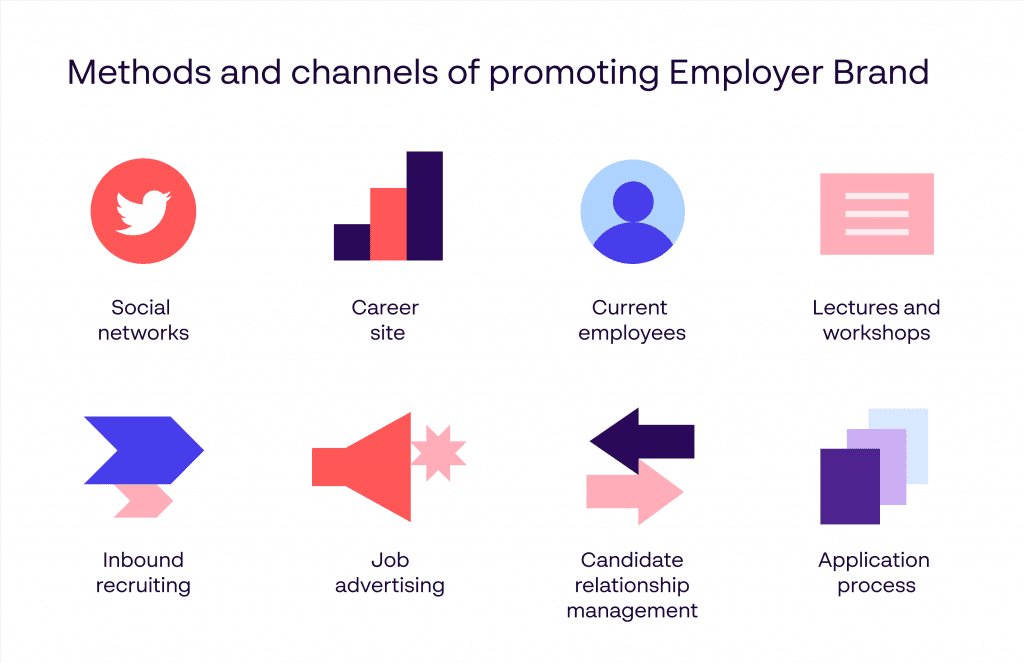
Some of the most common channels are outlined below.
Whichever channels you’re communicating on, authenticity is essential. Messaging should feel human, grounded, and reflective or real employee experience. If not, it risks breeding candidate distrust.
5. Create your Employer Value Proposition
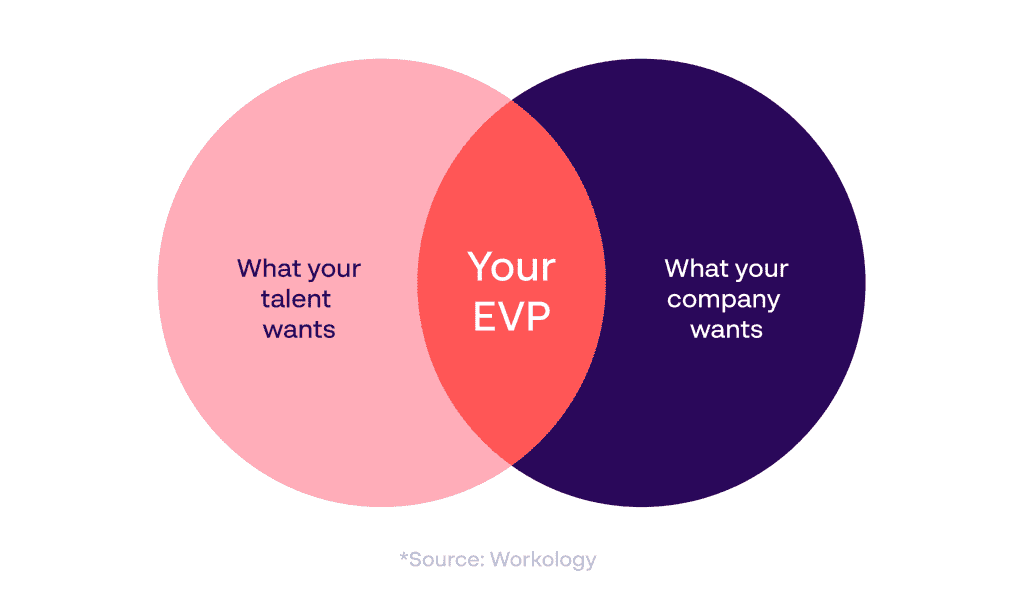
Your Employer Value Proposition (EVP) is your promise to current and future employees. It outlines what people gain from being part of your organization – professionally, emotionally, and socially. This makes it a centrepiece of your employer branding strategy.
Elements often include:
Company purpose
Workplace culture
Core business values
Professional development
Flexible working opportunities
Work-life balance
Benefits and perks
Support for wellbeing
Community and social impact
Your EVP should be clear, honest, and visible. Consider using Digital Asset Management for employer branding to ensure everyone across your organization can access your EVP whenever they need.
6. Develop or refine your employer brand guidelines
Brand consistency strengthens credibility. Dedicated brand guidelines ensure your visuals, tone, and narratives align globally while giving local teams what they need to adapt content responsibly.
Career growth directly influences employee retention. When people feel supported, motivated, and able to progress, they stay longer and contribute more. When they don’t, employee turnover can soon become a problem.
This is why having robust training and development programs is so important. They are not just a means of upskilling your staff. They also help you:
Everyone responsible for hiring, culture, or brand experience must be aligned on your approach to employer branding. This may include HR and talent acquisition, internal comms, marketing and brand teams, regional leads, and more.
Gather input early to ensure the strategy reflects real needs and is supported across the organization. Once stakeholders are aligned, you can start educating the wider teams to make sure everyone is on the same page.
9. Measure your success
Building your employer branding strategy is just the start. You need to monitor performance and refine your approach to ensure you stay aligned with evolving candidate and employee expectations.
Key metrics to track include:
Time to hire
Cost per hire
Application volume
Talent retention rates
Brand sentiment
Frequency of employer brand marketing
If results fall short, revisit your messaging, touchpoints, or processes – and continue course-correcting until you see the results you’re looking for.
10. Keep listening to employees
Employee expectations shift – and so does your company culture. Regular conversations, surveys, and focus groups help you stay grounded in what your people value.
This is especially important for global teams. Ensure you hear perspectives across locations, not just from headquarters. Getting relevant, on-the-ground insights is critical if you want to create a world-class employer brand that resonates with audiences everywhere.
11. Use video to tell your story
Whether it’s for organic advertising or high-volume recruitment campaigns, video is a great way to bring your culture to life. It shows real people, real workplaces, and real stories, making it easier for candidates to imagine themselves with you.
Video content marketing can be especially useful for large organizations that need to humanize their brand and reassure potential candidates they are friendly and approachable places to work.
12. Build employee advocacy
Your people are your most credible storytellers. When teams genuinely understand and support your message, their voices carry far more influence than any official campaign ever could.
Authentic advocacy cannot be forced. It comes from positive experiences and the freedom to speak openly. Create brand ambassadors by encouraging employees to:
Global brands thrive when their employer brand feels relevant everywhere. But achieving this consistently requires careful adaptation of content. Clear guidelines for language, cultural nuance, and imagery help teams create localized employer branding materials while staying true to your overall brand identity.
The future of your employer branding strategy
A strong employer brand is one of the most powerful tools you have for talent attraction and retention. It supports company culture, strengthens employee engagement, and creates a workplace people are proud to advocate for.
With the right employer branding solutions – from Digital Asset Management to Templated Content Creation and brand portals – you can empower global teams to deliver consistent, high-quality employer branding materials with ease.
When every team can communicate your culture confidently and consistently, you build a workforce that feels connected, inspired, and ready to move your organization forward.
An employer branding strategy is a documented plan for communicating your values, culture, and employee experience across every candidate and employee touchpoint. It helps you differentiate your organization from talent competitors and ensures you present a consistent, compelling identity that people can trust.
Why is employer branding so important today?
Candidates now form opinions long before speaking with a recruiter. Review sites, social media, and internal stories shape perception instantly. A strong employer brand strategy helps you stand out, reducing hiring costs, strengthening employee engagement, and building a more unified, purpose-driven company culture.
What should be included in an Employer Value Proposition?
A clear Employer Value Proposition (EVP) communicates what people gain by working with you – from your purpose and values to growth opportunities, flexibility, wellbeing support, and social impact. It should be transparent, meaningful, and easily accessible so teams can communicate it consistently.
How do I know if my employer brand strategy is working?
Tracking the right metrics is essential. Monitor time to hire, cost per hire, application volume, retention rates, brand sentiment, and the performance of your employer brand content. These indicators show you where you are progressing and where refinements are needed.
How can global organizations maintain brand consistency across regions?
Brand consistency comes from a balance of clear guidelines and thoughtful localization. Global rules for tone, imagery, cultural nuance, and messaging help create a unified identity, while giving local teams the freedom to adapt content in ways that feel authentic and relevant to regional audiences.
This content has been automatically translated and may include minor variations.
Today more than ever before, it is difficult to underestimate the value of customer brand equity. It is what separates a generic local soft drink in your supermarket to Coca-Cola and Pepsi. It’s the value that a brand adds to comparable products.
Customer brand equity (also referred to as Customer-Based Brand Equity, or CBBE) relates to how your customers’ attitudes towards your brand influence the success of your business overall. If customers recognize, understand and connect with your brand, performance goes up (provided experiences are positive).
It appears a straightforward concept to understand, but building customer-based brand equity isn’t anywhere near as clear-cut. It takes a lot of effort and nurturing your audience, but the rewards for getting it right can make a big difference to your business prospects.
Plus, measuring CBBE can offer valuable insights into your company’s performance and play a key role in guiding your marketing strategy.
Here, we dive deeper into customer brand equity and why it’s so valuable for companies to strive towards. This includes a breakdown of Keller’s brand equity model, and techniques you can apply to guarantee brand consistency and enhance your brand equity moving forward.
What is customer brand equity?
As noted earlier, customer brand equity represents how much the success of your brand is directly related to the attitudes of your customers towards it.
It’s no shock that loyal customers play a vital role in the success of any brand or organization – without them, it would be impossible for these to get anywhere. But their influence extends far beyond simply how much they’re buying into your products or services – it is as much about how they perceive your brand.
If customers have a positive association with your brand and use it regularly over your competitors, this will naturally have a positive effect on your business. Conversely, an overall negative perception of your brand – or if you remain unknown and not even on customers’ radar, this will have the opposite effect.
Today, people can publicly review and critique a brand’s quality of products and service within seconds. Paying attention to the strength of your customer brand equity is as crucial as ever.
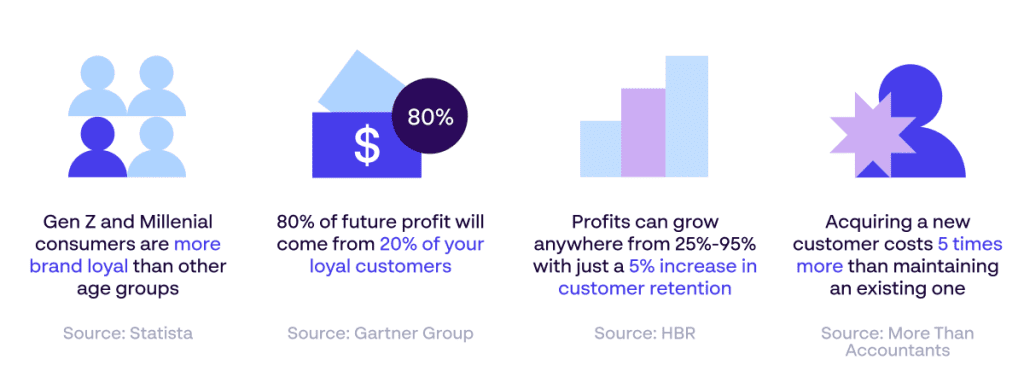
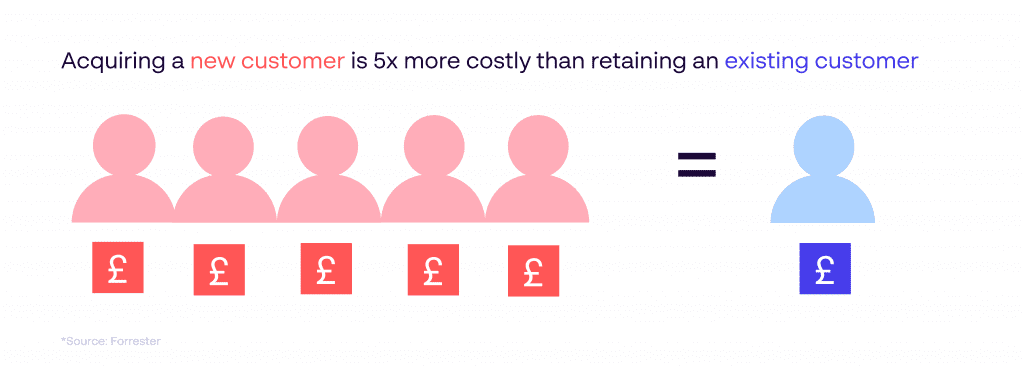
In essence, customer brand equity plays a vital role in depicting brand loyalty towards your business. As acquiring a new customer is 5 times as expensive as maintaining an existing one, having a strong CBBE is likely to benefit your bottom line.
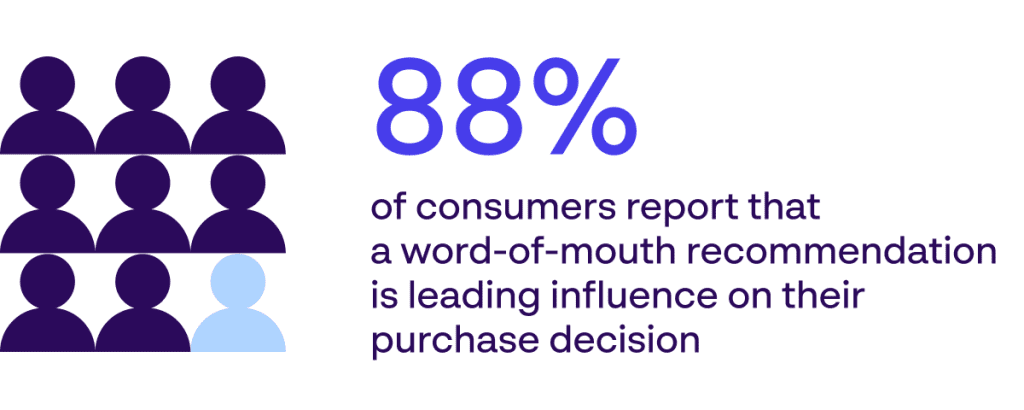
Plus, having loyal customers that understand and resonate with your brand will help generate new leads more naturally. Brand-loyal consumers are more likely to act as advocates for your services to loved ones and friends – especially valuable considering 90% of consumers claim a word-of-mouth recommendation is a leading influence on their purchase decisions.
This makes the value of your customer-based brand equity essential to the strength of your company as a whole. If this is managed well and harnessed effectively, you can make a big impression on how successful your business is operating.
Equally, an understanding of your customer brand equity can provide insight if your brand is not connecting with consumers in the way you anticipated. Identifying this can encourage a change in strategy or approaches that develop a stronger, more positive association between your target audience and your brand, leading to repeat business and loyal advocates.
Brand equity vs customer equity
Brand equity illustrates the worth of the brand, i.e. the value added to a product by branding it. Customer equity relates to lifetime values that are important to consumers.
Both are linked by a strong focus on customer loyalty, and the value of having a dedicated customer base in determining the overall worth of a brand. But, what makes customer brand equity a key focus is its direct connection to the financial impact customers have on an organisation as a whole.
Therefore, building customer-based brand equity achieves the critical aims of raising the value of your brand, while also giving insight into what your customers want and expect from your company.
The Keller Brand Equity Model
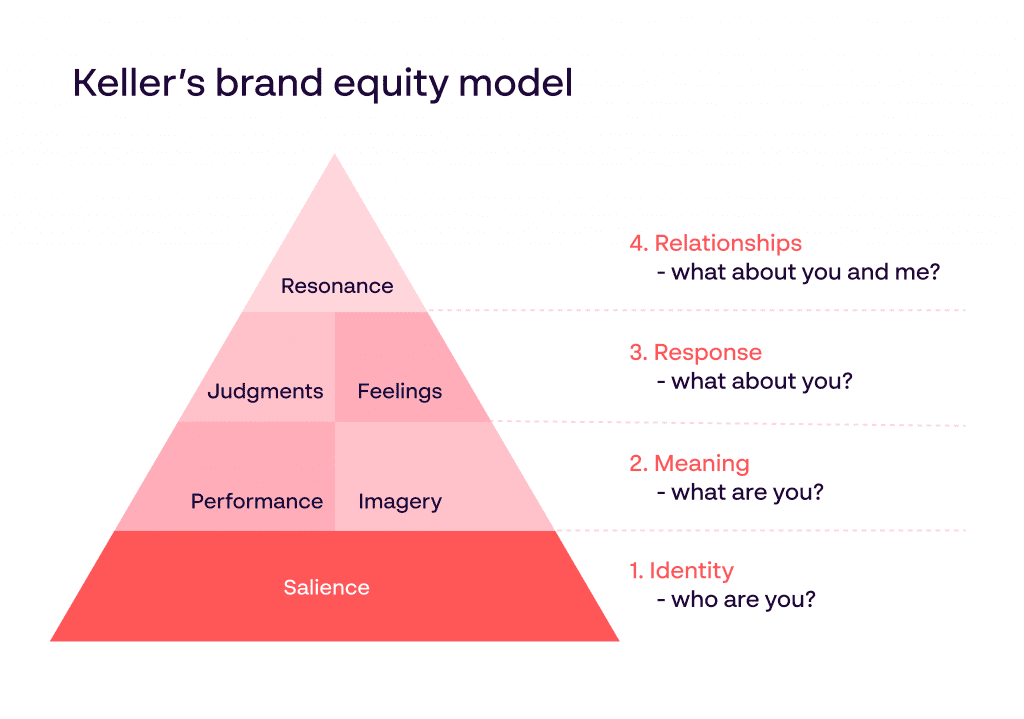
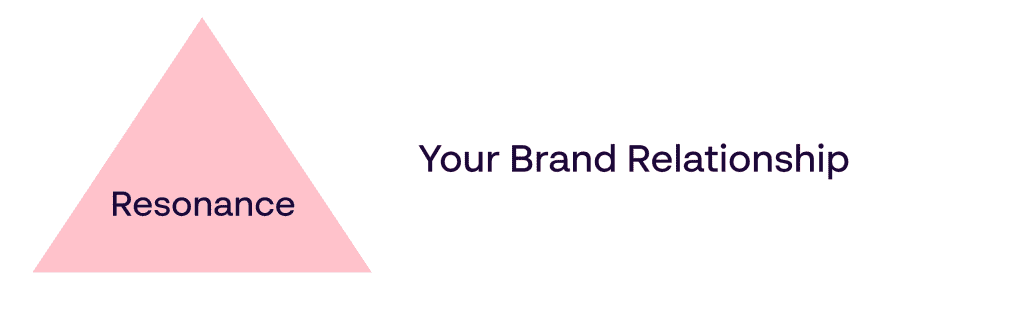
The standout CBBE model was developed by Kevin Lane Keller, a Professor of Marketing, in his 1993 book Strategic Brand Management. Through this model, Keller looked to illustrate the journey of customers’ relationships with brands – from recognition at the bottom, through to resonating with the brand at the peak.
As depicted in the above image, Keller identifies 6 components that contribute to customer brand equity, and thus how customers think and feel about a brand overall:
Salience
Performance
Imagery
Judgements
Feelings
Resonance
Here, we’ll cover these in greater detail and the role each plays in creating customer loyalty towards a brand.
Who are you?
At the foundation of the brand equity pyramid is salience, which represents how aware people are to the existence of your brand in general. This is the essential first step in building customer brand equity – if people don’t know about your brand, it will be hard for them to form an opinion about it one way or the other. This section carries the weight of the rest of the pyramid.
Of course, this stage is about more than ensuring people have some recognition of your brand; it must be the right recognition. At this first instance, it’s important you give people a clear, consistent and accurate depiction of your brand’s identity, as without this they will have little chance of progressing further up the pyramid.
To make the biggest positive impact on your customer brand equity at this level, you should conduct thorough research to get a clear understanding of your target audience, and what they are looking for out of a company that provides your products or services. How do they decide between your brand and another competitor?
Once you have established this, it is important that your awareness efforts:
Hone in on the pain points/interests that matter to them
Are placed on a platform that they interact with often
Are consistent across all channels you choose to market o
What does brand salience mean for your marketing team?
The people inside your organization must live the brand first, in order to help your audience recognize, trust and remember it. A brand portal becomes essential, acting as a single source of truth.
A well-structured showcasing of your brand identity includes ready-made campaign assets, tone of voice guidelines, or any content creation templates they can use. Everyone can visualize and represent the brand – employee, partner or stakeholder – with 100% brand consistency from day one.
What are you?
The second level of Keller’s CBBE model is divided into two segments – performance and imagery. Performance covers the actual features and capabilities of your products/services. This encapsulates:
Functionality
Reliability
Style/Design
Price
Durability
Customer Service
Customer Satisfaction
Consequently, if your product delivers on the promises highlighted in your brand awareness campaigns, then it should lead to positive experiences which, in turn, drive customers further up the brand equity pyramid. If it doesn’t deliver on their expectations, then you risk them falling away altogether.
This is why authenticity is more than just a buzzword when it comes to customer-based brand equity – it is central to encouraging loyalty and establishing long-term relationships.
Alongside performance is imagery, which is more about how your brand meets your customers’ social and psychological needs. Think of your brand as if it were a human – what would they be like? Is it strong and tough? Is it sensible and sophisticated? Is it quirky and exciting?
Brand imagery is what people think when they see your brand. It is about how happy they would be to be seen associated with your products as a result of its reputation.
How effective this proves for you will come from initially discussing your brand values and which you consider relate to the interests of your customers. How important is the environment for them? Do they care about their local community? Finding the answers to these and other questions will help you project an image customers can get on board with.
How can your marketing team show customers your brand meaning and brand features?
Ensuring every visual, message and asset reflects who you are as a brand – consistently and without compromise – requires fast and reliable access to the right materials, tailored to their roles and regions.
Digital Asset Management software system is key to making this possible. It centralizes all approved assets in one place, making it easy to locate, share, and use brand materials that align with your identity and values. When your DAM reflects your brand’s meaning with structure and clarity, your teams are empowered to deliver content that will resonate with audiences and is the starting point to evoking an emotional response.
What about you?
The third strand of the customer-based brand equity pyramid is also split in two, covering both judgement and feelings. These both relate to what people feel towards your brand, and the impact this has either positively or negatively.
First, judgement is about the opinions that people form about your brand. This could be good, like if someone considers your products reliable or handy. Or it could be detrimental, as in somebody judging them to be cheap or ineffective. And while you might disagree with their assessment, they still carry a great deal of weight.
Typically, the judgement of a brand breaks down into four segments:
Quality – the brand’s actual/perceived quality
Credibility – the brand’s reputation
Consideration – the brand’s relevancy
Superiority – the brand’s status against competitors
Plus, someone doesn’t have to even experience your brand first-hand to be affected by judgements – they can form an opinion simply through word-of-mouth of performance or company ethics.
To combat the potential problems of negative judgements, it’s essential your company is responsive to any complaints or issues that customers may have. Having access to software that can quickly turn around relevant marketing materials is extremely helpful in these circumstances.
Also, if these persist, it gives you just cause to reassess your brand and if it is delivering as it should be.
The other half of this equation is feelings, which unsurprisingly covers how people feel about your brand. According to Keller’s brand equity model, there are 6 positive brand feelings that companies should be aspiring to:
Warmth
Fun
Excitement
Security
Social approval
Self-respect
While your brand might not appeal to all the emotions listed here, it should focus on at least one and make sure customers feel that when they interact with or consider your brand.
Associating your brand with positive feelings and judgements is crucial for building customer-based brand equity – it grows trust and helps form a strong, lasting relationship between your company and your customers.
Remember – eliminating negative feelings and judgements is a tall ask once they’ve planted roots, so trying to instil positivity from the outset is very beneficial.
How can marketing teams quickly respond to affect how your brand is perceived?
Perception can shift in moments. Reacting to a crisis, capitalizing on a trend or addressing customer sentiment – the ability to act fast is non-negotiable.
When perception is shaped by how fast and authentically you show up, having the tools to act with clarity and control gives your brand a critical edge, such as flexible design templates. You need your frontline teams to create marketing content that can be localized, while fully on-brand in look and feel, with your brand’s tone and values in tact – reinforcing credibility and trust in real time.
What about you and me?
Finally, we reach the ‘Holy Grail’ of customer brand equity – resonance. This is the stage where customers are more than just aware of your brand and buying what you’re selling – they are advocates for your brand. These are the customers who go out on your behalf to introduce others to your company.
It is unquestionably the most difficult level to reach, but it comes with the greatest benefits. In Keller’s model, he breaks resonance down into 4 categories:
Behavioural loyalty – how habitually a customer buys from your brand
Attitudinal attachment – the love and connection people feel towards your brand
Sense of community – the bond that customers feel towards others who use your brand
Active engagement – how engaged people are with your brand even when not purchasing from it (e.g. social media follows, marketing events, online chats, etc.)
Achieving resonance with customers is a tall order, but there are numerous incentives that you might want to consider to encourage lifetime loyalty with your audience:
Exclusive offers for customers who have signed up for emails
Loyalty cards
Points-based rewards
Free/limited-time experiences
Shareholder potential
Community forums
Charitable donations/events
These are just some suggestions of what you can do to achieve this rarefied level of relationship with your customers. As highlighted, it doesn’t take many people to reach the summit of the customer brand equity model to make a significant difference to the strength of your brand and your business as a whole.
Measuring, managing and perfecting customer brand equity
Now you have a deeper understanding of what customer-based brand equity is and what Keller’s model represents, you can start to consider techniques and approaches to track this information – including through analytics and reporting – and help move people onto the pyramid and up the tiers over time.
Conducting regular research into the changing trends and feelings of your audience, as well as distributing feedback surveys, can help you determine whether your brand is leaving a positive impression on your audiences. Alongside this, when measuring customer brand equity, you should turn attention to your:
Financial metrics
Brand ‘buzz’ metrics
Consumer metrics
These will give you a clearer sense of how your brand is perceived, and the impact this is having on your business prospects. By keeping tabs on these insights and focusing on the four tiers of Keller’s brand equity model, you can make a significant uptick in customer loyalty and subsequently expand your company’s bottom line.
Beyond that, it is simply a case of delivering branded materials frequently, authentically and consistently. Each of these characteristics is crucial for enhancing your customer brand equity over time, so finding ways to make this seamless and straightforward for your company should be a top priority for your marketing teams.
Explore how to build brand equity. Step by step.
Take control of your content and help your teams resonate with every customer. Explore now.
FAQs
Why does customer brand equity matter to enterprise marketing teams?
Because brand equity isn’t just perception — it’s performance. When customers recognize, trust, and prefer your brand, you reduce churn, improve customer lifetime value, and increase marketing ROI. For global and multi-market teams, managing this equity means ensuring every asset, message, and campaign strengthens recognition and loyalty — not fragments it.
How can Keller’s Brand Equity Model guide my brand strategy?
Keller’s model provides a measurable roadmap to understand how customers move from awareness to advocacy. It helps pinpoint where your brand falls short — whether in salience (awareness), performance (delivery), or resonance (loyalty). For marketers, it becomes a practical structure for aligning creative, operational, and technology investments around one goal: lasting customer connection.
What are the biggest blockers to building brand equity at scale?
The most common challenges are: – Inconsistent branding across regions and channels – Slow content delivery, driven by bottlenecks in approvals or design – Fragmented assets that make on-brand creation difficult – Reactive campaigns that erode trust over time The result is an experience gap — what customers should feel about your brand versus what they actually do.
How can technology support stronger customer brand equity?
Technology plays a decisive role in sustaining consistency. – A Digital Asset Management (DAM) system centralizes every brand-approved asset, ensuring teams can access and share the right materials fast. Read more in our Digital Asset Management guide. – Templated Content Creation tools empower marketers to adapt, localize, and produce on-brand campaigns at speed — with brand control built in. Read more about creating content at scale. Together, these eliminate the operational noise that often weakens brand trust, helping your teams deliver experiences that reinforce brand equity at every touchpoint.
How can my marketing team measure the impact of our brand equity?
Modern brand equity measurement combines qualitative and quantitative insights. You should assess: – Perception metrics – awareness, recall, and sentiment trends – Engagement metrics – repeat purchase rate, advocacy, and loyalty scores – Performance metrics – campaign ROI, cost-per-acquisition, and conversion lift By connecting these insights with how effectively your brand materials are being used, you can see exactly how equity translates into commercial outcomes.
What role does brand consistency play in protecting brand equity?
Consistency is the operational layer of brand trust. When employees, agencies, and partners all work from a single source of truth — using approved templates, tone of voice, and guidelines — the brand remains unmistakable. This unified execution transforms awareness into preference and preference into advocacy.
How does Papirfly help global brands strengthen customer-based brand equity?
Papirfly enables marketing teams to create, manage, and deliver on-brand content across every market — without compromising control. – Digital Asset Management ensures every asset is accessible, structured, and up to date. – Templated Content Creation allows non-designers to produce branded materials that meet global standards. – Brand Portals engage employees and partners in living the brand consistently, every day. This combination helps organizations move from fragmented brand execution to measurable, scalable brand equity.
When should a business re-evaluate its brand equity strategy?
If you’re facing any of these signals, it’s time: – A merger, rebrand, or leadership change – Declining loyalty or inconsistent customer perception – Difficulty maintaining control over localized campaigns – Growing content demands that outpace brand governance Reassessing your brand equity strategy during these phases helps realign your brand promise with customer experience — and technology like Papirfly ensures those changes are executed consistently.
What’s the first step to improving brand equity today?
Start with visibility. Audit how your brand is represented across teams, regions, and channels. Identify where inconsistencies occur — in visuals, messaging, or execution. From there, implement tools that give you structure and control, enabling everyone in your organization to deliver on-brand experiences that build customer trust long-term.
This content has been automatically translated and may include minor variations.
In this modern, competitive landscape, a brand’s identity needs to be unique, clear and consistent in order to set itself apart. A big part of making this successful lies in effective corporate communications.
Learn more about how corporate communications showcases your brand’s personality to those within and outside your organisation, and how ensuring strong visuals and messaging across campaigns help to strengthen your image in the long term.
What are corporate communications?
Corporate communications is an incredibly broad field, which means it can be difficult to strictly define. At its core, the definition of corporate communications is the variety of ways a business or organisation communicates with its various audiences, both internal and external. These audiences will likely include:
Customers/leads
Employees
Stakeholders/investors
Partners
Suppliers
Media
Government bodies
The general public
Managing your corporate communications is an all-encompassing task, and one that is more important now than ever before.
Because, fundamentally, your corporate communications policy means more than just how you send messages – it is about fostering a unified brand identity. This ensures that your business speaks to a particular audience with one voice across all its available channels, with complete consistency of messaging and tonality, and effectively influences your audiences’ attitudes and actions.
As such, your corporate communications plan should first and foremost align with your corporate objectives.
What is the vision for your company?
What image do you want to project to each audience?
And of course, as the brand grows and evolves over time, your corporate communications strategy will too – it is a symbiotic relationship where a change in one directly influences the other.
The importance placed on corporate communications has resulted in blurring of the lines between this department with those responsible for marketing and PR. The head of your corporate comms team’s core function is to translate your brand’s identity to both your internal and external audience. To ensure this is maintained across all aspects of your work, this requires complete collaboration between these departments to avoid contradictions from creeping in.
Consider the functions that a corporate communications department nowadays is expected to fulfil:
The sheer enormity of what corporate communications covers is an indication of how pivotal it is to both forming and expressing your unique brand identity. It’s not an advantage to have a corporate communications strategy in place – it’s a necessity.
Maintaining this level of consistency across the vast number of channels you use to communicate is a challenge that often goes unappreciated, but it’s essential to maintaining how your brand is viewed by those who matter most to you.
How important are your corporate communications?
The importance of effective corporate communications cannot be understated. Your strategy plays an essential role in cementing the personality of your brand and influencing both current and prospective audiences to buy into your products, services or ideas.
This is true even in the midst of a global crisis, as maintaining communication during COVID-19 has been crucial in keeping employees, customers and the wider public engaged and informed with how businesses are managing the situation and supporting their audiences.
This is imperative to how you, as a brand and as a business, move forward for a variety of reasons, including:
Fostering employee engagement
Nobody wants to hear information second-hand, and this rings true for your employees. Employees that feel out of the loop or disconnected from the events taking place in their work will grow dissatisfied over time, decreasing productivity and the overall company culture. Remember, it is estimated that disengaged employees cost the UK economy up to £340 billion annually, and is one of the leading causes of staff churn.
Corporate communications go a long way towards keeping team members engaged with the big picture. From weekly newsletters informing your global teams about the latest developments for your company to regular evaluation meetings, your internal corporate communications play a big role in making employees aware, informed and included. The more engaged and involved your employees feel at work, the more productive and satisfied they will feel.
Furthermore, as consistent and strategic corporate communications trickle down from the executive-level to other employees, it will encourage greater two-way communication between employees and their managers. Having a greater understanding of the brand and what it stands for will spur engaged employees to make suggestions on how things may be improved, making corporate communications a great source of innovation from within.
Encouraging brand advocacy
Following on from keeping employees engaged and in-sync with your brand objectives, strong corporate communications also play a vital role in brand advocacy. With 2019’s Edelman report revealing that 63% of consumers trust what influencers say about a brand more than what the brand says about itself, having willing, active advocates for your brand – be it your employees or customers – can be a powerful advantage in attracting today’s audiences.
A particularly strong way to achieve boosted brand advocacy is by employees resharing content on your social media channels. When employees are feeling satisfied in their understanding of the direction the brand is moving, and feel involved in it, they will be more willing to share content with their friends and other followers, increasing the reach of your brand in a more natural, personable manner.
Improve customer loyalty and trust
Your customers are one of the most important audiences your corporate communications will engage with on a daily basis. And they expect authenticity through these in order to build trust with your brand and become loyal followers. As your marketing nurtures and connects with them through your various touchpoints, staying consistent and genuine with your messaging is crucial to developing this trust.
When your communications presents these qualities, customers become advocates. They evangelise your brand. Like and share content on your social channels. Let their family and friends know about the quality of your offering. All this stems from a corporate communications strategy that promotes your brand values coherently and frequently.
Building brand reputation
Your marketing activity needs to work hard to build and maintain a positive brand reputation. Social proof is a key indicator for employees, customers and the general public that your company is doing good things and following through on your brand values. Projecting these through your corporate communications is a powerful way to enhance your reputation.
Whether it’s a press release highlighting your annual earnings, or a social post about your work in the local community, communicating your core values, positive reviews and examples of your CSR work indicate to your audiences that you are a reputable organisation. And this reputation can act as a powerful factor in a customer or recruit choosing you over a competitor.
Furthermore, your corporate communications don’t just play a role in growing and reinforcing your current branding – it also plays a key role in cementing a corporate rebrand. This is a difficult change for any company, particularly one with locations spread across the globe. Your communications strategy can be crucial in detailing the rebrand both internally and externally, so you can quickly familiarise people with the alteration and minimise any backlash or confusion caused by this change in direction.
Limit fallout of crises
Crises often cause an unexpected blow to brands, but if your teams are well prepared, they can control the damage before it gets out of control. Turning to your corporate communications plan helps you swiftly respond to potential crises, be it a factory shutdown, loss of a member of staff or something mistakenly being published.
A crises plan will give guidelines and terminology to use in the event of these unfortunate circumstances taking hold, and outline how to prevent issues from escalating with a set of actions for your comms team.
What is your corporate communications strategy?
Now we’ve established how important corporate communications is to your overall brand identity, it is time to discuss how you put that strategy into practice.
Fundamentally, your corporate communications strategy should be tied to your overall business strategy and objectives. If it doesn’t have this foundation in place, teams will struggle to understand what’s being communicated and why it’s important. Objectives come first, followed by your strategy, followed by execution.
Aligning your corporate communications plan to your overarching brand objectives means that when your objectives change, your team can adjust your messaging too. It’s essential that the person at the helm of your corporate communication department – be it a specified Communications Director or another member of your staff – has a defined presence at boardroom level. The person in charge of comms is responsible for communicating the ethos developed at an executive level, so it’s important they hear the vision directly from the source.
When this is established, the production of your corporate communications strategy should incorporate the following to ensure best practice:
Identify and prioritise the goals of executives – this could involve a deeper dive into your organisation’s values, strengths, weaknesses and more
Clarify the audiences that will need to be engaged with – clearly defining the audience your communications are directed at, be it a group of employers, one of your target markets or your shareholders, is crucial to establishing the tone and information that needs to be incorporated to secure their attention
Conduct both internal and external corporate communications audits – this will help you to better understand what your audience wants from this aspect of your business – employee surveys, customer comments, supplier feedback, etc.
Craft your core communications messages, starting from the initial ideas and objectives – this is vital to establishing the tone of voice you wish to project to your various audiences, and removing any terminology you aren’t comfortable with
Develop the graphical details of your corporate communications – your strategy should think beyond the terminology you use, ensuring your various communications use the right logos, fonts, layouts, signatures, design elements, and more, ensuring consistency across the board
Identify the various tools and channels you’re going to utilise – consider conducting an audit into the various avenues you use to communicate your messages to discover what’s working and what isn’t, and use this information to create a plan of action into what channels and techniques are best placed to project your values to your audiences
Evaluate and amend your corporate communications strategy over time – remember that is an ever-evolving plan that should support your business as it develops – as your company changes, so should your communications to ensure they remain consistent with your objectives and in-line with the attitudes of your audience
The goal of your corporate communications strategy is to present a unified, coherent picture of who your organisation is, what it stands for and why it exists to your audiences. If you’d like to learn more about how we help global businesses achieve this level of uniformity across their range of communications,
What are the types of corporate communications?
At its most basic level, corporate communications break down into two categories:
Internal corporate communications
External corporate communications
While internal and external corporate communications are often unique to the audiences they talk to, they in many ways coincide. Especially following the rise of employee advocacy, brand ambassadors and social media platforms, the lines between the two have become increasingly blurred. They remain distinct entities with unique goals, but both work towards the unified goal of communicative consistency and increasing brand reputation.
What are internal corporate communications?
Your internal corporate communications are how your company connects with those within your organisation. From the personnel in your head offices to your workforce spread across the globe, your internal communications are crucial to engaging each individual in your company with your brand messages.
At a time where just 13% of employees worldwide are considered truly engaged with their company, having an internal corporate communications strategy is paramount to getting employees, from new recruits to stalwarts, in-sync with what your brand stands for. It’s focused on fostering a collective culture and identity among your employees with your organisation, ensuring staff fully understand where it is heading.
As mentioned above about the important benefits of following best practice with your internal corporate communications, nobody likes to be left out of the loop. This breeds disillusionment and disengagement, which can have significant detriments to their motivation and productivity levels.
Instead, by effectively, openly and consistently maintaining communications with your workforce, they become more familiar and engaged with your brand identity. If staff feel that they are being kept informed and that there are communication channels that work in both directions, it creates an environment where staff feel they have a voice and that their opinions carry some worth.
Examples of internal corporate communications
How can you achieve consistency across your internal corporate communications?
Here are a few techniques to achieve best practice with your internal corporate communications:
Encourage the free flow of information
Investing in a branded tool that allows staff to communicate frequently, be it a straightforward messaging app or collective workflow, helps create unity between team members and encourage sharing information, which is valuable to keep your company progressing.
Repurpose your marketing techniques for your workforce
When you create a marketing strategy, you will develop audience personas for your target markets. Why not do the same for your employees? Develop a deeper understanding of their motivations, needs and barriers, and repurpose content already going out in line with these to support your work comms.
Develop branded internal documents
Whether it’s employee feedback forms, staff handbooks or email signatures, make sure your brand values and design elements are consistent internally, so teams quickly become familiar with the tone and personality of your brand.
What are external corporate communications?
External corporate communications are how you choose to share your brand with the world outside of your company. This covers a lot of ground, from how you communicate with your current and prospective customers, to your relationships with government bodies, the media and the wider public. It’s a big part of how your brand identity reaches the masses.
The strategy you implement helps shape the way your audience and the public perceive your company and influences them to interact with your brand on a deeper level.
As such, it is essential that your external corporate communications strategy is well-planned and meticulously followed in accordance with your brand objectives. With such a wide range of channels encompassing these forms of communications, achieving total consistency becomes incredibly difficult without one coherent plan.
Without a unified plan, your external corporate comms can quickly become disjointed and off-piste, painting a confusing picture to your customers and your wider audiences. While how you talk to your customers could differ greatly to how you communicate to your suppliers or investors, these should maintain some distinct similarities in branding as both are founded on your organisation’s objectives.
In essence, your external corporate communications should be geared to support how you:
Inform and educate your customers, media and stakeholders about your brand
Maintain long-term, consistent relationships with your external audiences
Engage customers, partners and more with your brand personality
Market your products and services to customers more personably
Grow your audiences and connections under one, united identity
Examples of external corporate communications
How can you achieve consistency across your external corporate communications?
Like with your internal communications, brand consistency is critical for your external corporate communications. Realising this isn’t always straightforward, even with a coherent strategy in place, but it is crucial to project a uniform, unambiguous message to audiences outside of your inner circle.
Here are a few techniques to achieve best practice with your external corporate communications:
Segment your audiences
While you are likely already doing this as part of your employee marketing efforts, you also need to consider your shareholders, partners, suppliers and other external parties. Creating unique personas for each audience will help you adapt their unique motivations to your overarching brand ambitions, ensuring they never steer too far from your central message.
Saturate markets with messaging
Though we all like to innovate, you should learn to sometimes revel in the repetitive. Focus some of your energies on learning to explain the same things in different ways to make the messages accessible to a range of audiences, while retaining the same core information.
Be responsive
Corporate communications are a two-way street. Listen to how your external audiences are reacting to your communications, and adjust your strategy accordingly. Make sure the decision for amends comes from an executive level, preventing further inconsistencies or team members breaking brand guidelines in a bid to better communicate with customers.
What is the role of your corporate communications department?
Depending on the size and reach of your company, your communications department could be an entire division of your organisation or a role performed by one or two members of your team. However, its significance doesn’t vary whether you’re a start-up or a global brand.
The head of your corporate communications department, be it a manager, director or Chief Communications Officer, should have a seat at the boardroom level of your organisation. Their primary role is to translate your brand’s objectives, news, innovations and developments to both your internal and external audiences. It’s imperative that this is received first-hand to avoid any contradiction or confusion caused by second-hand information.
As well as your executive level, your corporate communications department must be closely connected to other areas of your organisation. It acts as an interpreter for your team, facilitating clear, on-brand communication from top-down as well as bottom-up.
Being in tune with the goings-on across all aspects of your business is vital in maintaining this consistent communication, meeting audience needs and working in collaboration with teams to perform their various responsibilities.
In today’s environment, your corporate communications team must be included in several key functions affecting how your business engages with people both inside and outside of it, including:
Management of your websites and social media channels
Being involved in the planning and creation of blogs and other social content
Organising and hosting networking events
Writing and distributing press releases and maintaining best practice policies for how your company interacts with the media
Representing the company in public settings, or preparing executives for presentations and news conferences
Managing and overseeing marketing materials and campaigns
Sourcing and communicating with relevant parties for advertising opportunities
Handling crisis communications in a swift and effective manner
Overseeing internal company communications, including meetings, training, evaluations and other employee events
Corporate communications and social media
The explosion of social media use in the past decade has completely changed the game for corporate communications. It is both a blessing and a curse for corporate communications departments. It doesn’t cost anything to post on social media, making it a cost-effective option to communicate with your various audiences.
However, the primary drawback is the effort required to keep up with demand. Social media channels present an unrelenting stream of information to users. Delivering fresh, up-to-date content to engage your audience is a time-consuming and often costly task, and maintaining consistency across all these channels when faced with these pressures.
The impact of social media on corporate communications is a double-edged sword, making it critical for brands to consider as part of their strategies. The following approaches can help you stay ahead on your social networks:
Invest in trusted social listening tools to make sure any mention of your company, products or executives is tracked and reacted to where necessary
Bring your corporate communications department into your social media teams, so both sides are united on the messages sent out being in-line with your universal strategy
Focus on social media content that is less sales-orientated, and more focused on delivering value and information, enhancing your brand reputation and increasing its share-ability
Experiment with different media formats and channels, helping you communicate your central brand messages in different styles for varied audiences
If you are seeking support maintaining total consistency across all your social media platforms, we can help you find the solution. Speak to our team today.
How do you measure corporate communications?
With the rise of digital media, the days of measuring the success of your corporate communications policies on column inches and the Advertising Value Equivalent (AVE) are a thing of the past. Instead, there is a greater focus on tracking digital metrics and online engagements as a measure of success, but even these do not paint a clear picture to measure the effectiveness of your corporate communications strategies.
It is unquestionably important to test your messages across your various channels and gauge the responses to these. Impressions, interactions and conversions on your website and digital platforms can be a good indicator of how effectively your communications are connecting with your audiences, as can open and click-through rates for your email campaigns. These can highlight patterns about your messaging that you can learn from and take forward.
However, the goal of corporate communications is something that is difficult to accurately assess – brand perception. Despite the Barcelona Principles helping this industry move away from AVEs and other output-oriented measures, there are still problems with how corporate communications teams can determine how well they are performing.
At this point, there is still no hard-and-fast answer as to how you should effectively measure your corporate communications. Hopefully, as technology evolves and a greater appreciation of how these initiatives help businesses operate is fostered, it will become more straightforward for brands to determine if their corporate communications department is delivering value.
We hope this article has given you a greater understanding and appreciation of the importance of your corporate communications on your overall brand identity. In this increasingly competitive landscape, your brand is what sets you apart – it’s the culture among your employees far and wide, the layer of trust your customers look towards and the motivation that keeps you evolving and moving forward.
If you take anything away from this piece, it’s the importance of achieving brand consistency as part of your corporate communications strategy. Your brand is unique to you, and it’s crucial that its messages, visions and characteristics are maintained across everything you communicate, whether it’s a far-reaching press statement or a meeting between your employees. Every element of your communications should be geared to presenting the ambitions and nature of your brand in accordance with your objectives.
This content has been automatically translated and may include minor variations.
Effective internal communications is about more than just information sharing – it’s the foundation of a strong culture and unified brand.
When teams understand the company’s direction and feel part of its story, engagement rises, collaboration strengthens, and the brand thrives. But when communication breaks down, so does connection. Deadlines slip, morale falls, and culture becomes fragmented.
In this internal communications guide, we look at how to develop an effective strategy, including the core types, proven best practices, and the role it plays in reinforcing your brand identity. Need support with external as well as internal comms? Read our Digital Asset Management guide.
What is internal communications?
Internal communications is how people within your organization share information, ideas, and goals. It’s the bridge between leadership and employees and the channel through which strategy becomes shared understanding.
Unlike external communication, which shapes how the world sees your brand, internal communication shapes how your people live it. Its purpose is simple: to build a connected culture grounded in your company’s mission, values, and ambitions.
When employees don’t know where the business is heading or how their work contributes, they disengage. Clear, consistent communication and internal brand asset management ensures everyone feels informed, valued, and part of something bigger.
7 main types of internal communication
Strong internal communication is multi-layered. It combines different approaches that serve distinct but connected purposes:
Top-down communication – Leadership updates that align teams with business goals and values.
Change communication – Clear messaging around organizational updates, from new policies to structural shifts.
Information sharing – Equipping teams with the tools, training, and context they need to succeed.
Crisis communication – Fast, transparent updates that maintain trust during disruption.
Two-way communication – Encouraging ideas and feedback to shape company culture collaboratively.
Peer-to-peer communication – Enabling teams across locations to collaborate and share expertise.
Culture communication – Recognizing achievements, celebrating success, and building a shared identity.
4 key benefits of internal communications
When done right, internal communications strengthen every part of the business, from productivity to employee experience. Here are four key benefits of effective internal communications:
1. Keep people informed and engaged
Open communication replaces rumor with trust, building loyalty and aligning teams around a shared vision.
2. Drive motivation and productivity
Engaged employees are 20–25% more productive (Source: McKinsey Global Institute). Celebrating success and progress keeps morale high and people inspired.
3. Invite collaboration
Two-way channels empower teams to share feedback, solve problems, and feel heard.
4. Protect brand consistency
With clear brand guidelines, you can ensure every internal message reflects and strengthens your brand values. Worried about privacy and consent requirements? Learn more about Papirfly’s built-in DAM GDPR compliance.
Best practices for building your internal communications plan
A strong strategy doesn’t happen by accident. It’s built on intention, consistency, and understanding what your teams need most.
1. Assess your current communication tools
Identify what’s working – and what’s not. Which channels resonate? Where are messages being lost? This insight helps streamline your approach.
2. Involve your leadership team
Executives set the tone. Their active participation ensures communications reflect company priorities and values.
3. Know your audience
Your employees are your internal customers. Understand their preferences, motivations, and challenges. Tailor communication styles and channels accordingly.
4. Set clear objectives
Define what success looks like—whether that’s stronger engagement, improved consistency, or faster feedback loops. Keep goals measurable and aligned with broader business outcomes.
5. Establish your tone of voice
Your internal voice should reflect your culture—clear, human, and encouraging. It’s not corporate jargon; it’s communication people want to read.
6. Choose the right channels
Go beyond email. Use intranets, video updates, social collaboration tools, or workplace displays to meet people where they are—especially in hybrid or global teams.
7. Align internal and external communications
The story you tell your people should match the one you tell your customers. When both align, authenticity grows and your brand becomes stronger from the inside out. The best Digital Asset Management platforms help you create a single source of truth, delivering brand assets (both internal and external) to the right people at the right time.
Internal communications guide to measuring success
Measuring the success of your internal communications comes down to one thing – real engagement.
Start by tracking open and click-through rates across digital channels to understand what resonates. Regular employee surveys can reveal honest feedback, while monitoring participation in events and initiatives shows where your messages are inspiring action. Reviewing turnover and engagement trends helps you spot shifts in culture before they impact morale.
Together, these insights create a clear picture of how effectively your teams are connecting – and how you can refine your tone, timing, and channels to communicate with greater impact.
The future of internal communications
The world of work is evolving – and so is how teams connect. Here are some of the key trends that will shape internal communications in the future:
Board-level buy-in – executive teams are becoming increasingly focused on internal comms and its ability to create a collective identity.
Joined-up messaging – The gap between internal and external storytelling continues to narrow, as organizations look to combine the powers of their teams and their brand.
Visual storytelling – Video and rich media drive far higher engagement than text alone and will play an increasingly prominent role in internal communications.
Mobile-first communication – With millennials and Gen Zers making up the majority of tomorrow’s workforces, teams will expect updates wherever they are, in real time.
Personalization at scale – Modern employees only engage with information that feels tailored to them, so relevance is key.
Bringing it all together
Internal communications are not just a business function – they’re the heartbeat of your brand culture. They connect people to purpose, ensure consistency across borders, and turn information into inspiration.
For global organizations, this connection is crucial. When every employee understands and embodies your brand, you achieve true global brand alignment.
Discover how Papirfly can help you strengthen internal communication through Digital Asset Management software, brand portal software, and templated content creation tools.
What is internal communications and why is it important?
Internal communications is how information, ideas, goals, and approved digital assets are shared across an organization. It connects leadership and employees, ensuring everyone understands the company’s mission and direction. When communication is consistent and clear, engagement rises, productivity improves, and culture becomes stronger.
How do internal communications guide and support brand consistency?
Every message your teams see internally influences how they represent your brand externally. Consistent internal communication – anchored by brand guidelines and centralized brand assets – ensures your people understand your brand values and apply them in every interaction. This alignment drives stronger brand adoption, brand identity and trust.
What are the main types of internal communication?
There are seven key types: top-down, change, information, crisis, two-way, peer-to-peer, and culture communication. Together, they create a well-rounded framework that keeps employees informed, engaged, and connected to one another – especially across global teams.
What are the biggest benefits of a strong internal communications strategy?
An effective internal communications plan keeps people informed, motivated, and aligned. It improves collaboration and increases productivity while supporting messaging consistency, reducing misinformation, and strengthening brand governance. Ultimately, it helps create a workplace culture where everyone feels valued and part of something meaningful.
How can organizations measure internal communications success?
Success is measured by engagement, not just activity. Track open and click-through rates, run employee surveys, and monitor event participation and retention trends. These insights reveal what resonates, where engagement is strongest, and how communication can be improved to have a greater impact.
What does the future of internal communications look like?
Internal communications are becoming more visual, mobile-first, and personalized. As organizations embrace real-time updates, video storytelling, and tailored messaging, employees will expect faster, more relevant, and more human ways to connect. Executive involvement will also grow, making internal comms a central part of brand strategy.
This content has been automatically translated and may include minor variations.
The world of retail marketing is fast paced and ever-changing. Whether it’s at the store or head office level, marketers in this industry often deal with very limited time constraints, constant adaptation to trends and increased pressure on resources. In order to introduce more effective ways to manage campaigns for retail marketing, we must first understand exactly what it is…
What is retail marketing?
Retail marketing is the tactics and strategy of promoting your business and products to consumers.
The traditional retail marketing definition – a product, at a price, being promoted and then sold from a place of business – has given way to a more consumer-focused model. And the retail marketing strategy has changed to keep pace.
Now technology sees an ever-evolving shift in what products are made available and how they’re sold, delivered and promoted. In-store marketing has become more inclusive. And retail brand marketing has developed into a dominant force.
But how do you develop a brand? And get that to market in as crowded a space as retail? Here we look at retail marketing objectives and strategy in more detail.
Why retail marketing is important
Why is retail marketing important? Because quite simply, people want products. Your role as a retail marketer is to get your products to your audience, and how you market them goes a long way to achieving that aim.
You’re not waiting for the consumer to find you. You’re bringing the product to the consumer. And in an increasingly competitive landscape where consumers are spoilt for choice over virtually every product – if you’re not marketing your products effectively, they will find alternatives.
But there are other reasons why retail marketing is valuable for your brand beyond the long-established cycle of buying and selling:
1. It helps you connect with consumers and close the sale
Consumers tend to need multiple touchpoints with a brand, and a decent understanding of the value the product brings to them as an individual before making a purchase. Retail marketing allows you to speak to consumers on a variety of levels, at different stages of the buying cycle. The awareness, education and decision stages can all be directly influenced by campaigns at different touchpoints.
2. It helps categorise products for the consumer
Marketing, like Point of Sale and digital signage, help purchasers find and buy what they need. A customer may not even know what comprises the entire range of products and accessories relating to their needs. Often they’re looking for a solution, sometimes, to see if one exists at all. Categorising products helps satisfy the problem-solution issue, and delivers the options of the right product in an easy way for consumers.
3. Provides a service to the customer
As mentioned earlier, people today can choose from a variety of places to find the goods they’re looking for. Part of what makes retail marketing important is how it presents convenient information and incentives to consumers as to why they should choose you and your products.
4. It improves the standard of living
By making a variety of goods and service available to the people at a reasonable price it improves the standard of living.
Beyond the important part retail marketing plays for individual retailers, it also plays a valuable socio-economic role. From the employment opportunities available to retail marketing managers and similar positions, to the impact the retail industry as a whole has on a country’s GDP, retail and therefore retail marketing is a powerful force in today’s world. That’s why there are university degrees in retail marketing.
Retail marketing creates a constant flow of information between the market, consumers and manufacturers. Each helps encourage the other to produce higher quality and better fitting products and services.
What is a retail marketing strategy?
Traditionally, the core of a retail marketing strategy started with the four Ps. These aspects created the foundation for your future retail marketing efforts and put a heavy focus on your products and your organisation as a whole.
The four Ps
Product:
What is the product you want to sell? The two main types are soft goods (fashion, paper products, etc.) and hard goods (household items, tools, electronics, etc.)
Price:
Pricing is key to any retail strategy. You need to cover the cost of the goods, and weigh these against your potential overheads, such as staff and shop rental. Developing a pricing strategy for your products price will typically involve discount offers and competitor analysis.
Place:
Where will you sell the product? You could operate through a distributor, online or in a catalogue. When deciding this, first understand where your customers will feel most comfortable purchasing from.
Promotion:
This is where you define how you will market your product. Technology has opened up countless new opportunities to promote a product, so it’s essential to understand your objectives and choose the right mix of channels.
That was the traditional approach. However, as time has passed, retail strategy has evolved beyond the four Ps into the four Cs. Where the Four Ps centred around the product and how to get it to market, the four Cs approach instead concentrates on the consumer.
The four Cs
Consumer (Product):
Whereas once the focus was on the product, the focus changed to the needs of consumers. Manufacturers would ask what products do people need? They built products around consumer needs.
Cost (Price):
The basics of cost are the same as in the Four Ps in that you need to cover the costs involved in bringing your product to market. But now you need to consider the customer’s perceived value of what they’re buying matches their expectations. Cost also considers how much it will cost them to switch to a competitor.
Convenience (Place):
The internet has changed what convenience means forever. You can buy online and have something delivered the same day or pick it up from a nearby store at a time that works for you. But you need to be offering your customers options that suit them.
Communication (Promotion):
Instead of one-way advertising – ‘here’s our product. Buy it because it’s great…’ – promotion becomes about having conversations with your customers and building loyalty to your brand. Customer conversations can inform brand and product development and are crucial for a long-term retail marketing strategy.
Overall, developing a well-orchestrated retail marketing plan helps provide a greater return on investment, while attracting more potential customers.
But once you have this strategy, it is vital that it evolves over time in response to the economy, new products and innovations, consumer trends and more. Many of the most enduring and celebrated global brands survived by adapting their strategies and branding over time, be it a change of slogan or logo on their various offerings to customers.
Next-day delivery becomes same-day delivery. Partnerships are created to expand existing sales channels. Your retail marketing strategy must be malleable and capable of adjusting to new behaviours, patterns and developments in order to achieve long-term success.
What are the types of retail marketing?
An extensive range of marketing channels for retailers is available to be utilised, each presenting different advantages in line with your goals. Each should be considered in relation to your means and your overarching retail marketing strategy, particularly when it comes to where your target markets are most likely to see and engage with it.
Here are some of the most common types of retail marketing:
Online and digital marketing
The mix of online marketing tactics includes everything from optimising your site for search engines (SEO), automated abandoned basket emails and utilising social media with organic posts and paid adverts to pay-per-click adverts, affiliates and content marketing.
Direct marketing
Any marketing that is designed to elicit a direct response. This is usually a sale but could be a showroom visit or a request for more information. Direct Marketing includes letters through the post, flyers and email newsletters too. Television ‘infomercials’ are even considered a form of direct response marketing.
Point of sale
In-store promotions such as posters, shelf talkers or samples are known as point of sale. You are grabbing the consumer’s interest at the point of sale.
Public relations
PR relates to managing the perception of your brand, and making positive associations and stories to your company. Digital and traditional PR work to ‘spin’ stories that put your brand in a position of authority, maintain relationships with small and large media outlets and provide expert comment on your industry.
Experiential marketing
If you want to promote your product or brand give consumers a taste of what it’s like in the real world. Samples and test drives are a good example of this, but some marketers have gone to incredible lengths to promote a product. Remember Red Bull’s record-breaking skydive from the edge of space?
Limited-time discounts
Discounts are a common tactic to get shoppers to buy. They’re also a good way to clear stock. Add a time limit to increase the sense of urgency and the fear of missing out.
Catalogues
A catalogue is great for allowing people to browse in their own time. Not only can you present products in an idyllic real-life situation, if they leave your store without buying, just hand them a catalogue on the way out. It maintains that connection, for when they are ready to buy and showcases your entire range.
Word of mouth
Word of mouth is one of the most powerful marketing tools. A good recommendation often leads to a sale, or at the very least a highly qualified lead. As well as great products, deliver great customer service and a strong brand. It will help people spread the word.
Some companies formalise the word of mouth strategy with a referral scheme known as refer-a-friend. These deliver rewards for both referrer and referee.
TV and radio advertising
The more traditional channels of television and radio advertising are still useful in an overall marketing mix. Television adverts are often mirrored online through sites such as YouTube, while some companies choose to create ‘television’ adverts purely for YouTube alone.
Television sponsorships are frequently used too.
Partnerships
These are a good way of reaching another potential audience and might take the form of a promotional flyer that another company inserts into its current orders when they are sent out. Or a fast-food chain might partner with a cab company to provide a door-to-door delivery service.
We’ve looked at some tactics and below are the most common outlets for your retail marketing strategy:
Department stores – these offer high levels of customer service alongside a wide range of products and possibly a shop-in-shop model, where other brands sit within the same area of the department store.
Prices typically vary over time, and discount sales are common. In these environments, a customer has the convenience of many products in one place.
Supermarkets – once the main outlet for food, drink and groceries, the supermarket has diversified into banking, insurance and homewares.
In a competitive industry, supermarkets have huge buying power and will sell at low prices, in exchange for volume.
Warehouse retailers – usually in a no-frills environment, warehouse retailers keep overheads down and can sell a wide range of goods at competitive prices.
Speciality retailers – here expert knowledge is backed up with premium prices. Speciality products are added as part of an added value experience.
Ecommerce retailers – also known as etailers. Products are sold online via a website. These are highly convenient and can pass overhead savings, for example not having a brick-and-mortar store, onto customers. Most can ship products anywhere in the world.
Convenience retailers – smaller localised stores, often found in residential areas. These offer a smaller range of products, but at higher prices due to the nature of convenience.
Discount retailers – a variety of discounted products with low prices. Discounter retailers buy less fashionable and overstocked branded products from a range of suppliers and resell at discounted prices.
All or just some will fit your strategy, depending on where your customer is.
How to develop your retail marketing plan
Now we’ve established the basics and importance of retail marketing. To get your brand, products and services out there, it is important to consider the steps to develop an effective, feasible and unique strategy to achieve this.
Below we’ve incorporated some aspects of retail marketing best practice to consider when constructing your plan.
Develop your brand
Create your brand story and qualities
Align this with your business objectives
Develop the assets needed to communicate your brand
Define your position
Examine what your competitors are doing
Assess your place in the market – where do your products fit in the landscape?
Use customer surveys for feedback
Identify your target market
What are the demographics of your customers?
Where and how do they prefer to shop?
What needs and wants do they have that you can resolve?
The benefits of your product
Determine the USPs of your product against the needs of your customers
Develop your messaging around these key advantages your products offer
Detail your tactics
How will you promote your product?
Which retail marketing channels will you use?
Will you use advertising?
Build a schedule
Create a budget for your retail marketing campaigns
Plan out when the various aspects of your campaign will be delivered, and through which channels
Alongside these best practices, you might also want to consider these other features of effective retail marketing strategies:
Begin with a story
Every great marketing campaign begins and ends with a story.
It’s a hook designed to grab the audience and pull them in and ideally connect with a very personal emotion. When building your story focus on an individual who looks and fits into the organisation’s key demographic.
Highlight the problem, and show how your product can fix it. The stories do not need to be complex, but are there to showcase the unique advantages of your products and your brand’s distinct personality.
Understand the marketing channels available to you
There are dozens of marketing channels, ranging from social media and internet paid advertising to blogging, TV spots, internet video and word of mouth. You shouldn’t be hasty in determining which one is best suited for your ambitions.
You need to understand the particular channel before using it. The better you understand a marketing method, the stronger you become in this particular ecosystem as you learn how to best utilise the benefits offered by the marketing method.
You may decide to go with a specialist advertising firm to assist with this, or you may bring in a professional who knows the ins and outs. Either way, you need to understand the channels you’ll be working with ahead of time.
Unite your messaging
When you advertise across multiple marketing channels and in numerous locations, it’s crucial to have a strong unifying message. Your messaging needs to be consistent down to the individual product level.
How you position your products across all your marketing channels needs to be consistent with regards to pricing, brand logos, technical specifications, as well as additional text and images.
In this connected world, customers will find you out fast if you can’t keep consistent.
Let branding do the selling too
It’s best to focus on branding, and connecting customers with the brand, as well as selling the product. By telling a good brand story too, you’ll be in a stronger position and you’ll get more engaged and loyal customers in the long term.
How to build a retail brand
Brand value increases exposure and goodwill toward your company. As your brand value grows, your business becomes a more valuable commodity, as more people recognise who your company is and what you stand for.
The value of your brand, also referred to in some cases as brand equity, is generally identified as the amount of money the business makes when compared to a similar product with a generic brand. In other words, how much more (or less) money does your company make due to its branding.
What is retail brand activation?
Brand activation is the process of making a brand a popular, trusted household name. It’s crucial in developing a positive connection between your brand and your audiences. First impressions count.
You may find product samples in stores, pop-up shops in high streets or more complex experiential events. It’s as much about an emotional engagement with consumers as it is putting a new product or brand in the hands of potential buyers.
Here you’ll showcase the core features that make you stand out from the competitors. You’re creating your brand positioning. Doing this effectively and consistently results in greater customer loyalty, as long as their values match your own.
Also consider:
Marketing and creative that engages with an audience on an emotional level. Get them to believe in your brand.
Timing – engage your customers at a time that’s right time for them.
Achieving brand consistency
In everything you do, your brand identity should remain consistent throughout the entire company. However, building brand consistency can prove difficult, especially for new companies searching for an audience. Here are several ways brand consistency can be realised as part of your retail strategy.
Create a brand guide
Every brand needs to have a clear voice and identity. It’s what the company stands for and what gives it personality. However, unless you have this clearly defined and established, your company will lack brand consistency. This is why creating a brand guide is necessary.
The brand guide should outline what personality the brand has, the brand’s identity and what sort of character your brand has. All of these traits should receive a clear identification as soon as possible. This way, you can determine your brand’s voice, which will guide a lot of your retail marketing efforts. Generally, your brand guide will fall in line with your key demographic, yet customised for your unique values and objectives.
Once you have created a brand guide, use it for every bit of marketing material, social media post and in-store display. Ask yourself if it fits into the brand guide. If it does, good. This helps build brand consistency. If it doesn’t, adapt the material until it does.
Evolve with the times
It might sound counterintuitive, but your brand needs to evolve. This doesn’t mean dropping all your products and completely changing the services you offer. Instead, evolving your brand identity simply means keeping your company vibrant and current.
Companies evolve their brand identity all the time.
If you look at the history of the Lego logo as one example you’ll find 13 versions since the company began in 1932.
And Lego is certainly not the only brand to reinvent itself – Apple, Burberry and Stella Artois among others have all reinvented their brand. There are many examples and the reasons behind it vary from facing bankruptcy to wanting to appeal to a new generation of consumers.
By constantly revisiting the brand guide and refreshing it when necessary, it is possible to not only stay current, but it allows your business to continue to stand out in your industry. Just make sure everything you produce and all marketing material is consistent with your brand identity.
When you establish a clear brand identity, it allows you to build brand consistency and use this to inform any retail marketing campaign.
Use social media to build a retail brand
Social media has become a powerful way of communicating all elements of a brand to today’s consumers:
The best retail marketing ideas should incorporate a mix of social media techniques:
Don’t stick to a single channel
Customers use more than one channel. You should too.
Use social to support existing campaigns
As well as the obvious advantages of reaching out to new audiences, using social to support existing campaigns will help create a seamless brand experience for your customers.
Use social media for feedback
Social media channels offer great opportunities for gathering feedback about products and testing new ideas.
It’s a great customer service tool
Some customers will only use social media to contact your business. Develop the customer service side of it, to ensure their experience is as good through social as it would be if they phoned.
Get customers to share
A huge advantage of social is the ease with which customers can share their positive experiences. A photo for example, of them happily using a new product. Use them as your advocates.
Listen for trends
Social media channels are where people chat. Look for trends in your market, or about the products you are selling. It’s also a great opportunity to hear what customers are saying about your business.
Use social shopping
People can now buy directly through social media. Make sure you’re on board with this to maximise your business’s sales potential.
Retargeting
If someone comes into your shop or visits your site but doesn’t purchase, it’s possible to retarget them through their social media pages. Like social shopping, it’s all part of the marketing mix.
What does brand equity mean in retail?
The principle here is that well-established brands, those with a good reputation, are more successful.
Brand equity is important. It affects both the user experience and your potential customers’ confidence over making a purchase from your company.
Retail brand value
Brand value allows a business to charge more for the brand name, and it generates more interest as consumers want to be part of your brand. As your own customer brand equity grows, so too does your ability to increase profits over the competition.
However, as a company, you must first identify and agree upon a way to define your own brand value, in addition to how to measure growth.
Define your brand values
Do not confuse brand value with brand values. The values of your brand are what your company stands for.
It is important to have clear brand values established ahead of time. This way, you can define your retail brand’s value while maintaining core values. Core values are often a prime motivation for customers to engage with your organisation. They like that you provided quality products at affordable prices, or that you donate a portion of proceeds to a local charity, or that everything is made with locally sourced materials.
As brand value grows, and you shift your core values, it will affect brand equity. Increasing the prices of your products, as an example, may negatively impact the way customers saw you as an affordable option.
Brand valuation methods
Your business needs to determine not only how to define brand value for the company itself, but also how to measure it.
The income approach brand valuation, also known as in-use approach brand valuation, looks at predicted future net earnings and connects it to the brand in order to establish a retail brand value.
In other words, it forecasts future sales. You’ll also have your forecast to use as a measuring tool.
Market-based brand valuation occurs when you compare your brand against others on the marketplace. You would be looking at, for example, transactions, prices for similar products and client growth.
You then measure brand value in comparison to the competition.
Cost-based brand valuation looks at the costs your business has accumulated since it started. It looks at how much it would cost to replace the brand.
You’d be aiming to have revenue greater than the cost of creating the brand.
Moreretail marketing tips
Have a local appeal – customers want to feel special, and that their unique needs and pain points are being met by your brand and its products. Even if you don’t have a physical store location, you should still be making efforts to localise your marketing to connect on a deeper level with consumers. Employ location-based marketing techniques, such as targeted adverts and discount codes for users in select areas, to drive traffic directly in your local markets.
Create a unique in-store experience – more and more people shop online for its convenience, but nothing beats a friendly face when they come into your store. Get inventive with your retail marketing efforts here, as customers are only a few steps away from a sale. Experiential marketing can be particularly effective, whether it’s sampling sessions or free trials of products, it can greatly enhance their experience and how they view your brand.
Retarget online customers – customers who don’t purchase can be retargeted through advertising and social media
Use online data for agile retail marketing – When your customers shop with you, you build up a profile of information, such as their personal details, buying habits and browsing history. As you amass more insight, your digital marketing and website messaging can be tailored to create a more personalised experience for individual consumers.
How to do retail marketing well – your template
Effective retail marketing requires a good amount of initial research. That would include data that helps you understand the market for your product, including a SWOT analysis, a competitor analysis, understanding the demographics of your audience and where they are buying. Are there any trends? Are there areas where other companies have been successful or failed? The more you have at this stage, the more you have to work with.
Based on the data you’ve acquired, you should have a good idea as to what sort of product or service to highlight in your upcoming marketing campaign. You’ll also uncover other attributes including key demographics and what marketing channels generate the highest return among these audiences.
With a wealth of information provided off the back of your analytical data, you have a strong foundation to produce a functional, successful retail marketing plan.
You just need to generate a template for documenting what works, what doesn’t and how you can evolve the plan over time. Here are a few suggestions on creating that marketing plan template:
Target customers – consumer profiling
There’s a good chance your company has a few different key demographic consumers. Or, you may be interested in attracting a new demographic to the company.
Identify the target customers. Create a customer profile, regarding their age, income level, gender, character traits, interests and everything else you might need to put a real face behind the target customer profile. This step should be an essential part of each of your marketing plans, always placing the consumer, their characteristics and their needs at the heart of everything moving forward.
USP
Your unique selling proposition helps separate your business from the competition. Basically, it’s what special feature your brand delivers that nobody else does. Are you the fastest? Are you first? Whatever it is, say it loud and say it often.
Many companies fall short here, placing their focus on generic benefits over something that genuinely makes their business unique.
Expenses and projections
Where possible make projections for expenses and don’t lose sight of costs. Your budget may be the most crucial part of any retail marketing plan. It will inform where and how you advertise.
Measure success
An often overlooked part of any retail marketing plan is taking time to reflect on the areas that did work, and what fell short of expectations. Testing and refining are crucial in finding the successful formula, so ensure during and after each campaign, you devote time to analysing where improvements can be made.
In addition, define what success means for your company at the start of the process and build milestones throughout to keep you on track. This presents a benchmark for your marketing efforts, so you’re aware if changes are required to achieve the goals you have set out to accomplish.
Great retail marketing ideas for retail stores
In-store events, such as book signings or book clubs, can be promoted through social media and email.
Leveraging employees to share information about the store through their own social media channels.
Taking advantage of channels like Instagram Stories, which allow you to show off certain aspects of your store in an informal manner.
Price discounts are a fast way to increase sales and get people through the door. Most customers these days expect some kind of sale.
Get their attention by creating a brilliant window display. Use it to promote your sale.
Many high-street stores promote loyalty programs. It creates returning customers, but in some cases retailers can even maintain a higher price on their products as customers return to spend their loyalty points.
Stock products made locally. It’s a great selling point and you can align your brand behind supporting your local community.
PIM – Product information management
You’ve developed the brand, created the strategy but your business will still need to implement and managing processes at each stage of your customer’s journey, including the eventual purchase.
Bigger opportunities mean more challenges, especially when it comes to product-related content. The strategic opportunities of new lines may not include the practical reality of getting those products online, into shops or within catalogues.
Who’s making sure that the descriptions are accurate from a technical (and legal) point of view? Perhaps most importantly from a marketing perspective, with so many products to list and lots of people involved in content creation, is your central brand message in danger of becoming muddled or diluted? And how do you make sure your marketing is using the correct pricing?
This is where your product information management (PIM) strategy comes in.
At heart, it describes a set of processes and tools to help you stay in full control of the information linked to your product lines. Getting it right enables you to make your whole content creation process much more efficient, and promotes a stronger, more accurate and more compelling marketing message.
Why do I need PIM?
From your buying or product development department, via marketing and customer queries, and right through to order dispatch, your products are essentially on a ‘journey’ as they pass through your organisation.
Unless the right information about these products is presented to the right people at the right time, that journey can become needlessly protracted. Here’s how:
Governance
Multi-channel marketing and sales are now part of the marketing mix. Tone and content may alter to meet the needs of different channels, but with multiple sales platforms to manage, there’s a risk of straying from important product information. So it’s useful to have a central hub for core information about the product for your people to draw on – along with channel-specific guidelines.
Flow of information through the company
Where information is fed into a single source, you don’t have marketing teams sitting on their hands waiting for technical information from the product development department. They can access these details immediately and independently to greatly reduce turnaround times for marketing to reach consumers. Plus, it offers a valuable platform for collaborative working with employees who may be based remotely.
Flow of information to the customer
Having access to managed product information makes it easier for your marketers to tailor advertising and marketing materials to your various audiences. This allows you to showcase particular features or particular product variants to groups based on how receptive they will be to these aspects, supporting your personalised marketing efforts.
Only 5% of retailers focus on Gen Z. However 60% still target millennials.
Be vocal about social issues. Most retailers think it’s a risk worth taking and that there are inherent risks with sitting on the fence.
Be varied with your use of discounts. People seek deals, especially those shopping on mobile. Retailers will offer exclusive discounts to mobile users.
Invest in voice search. Many retailers believe it’s the way of the future.
Retailers will use more exclusive products and offers to compete in the digital space.
You may also want to improve on the basics
Ensure you comply with GDPR and the EU ePrivacy Directive
Differentiate your brand
Improve the shopping experience
Whether it’s retail digital marketing or in-store marketing, paying attention to these trends while shaping your strategy will make it more likely you see rewards for your retail marketing efforts.
Retail marketing during COVID-19
In the wake of the Coronavirus pandemic, few sectors have felt both extremes brought on by this crisis like the retail industry. From the immense pressure placed onto supermarkets and other essential organisations, to the reduced traffic experienced by high street shops and fashion lines, 2020 has brought unprecedented challenges to this sector.
When discussing the retailers’ response to COVID-19, there’s a greater emphasis than ever on keeping engaged with customers at this time of confusion and misinformation, investing in digital channels and producing content that resonates with audience’s pain points and changing behaviours in these unique circumstances.
While there is the temptation for those with reduced activity to take their foot off the gas, we firmly believe now is the time to focus on innovation and adaptation. By taking these strides, retailers will be in a stronger position to maintain customer loyalty in this difficult period and perhaps form connections with new audiences both now and beyond this crisis.
So, why retail marketing?
In its simplest form retail marketing is the process of getting your product or service in front of the audience. The immediate benefits are more sales, which are crucial for the survival of a business.
Retail is experiencing a transformation too. People want the experiences to be more personal. Providing brilliant customer service distinguishes you. Great branding inspires confidence and it all has the power to result in repeat custom.
Some of the strategies and techniques available to the retailer are listed here, but when it comes down to it, the sky (and budget) is the limit with developing ideas that get your brand to the top in this noisy world.
A well-defined marketing mix, delivering the right message at the right time, to the right people is a recipe for success.
Table of contents:
As Adgistics is now part of Papirfly, the Adgistics website has been retired. You have been redirected to Papirfly website where you can learn more about our AI-powered DAM and enterprise design templating solutions!