

This content has been automatically translated and may include minor variations.
Pharma marketing trends 2026 are defined by one core reality — complexity is increasing, and tolerance for risk is shrinking.
For global marketing leaders in pharma, the pressure is clear: prove ROI, maintain compliance, and deliver consistent brand experiences across increasingly fragmented markets. Content volumes are rising across channels and regions. Regulatory scrutiny remains high. And executive teams expect measurable impact from every marketing investment.
According to McKinsey’s 2026 marketing outlook, 76% of CMOs prioritize measurable growth and performance accountability (Source: McKinsey, 2026). This reinforces a broader shift — brand investment must now connect directly to operational efficiency and business outcomes.
The question is no longer whether pharma teams are digitally mature.
The question is whether their marketing infrastructure can scale trust, compliance, and content velocity at the same time.
Why trust‑led brand governance defines pharma marketing trends 2026
In pharma, brand and trust are inseparable.
Every touchpoint — from medical education materials to patient-facing resources — influences credibility. When messaging differs across regions, when outdated assets circulate, or when claims lack consistency, trust erodes quickly.
Brand consistency is therefore no longer a design concern. It is an operational requirement.
Digital Asset Management becomes foundational here. By centralizing approved assets and governing access globally, organizations create a single source of truth across medical, commercial, and regional teams.
This structure reduces duplication, prevents off-brand execution, and strengthens long-term brand equity.
Takeaway: Trust at scale requires systems, not isolated campaigns.
Learn more about how structured solutions support pharma teams.
Why isolated campaigns no longer work in pharma
HCP and patient journeys are not linear.
Education, peer validation, digital engagement, and prescribing decisions unfold over time. Multiple stakeholders influence each stage. Treating brand, performance, and medical communication as separate initiatives creates fragmentation.
Full-funnel strategies are replacing siloed campaigns.
But full-funnel alignment only works when content operations are connected. If assets, approvals, and localization processes are fragmented, speed slows and compliance risk increases.
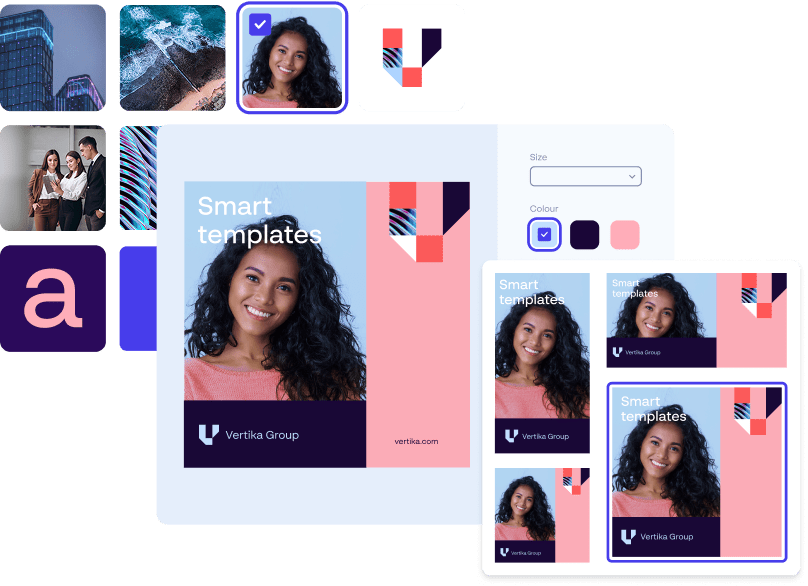
Templated Content Creation enables structured flexibility. By embedding brand rules, approved claims, and workflow controls into templates, organizations empower local markets without sacrificing governance.
Takeaway: Scalable engagement requires distributed execution within centralized control.
How privacy‑first marketing builds competitive advantage
As AI and personalization expand, data governance becomes more visible to both regulators and stakeholders.
In global pharma markets, privacy is closely tied to brand perception. Transparency around data usage strengthens credibility. Weak governance weakens trust.
Forward-looking pharma teams are embedding privacy frameworks into their marketing infrastructure rather than layering them on after campaigns are built.
Digital Asset Management supports this shift by controlling asset access, usage rights, and regional permissions. Teams work only with approved, compliant materials.
Takeaway: Privacy is no longer a compliance box — it is a brand differentiator.

Data breaches across 10‑year period led to an average loss of $1.9 billion in market capitalization.
Source: SSRN working paper, 2024
Data breaches across 10‑year period led to an average loss of $1.9 billion in market capitalization.
Source: SSRN working paper, 2024
What governed AI actually means in regulated industries
AI adoption is accelerating across marketing functions. However, in pharma, uncontrolled generative use introduces unacceptable risk.
Claims accuracy, fair balance requirements, and regulatory review processes demand structure.
Leading organizations are applying AI within governed systems to:
- Automate asset tagging and metadata management
- Improve search and discoverability within Digital Asset Management
- Accelerate localization and version control workflows
- Streamline approval routing
This is not open-ended generation. It is structured augmentation.
Takeaway: AI only creates value in pharma when embedded inside governed content frameworks.
How to scale compliant, on‑brand content globally
Content demand continues to expand across therapeutic areas, markets, and digital channels.
The challenge is not producing more content. It is producing compliant, on-brand content efficiently across global teams.
Pharma organizations often face tension between:
- Global control and governance
- Local speed and relevance
Without structured systems, this tension leads to bottlenecks or brand drift.
The combination of Digital Asset Management and Templated Content Creation resolves this. Global teams define brand standards and compliance rules. Local markets execute within predefined parameters. Workflows ensure approvals remain intact.
This approach strengthens brand consistency while increasing execution speed.
Takeaway: Operational structure is becoming the foundation of marketing performance.
Preparing for pharma marketing in 2026
Pharma marketing trends 2026 point to a clear conclusion — operational maturity is now a competitive advantage.
Organizations that succeed globally will:
- Prioritize trust through structured brand governance
- Strengthen Digital Asset Management foundations
- Align global and local teams through controlled flexibility
- Apply AI within defined regulatory guardrails
- Connect brand investment to measurable performance
The future of pharma marketing is not defined by more campaigns.
It is defined by systems that enable compliant, consistent engagement at scale.
Scale compliant content across global pharma
Explore structured content creation at scale.
Scale compliant content across global pharma
Explore structured content creation at scale.
Explore structured content creation at scale.
FAQs
Why are pharma marketing trends 2026 focused on trust?
Trust influences prescribing confidence, patient engagement, and long-term brand equity. In regulated markets, consistency and governance directly impact credibility.
How does Digital Asset Management support pharma marketing?
It centralizes approved assets, governs access across regions, and ensures brand consistency while reducing compliance risk.
What does full-funnel marketing mean in pharma?
It connects education, consideration, and activation into one measurable journey that reflects real HCP and patient decision behavior.
How can AI be used safely in pharma marketing?
AI should operate within structured systems that use approved assets, embedded brand rules, and auditable workflows.
Why is scaling on-brand content difficult in global pharma?
Multiple markets, regulatory requirements, and stakeholder layers increase complexity. Without templates and asset governance, execution slows and risk increases.
Table of contents:
- Why trust‑led brand governance defines pharma marketing trends 2026
- Why isolated campaigns no longer work in pharma
- How privacy‑first marketing builds competitive advantage
- What governed AI actually means in regulated industries
- How to scale compliant, on‑brand content globally
- Preparing for pharma marketing in 2026
- FAQs