

This content has been automatically translated and may include minor variations.
Marketing teams manage an average of 11.4 channels; a 40% increase since 2020. This requires Digital Asset Management (DAM) to move beyond traditional “System of Record” i.e., a static repository for files, as many DAM systems still are today.
To survive tactical overload, brands must ensure their DAM is an effective System of Action; the user experience of managing, creating, and distributing localized and personalized content needs to be fast and seamless for any team to achieve the agility and immediate impact today’s market demands.
As a long-standing SaaS vendor trusted for delivering complete brand control for leading global brands, we at Papirfly are excited to reveal our top committed 2026 Roadmap items. These innovations continue to transform your DAM into an intelligent content command center, as we remain dedicated to helping you serve your team and organization’s daily needs with unprecedented speed and precision.
Natural language search and conversational assistants enable intent‑based asset retrieval
Search is only powerful if people can actually use it. Our new conversational AI search allows you to find media by intent, not relying on guessing filenames or known taxonomy. Papirfly’s Brand Portal (the front-end DAM) understands context, relationships, and meaning to strengthen retrieval, accuracy, and adoption for all users.
For example, describing a scene like “a man in the factory making a graceful gesture” allows non-experts or infrequent DAM users to surface the perfect asset instantly.
For global and multi-brand organizations, this removes friction across regions and roles. Local teams gain speed. Central teams retain control. Brand-approved assets become easier to find — and therefore more likely to be used correctly.
AI asset quality control flags blurred, misaligned, and non‑compliant images
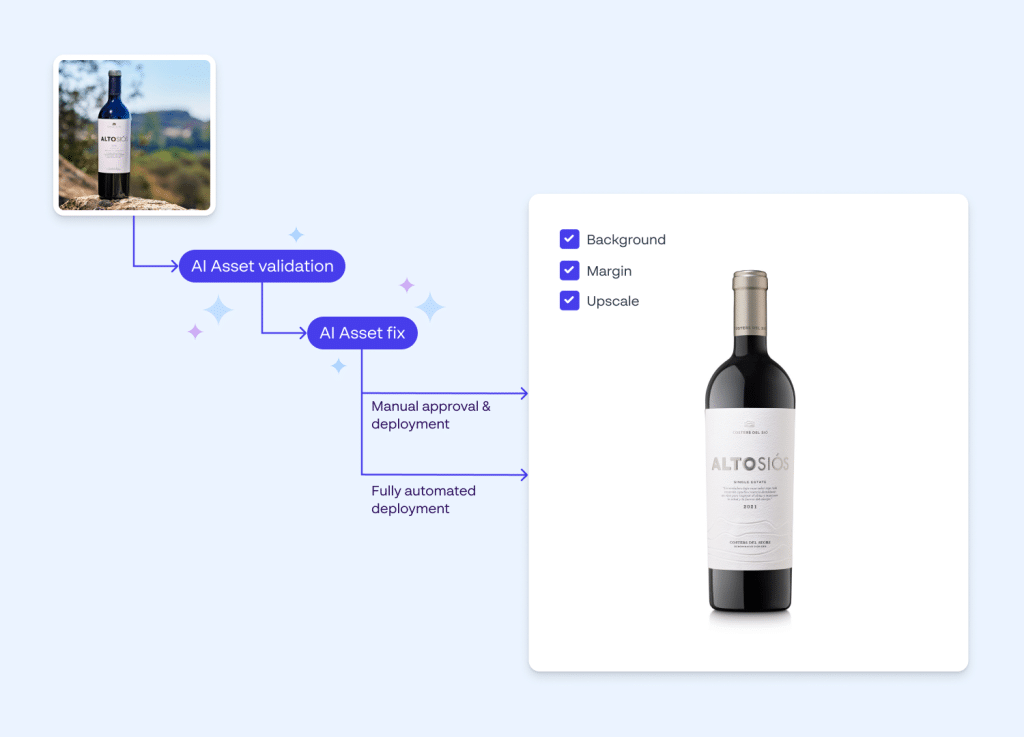
Organizations managing large volumes of visual assets must validate thousands of new images every day. This process is subject to quality errors and high human resource costs.
Our AI-driven quality control automatically detects and flags issues like hard blur, poor centering, or incorrect backgrounds. By automating these “find-and-fix” tasks, Papirfly eliminates bottlenecks in your asset verification process, significantly reducing time to market.
Automatic asset renditions apply channel‑specific formats
Content velocity should not come at the expense of brand integrity. Our new Image Variants feature instantly delivers multiple outputs ready for distribution, cropped to set image parameters e.g. banner ads for all your priority distribution channels, social media tiles for all active platforms.
Far from being duplicate files, these dynamic, brand-controlled outputs ensure every user fetches a channel-ready rendition every time. Papirfly focuses on capabilities that control scale in this way, so teams move faster with built-in guardrails. Central marketing retains authority. Local execution becomes simpler.

Unified notifications centralize approvals, updates, and campaign alerts
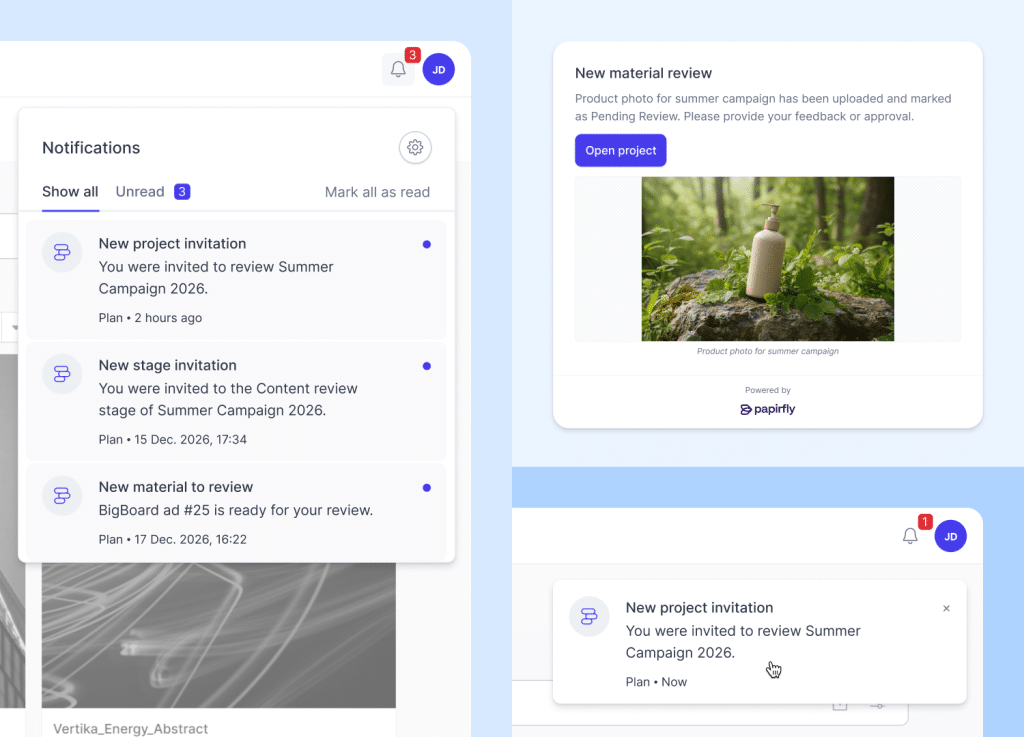
Remove inbox clutter with our centralized Notification Centre; delivering real-time, automated alerts for approvals, asset changes, or campaign updates directly within your app or via email.
Standardized and localized to your preferred language, these notifications ensure critical project steps are never missed, bringing greater flow and predictability to global organizations’ content operations across teams, brands, or time zones.
Flexible metadata thesaurus maps your brand’s synonyms to improve search results
Every brand has its own language: industry terminology, product synonyms, brand-specific terms, and more. Your organization’s everyday language must be reflected when quickly locating brand assets and content. For example, if someone searches for “case studies” when meaning your officially named “Customer Stories”, users should always be led to the same correct assets.
AI-powered search is only as strong as the data behind it. Our Flexible Metadata Thesaurus introduces controlled vocabulary mapping and structured hierarchies that keep large asset libraries organized and intuitive. In this way, Papirfly’s DAM ensures your asset library stays navigable and reliable as your content volume scales.

Why Papirfly wins brand control in the DAM landscape
While many alternatives remain static file cabinets with a few integrations, Papirfly is the only solution within one user interface that is built for brand control at scale. We don’t just help you store assets; Papirfly powers your campaign execution with a brand-safe approach to AI that delivers immediate, measurable ROI.
With more to come in 2026, including updates on AI in our already best-in-class Enterprise design templates, explore our existing DAM and Templated Content Creation solutions. Talk to one of our experts, or contact your existing Papirfly representative to meet your latest challenge to achieve complete brand control.
FAQs
Does the Papirfly Roadmap 2026 include AI functionality?
Yes. The Papirfly Roadmap 2026 introduces AI across key Digital Asset Management workflows — including natural language search, automated asset quality control, and metadata optimization.
These capabilities are designed to strengthen brand control and operational efficiency, not replace human oversight. AI supports faster execution while maintaining governance.
Does Papirfly offer AI-powered search?
Yes. Our conversational AI search enables intent-based asset retrieval.
Instead of relying on exact filenames or taxonomy knowledge, users can describe what they are looking for in natural language. This improves adoption across global teams and ensures brand-approved assets are easier to find — and therefore more likely to be used correctly.
Does Papirfly use generative AI?
Papirfly’s AI roadmap focuses on brand-safe, governance-led AI.
While some AI design tools prioritize unrestricted generative creativity, Papirfly applies AI where it strengthens control — such as improving search accuracy, validating asset quality, and structuring metadata.
Papirfly’s DAM approval workflows ensure only verified AI-generated content becomes part of the available assets teams can use. Our Templated Content Creation solution provides guardrails against the misuse of GenAI by locking brand elements, with approval workflows to ensure no off-brand AI-generated content gets past key brand gatekeepers.
There is more to come later in the year on developments in AI templating.
How does Papirfly compare to AI design tools?
Many AI design tools prioritize flexibility and speed. However, flexibility without guardrails can introduce brand risk.
Papirfly combines Digital Asset Management and Templated Content Creation in one interconnected system. This ensures content velocity increases without compromising governance, approvals, or brand standards.
How does the Papirfly Roadmap 2026 improve brand consistency and content velocity?
The roadmap introduces:
– AI-driven quality control to prevent off-brand assets
– Dynamic, channel-specific renditions to ensure correct formats
– Centralized notifications to streamline approvals
– Structured metadata to improve search reliability
Together, these features reduce bottlenecks while strengthening brand governance — allowing teams to move faster with confidence.
Is this update scalable for global and multi-brand organizations?
Yes. The roadmap enhancements are designed specifically for organizations managing multiple brands, regions, or user roles.
Features like metadata thesaurus mapping, localized notifications, and dynamic renditions ensure central teams retain control while empowering local teams to execute with agility.
This supports scalable growth without increasing operational complexity.
Table of contents:
- Natural language search and conversational assistants enable intent‑based asset retrieval
- AI asset quality control flags blurred, misaligned, and non‑compliant images
- Automatic asset renditions apply channel‑specific formats
- Unified notifications centralize approvals, updates, and campaign alerts
- Flexible metadata thesaurus maps your brand’s synonyms to improve search results
- Why Papirfly wins brand control in the DAM landscape
- FAQs