

This content has been automatically translated and may include minor variations.
Franchise development leaders carry a responsibility that extends well beyond territory expansion and partner onboarding. They are custodians of the brand.
As franchise networks grow, protecting brand consistency becomes structurally more difficult. Each new location introduces local interpretation. Each new marketing activation carries reputational risk.
And in an era where franchisees have instant access to AI-powered design and copy tools, content can be produced in minutes – without governance automatically keeping pace.
The commercial stakes of brand trust are real.

81% of consumers say they must trust a brand before buying from it
(Source: Edelman Trust Barometer, 2024)
That trust is built through consistency – across every touchpoint, market, and customer interaction.
The question for franchise development leaders is not whether local teams will create content. They will. The question is whether the right systems exist to protect brand standards while enabling local relevance.
Here are five ways to do exactly that.
Why franchise brand consistency breaks down at scale
Franchise systems are inherently distributed. Central teams define the brand. Local teams activate it.
But distributed execution increases variability, and variability compounds over time.
When franchisees create content independently, small inconsistencies accumulate – off-brand visuals, inconsistent offers, tonal drift, or messaging that no longer reflects the current brand position.
Individually, these inconsistencies feel minor. Collectively, they erode the brand equity that franchise development has built.
Brand investment is a long game.
“Consistent brand investments over time build lasting relationships — and trust — that influence buyer behavior and drive business growth.”
Karen Tran, Principal Analyst, Forrester
Franchise brand consistency is not a cosmetic concern but a vital structural challenge that must be faced.
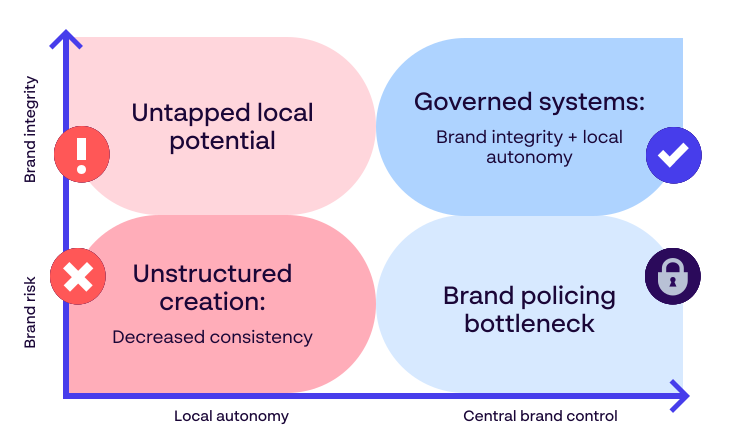
1. Replace static guidelines with governed systems
Most franchise organizations already have brand guidelines. Many have onboarding toolkits and shared asset libraries. But documentation alone does not shape daily behavior.
Franchise brand consistency improves when governance becomes operational.
A structured Digital Asset Management environment creates a single source of truth. Approved assets are centralized. Outdated files are removed. Version control eliminates confusion. Access can be segmented by region or role.
Instead of telling franchisees how to stay on-brand, you create an environment where the correct assets are the default choice.
This reduces compliance risk while accelerating adoption of central campaigns.
2. Embed brand rules directly into content creation
AI has dramatically lowered the barrier to content production. But speed without structure leads to gradual brand erosion.
Franchise brand consistency depends on more than logo placement. It relies on hierarchy, tone, layout logic, and strategic messaging alignment. These elements are difficult to enforce through documentation alone.
Templated Content Creation embeds brand standards directly into the workflow. Core design elements remain fixed. Approved layouts guide structure. At the same time, controlled areas allow franchisees to tailor pricing, promotions, and local messaging.
Creativity operates within guardrails.
This balance protects brand integrity while preserving local relevance.
3. Remove bottlenecks without removing oversight
As franchise networks expand, central marketing teams often become reactive approval hubs. Every localized variation requires review. Execution slows. Frustration grows.
Franchise development leaders must design systems that scale without multiplying oversight.
When franchisees operate within governed templates and curated asset libraries, manual approvals decrease. Campaign rollout accelerates. Risk drops.
Franchise brand consistency improves because critical elements are controlled upstream — not corrected downstream.
Autonomy increases without compromising control.
4. Turn onboarding into a brand control advantage
Onboarding is one of the highest-risk moments for franchise brand inconsistency. New franchisees are absorbing operational, financial, and marketing processes simultaneously.
If brand standards are delivered purely as documentation, interpretation varies.
A governed brand portal transforms onboarding into a practical brand immersion. New partners access curated assets, structured campaign kits, and embedded templates from day one.
They do not just read the brand guidelines. They execute within them.
This shortens time to first campaign while embedding franchise brand consistency from the outset.
5. Govern AI before it governs your brand
AI is not the threat. Unstructured AI usage is.
Franchisees will experiment with generative tools. Attempting to ban them entirely is unrealistic. The more effective approach is to define the ecosystem in which AI operates.
When AI-generated content is built within approved templates and supported by centralized asset governance, speed increases without undermining standards.
Digital Asset Management ensures only validated assets are available. Structured templates maintain visual and tonal alignment.
Franchise development leaders who govern AI strategically can scale local marketing without weakening brand integrity.
From reactive brand control to governed scalability
How structured systems protect franchise brand consistency at scale
Without governed systems
Reactive, fragmented, inconsistent

Scattered asset folders

Manual approvals

Open design tools

Inconsistent execution
With governed brand infrastructure
Scalable, structured, consistent

Centralized Digital Asset Management

Embedded template guardrails

Structured AI usage

Confident local activation
Conclusion
Franchise development cannot protect brand consistency through guidelines alone. It requires infrastructure.
Consistent experience builds trust. Sustained brand investment compounds growth.
Governance and growth are not opposing forces. With the right systems in place, they reinforce one another.
When franchise brand consistency becomes scalable, local creativity can occur within a governed structure. And long-term brand equity strengthens with every new location added to the network.
Scale franchise brand consistency with confidence
Support local creativity without compromising control
Scale franchise brand consistency with confidence
Support local creativity without compromising control
Support local creativity without compromising control

FAQs
What is franchise development and why does franchise brand consistency matter?
Franchise development is the process of growing a franchise network through new locations and partners. As networks expand, maintaining consistent brand standards becomes more complex – and more critical. Inconsistency across touchpoints erodes the trust that drives long-term customer loyalty.
Why is brand consistency harder to maintain as franchise development scales?
Distributed teams and AI-driven tools allow franchisees to create marketing content instantly. Without structured governance, small variations in tone, design, or messaging accumulate over time and gradually dilute the brand.
How can franchise development leaders protect brand standards without limiting creativity?
By embedding brand standards into systems rather than relying on documentation alone. Centralized asset libraries and governed templates allow franchisees to localize content while core brand elements remain protected.
How does Digital Asset Management support franchise development?
Digital Asset Management creates a single source of truth for approved assets. It removes outdated materials, improves visibility, and ensures franchisees always use compliant, up-to-date brand content across every market.
Should franchise organizations restrict AI marketing tools?
Restricting AI entirely is rarely effective. A more sustainable approach is governance. When AI-generated content operates within approved templates and asset systems, speed increases without compromising brand integrity.
Table of contents:
- Why franchise brand consistency breaks down at scale
- 1. Replace static guidelines with governed systems
- 2. Embed brand rules directly into content creation
- 3. Remove bottlenecks without removing oversight
- 4. Turn onboarding into a brand control advantage
- 5. Govern AI before it governs your brand
- Conclusion
- FAQs